
Catalogue Search | MBRL


Are you sure you want to remove the book from the shelf?

{{itemTitle}}
23,636
result(s) for
"Visual Culture"
Sort by:

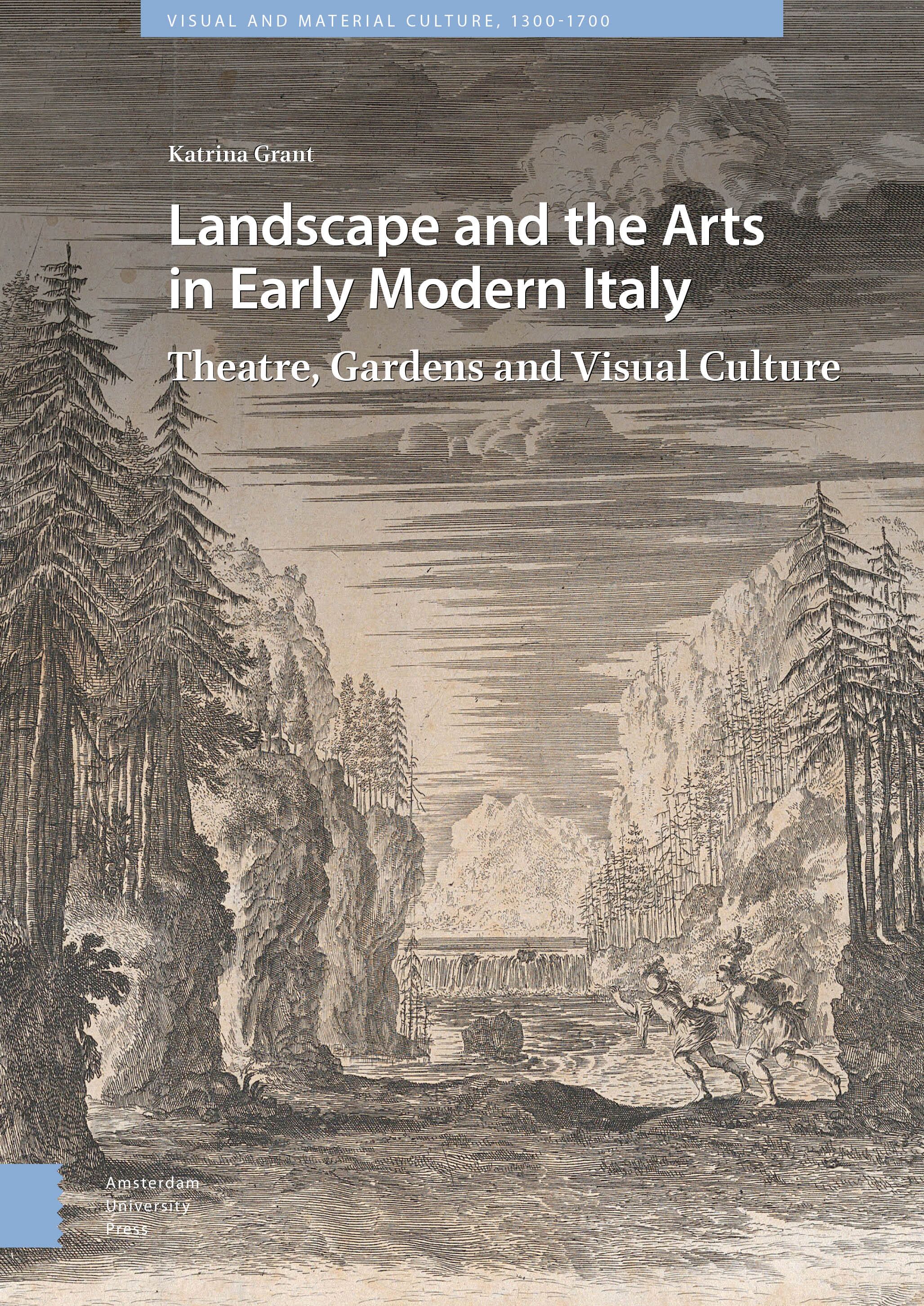
Landscape and the Arts in Early Modern Italy
Landscape and the Arts in Early Modern Italy: Theatre, Gardens and Visual Culture argues that theatre, and the new genre of opera in particular, played a key role in creating a new vision of landscape during the long seventeenth century in Italy. It explores how the idea of gardens as theatres emerged at the same time as opera was developed in Italian courts around the turn of the seventeenth century. During this period landscape painting emerged as a genre and the aesthetic of designed landscapes and gardens was wholly transformed, which resulted in a reconceptualization of the relationship between humans and landscape. The importance of theatre as a key cultural expression in Italy is widely recognised, but the visual culture of theatre and its relationship to the broader artistic culture is still being untangled. This book argues that the combination of narratives playing out in natural settings (Arcadia, Parnassus, Alcina), the emotional responses elicited by sets and special effects (the apparent magical manipulation of the laws of nature), and, the way that garden theatres were used for displays of power and to enact princely virtue and social order, all contributed to this shifting idea of landscape in the seventeenth century.
eBook


“And I Shall Give to Thee the Crown of Life”: The Utstein Antependium and the Visual Religious Culture in Early Modern Norway (ca. 1680–1700)
Stavanger Museum (Norway) preserves an embroidered artefact dating from ca. 1680–1700, known as the Utstein antependium. Depicting six scenes of a woman zealously preparing for the afterlife under divine observation before receiving the Crown of Life, the antependium has puzzled the few scholars who have studied it, as its iconography appears “too Catholic” in post-Reformation Norway. In this article, we argue that the embroidered images and accompanying texts emphasize how a life lived faithfully and charitably on earth would secure one’s place in heaven is also applicable to a Lutheran context. Comparing the antependium’s iconography with previously overlooked votive paintings from the same period, we aim to demonstrate how the maker(s) ingeniously combined image, text, and theological concepts into an unprecedented iconography in textile form in early modern Norway, showing how “she” would receive “the Crown of Life” at the end of time thanks to her spiritually advanced disposition.
Journal Article

Farewell to visual studies
\"A transdisciplinary collection of essays discussing the identity, nature, and future of visual studies as a laboratory for thinking about relations between fields including art history, cultural studies, sociology, visual anthropology, film studies, media studies, postcolonial studies, philosophy of history, the science of vision, and science studies\"--Provided by publisher.
Book

Critical Questions and Embodied Reflections: Trans Visual Culture Today-A Roundtable
My most profound gratitude goes to Jordana Moore Saggese for supporting this project and all the contributors and collaborators who have made this special issue possible. It has been an honor and a delight working with you all. I look forward to ongoing conversations.
Journal Article


On the Perfect Sphere: The Preference for Circular Compositions for Depicting the Universe in Medieval and Early Modern Art
This essay explores circular compositions in medieval and early modern art. Delving into the intersection of religious, philosophical, and scientific ideas, the text examines the prevalence of circular depictions in medieval and early modern aesthetics. Utilizing an interdisciplinary approach, the author draws from primary Hermetic and Neoplatonic sources, providing four reasons for this preference. Firstly, this essay explores the scientific understanding of the shape of the universe, planets, and stars. The second reason delves into the psychological, symbolic, and geometric aspects associated with circular compositions, connecting them to Christian cosmological diagrams and symbolism in the visual arts. Furthermore, the essay investigates the conceptualisation of the universe as a mirror reflecting the divine, emphasising the role of beauty in religious art. The essay concludes by examining the visual culture of medieval and early modern periods, tracing the evolution of circular representations from Roman coins and shields to illuminated manuscripts and paintings. The article sheds light on a hitherto underexplored aspect of medieval and early modern cultures, despite its significance in shaping symbolism and organizing iconographic programs within these periods.
Journal Article

Seen and unseen : visual culture of imperialism
\"Seen and Unseen teases out and explores how visual mediums construct visual cultures that often create limited perspectives of certain issues and groups, specific to this volume, the representation of Islam and Muslims. It deals with fixed and stereotypical visual representations and explores alternative and challenging visual representations which reconstruct and dismantle existing belief systems. It approaches the topic from a vantage point of diverse multiple perspectives. Covering issues from Brunei, Iran, Egypt, and England and cyberspace, essays examine the visual cultures of how Islam and Muslim people are understood, misunderstood, misrepresented, or even embraced visually. Scholars in this volume draw on historical paintings, books and their covers, photography, and news to demonstrate the diversity and sometimes contradictory visual cultures that construct and adhere meaning to how Islam and Muslim people are seen. Contributors: Hoda Afshar, Jared Ahmed, Syed Farid Alatas, Sanaz Fotouhi, Christiane Gruber, Layla Hendow, Raihana M.M., Bruno Starrs and Esmaeil Zeiny\"-- Provided by publisher.
Book

Trade, Globalization, and Dutch Art and Architecture
We all look to our past to define our present, but we don’t always realize that our view of the past is shaped by subsequent events. It’s easy to forget that the Dutch dominated the world’s oceans and trade in the seventeenth century when our cultural imagination conjures up tulips and wooden shoes instead of spices and slavery. This book examines the Dutch so-called “Golden Age” though its artistic and architectural legacy, recapturing the global dimensions of this period by looking beyond familiar artworks to consider exotic collectibles and trade goods, and the ways in which far-flung colonial cities were made to look and feel like home. Using the tools of art history to approach questions about memory, history, and how cultures define themselves, this book demonstrates the centrality of material and visual culture to understanding history and cultural identity.
eBook