
Catalogue Search | MBRL


Are you sure you want to remove the book from the shelf?

{{itemTitle}}
3,981
result(s) for
"Visual communication History."
Sort by:

How to see the world : an introduction to images, from self-portraits to selfies, maps to movies, and more
\"In How to See the World, visual culture expert Nicholas Mirzoeff offers a sweeping look at history's most famous images--from Velâazquez's Las Meninas to the iconic \"Blue Marble\"--to contextualize and make sense of today's visual world. Drawing on art history, sociology, semiotics, and everyday experience, he teaches us how to close read everything from astronaut selfies to Impressionist self-portraits, from Hitchcock films to videos taken by drones. Mirzoeff takes us on a journey through visual revolutions in the arts and sciences, from new mapping techniques in the seventeenth century to new painting styles in the eighteenth and the creation of film, photography, and x-rays in the nineteenth century. In today's networked world, mobile technology and social media enable us to exercise \"visual activism\"--the practice of producing and circulating images to drive political and social change. Whether we are looking at pictures showing the effects of climate change on natural and urban landscapes or an fMRI scan demonstrating neurological addiction, Mirzoeff helps us to find meaning in what we see,\"--Amazon.com.
Book

Art for animals : visual culture and animal advocacy, 1870-1914
Animal rights activists today regularly use visual imagery in their efforts to shape the public's understanding of what it means to be \"kind,\" \"cruel,\" and \"inhumane\" toward animals. Art for Animals explores the early history of this form of advocacy through the images and the people who harnessed their power.
Following in the footsteps of earlier-formed organizations like the RSPCA and ASPCA, animal advocacy groups such as the Victoria Street Society for the Protection of Animals from Vivisection made significant use of visual art in literature and campaign materials. But, enabled by new and improved technologies and techniques, they took the imagery much further than their predecessors did, turning toward vivid, pointed, and at times graphic depictions of human-animal interactions. Keri Cronin explains why the activist community embraced this approach, details how the use of such tools played a critical role in educational and reform movements in the United States, Canada, and England, and traces their impact in public and private spaces. Far from being peripheral illustrations of points articulated in written texts or argued in impassioned speeches, these photographs, prints, paintings, exhibitions, \"magic lantern\" slides, and films were key components of animal advocacy at the time, both educating the general public and creating a sense of shared identity among the reformers.
Uniquely focused on imagery from the early days of the animal rights movement and filled with striking visuals, Art for Animals sheds new light on the history and development of modern animal advocacy.
eBook


The Medieval Salento
Located in the heel of the Italian boot, the Salento region was home to a diverse population between the ninth and fifteenth centuries. Inhabitants spoke Latin, Greek, and various vernaculars, and their houses of worship served sizable congregations of Jews as well as Roman-rite and Orthodox Christians. Yet the Salentines of this period laid claim to a definable local identity that transcended linguistic and religious boundaries. The evidence of their collective culture is embedded in the traces they left behind: wall paintings and inscriptions, graffiti, carved tombstone decorations, belt fittings from graves, and other artifacts reveal a wide range of religious, civic, and domestic practices that helped inhabitants construct and maintain personal, group, and regional identities.The Medieval Salentoallows the reader to explore the visual and material culture of a people using a database of over three hundred texts and images, indexed by site. Linda Safran draws from art history, archaeology, anthropology, and ethnohistory to reconstruct medieval Salentine customs of naming, language, appearance, and status. She pays particular attention to Jewish and nonelite residents, whose lives in southern Italy have historically received little scholarly attention. This extraordinarily detailed visual analysis reveals how ethnic and religious identities can remain distinct even as they mingle to become a regional culture.
eBook

Art for animals : visual culture and animal advocacy, 1870-1914
\"Explores the ways in which visual imagery was used for animal advocacy campaigns in the late nineteenth and early twentieth centuries, and the ways in which these images were created, circulated, and consumed in a wide range of cultural contexts\"--Provided by publisher.
Book

The printed and the built : architecture, print culture and public debate in the nineteenth century
The Printed and the Built explores the intricate relationship between architecture and printed media in the fast-changing nineteenth century.Publication history is a rapidly expanding scholarly field which has profoundly influenced architectural history in recent years.
eBook

Stop reading! Look! : modern vision and the Weimar photographic book
In the second half of the Weimar period (1918-33), photographers produced books consisting almost entirely of sequenced images. The subjects ranged widely: from plants and nature to the modern metropolis, from exotic cultures to the German Volk, from anonymous workers to historical figures. While many of the books were created by key practitioners and theorists of modern photography, scholars have rarely addressed the significance of the book format to modern conceptions of photographic meaning. The term \"photo-essay\" implies that these photographic books were equivalent to literary endeavors, created by replacing text with images, but such assumptions fail to explore the motivations of the books' makers. Stop Reading! Look! argues that Weimar photographic books stood at the center of debates about photography's ability to provide uniquely visual forms of perception and cognition that exceed the capacity of the textual realm. Each chapter provides a sustained analysis of a photographic book, while also bringing the cultural, social, and political context of the Weimar Republic to bear on its relevance and meaning. Publisher.
Book
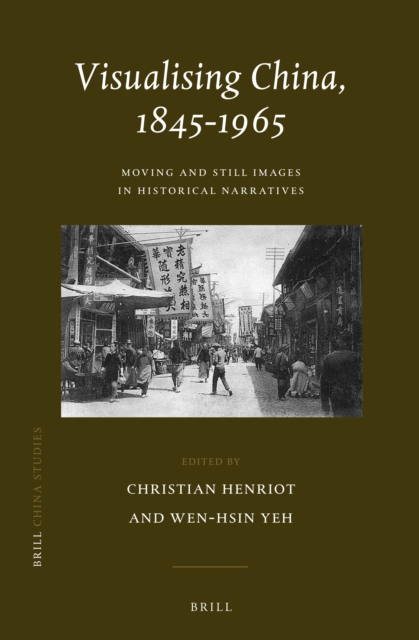
Visualising China, \u20281845-1965
In this work, the authors launch a broad inquiry aimed at a synergistic understanding of the story of visuality in modern China. The essays cluster around several nodal points including photographs, advertising, posters and movies, from the 1840s to the 1960s.
eBook

The imaginary : word and image = L'Imaginaire : texte et image
The imaginary as a critical concept originated in the twentieth century and has been theorized in diverse ways. It can be understood as a register of thought; the way we interpret the world; the universe of images, signs, texts, and objects of thought. In this volume, it is explored as it manifests itself in encounters between the verbal and the visual. A number of the essays brought together here explore the transposition of the imaginary in illustrations of texts and verbal renditions of images, as well as in comic books based on paintings or on verbal narratives. Others analyze ways in which books deal with film or television and investigate the imaginary in digital media. Special attention is paid to the imaginary of places and the relationship of the imaginary with memory. Written in English and French, these contributions by European and American scholars demonstrate the various concerns and approaches characteristic of contemporary scholarship in word and image studies.
Book

When Ego Was Imago
The diffusion of personal signs of identity during the twelfth century introduced individuals to mediated forms of communication. The book analyses the conditions for and the implications of their partnering with material signs and images in expressing self and accountability.
eBook