
Catalogue Search | MBRL


Are you sure you want to remove the book from the shelf?

{{itemTitle}}
260
result(s) for
"Visual perception Fiction."
Sort by:

Re-zoom
A wordless picture book presents a series of scenes, each one from farther away, showing, for example, a boat which becomes the image on a magazine, which is held in a hand, which belongs to a boy, and so on.
Book

Information Bodies: Computational Anxiety in Neal Stephenson's Snow Crash
Cognitive science-based enactive theories of perception afford surprising insight onto a less examined component of perceptual experience: perceptual entrainment through the embodied encounter with tools. My analysis of the body/tool/perception nexus in Neal Stephenson's Snow Crash (1992) introduces the concept of perceptual entrainment in two steps: first I explain Alva Noë's claim that perception is virtual—that it takes place as an active process of environmental investigation rather than through computer-processing-like brain activity. I then take Noë's approach to perception a step further by examining how tool use directs and amplifies our perceptual focus. I argue that in Snow Crash, tools contain within them ideologies of repression that emerge precisely at the “technological interface,” moments when characters in the novel engage with tools that interpellate them, enable them to wield power, or blur the boundaries between control and abjection. This article analyzes the novel's computational anxiety—the fear of loss of self identity via an informational/mathematical determinism mapped by the tool that entrains our perception.
Journal Article

Which is different?
A trio of dinosaurs decides who is holding an item different from the others.
Book

Time perception in film is modulated by sensory modality and arousal
Considerable research has shown that the perception of time can be distorted subjectively, but little empirical work has examined what factors affect time perception in film, a naturalistic multimodal stimulus. Here, we explore the effect of sensory modality, arousal, and valence on how participants estimate durations in film. Using behavioral ratings combined with pupillometry in a within-participants design, we analyzed responses to and duration estimates of film clips in three experimental conditions: audiovisual (containing music and sound effects), visual (without music and sound effects), and auditory (music and sound effects without a visual scene). Participants viewed clips from little-known nature documentaries, fiction, animation, and experimental films. They were asked to judge clip duration and to report subjective arousal and valence, as their pupil sizes were recorded. Data were analyzed using linear mixed-effects models. Results reveal duration estimates varied between experimental conditions. Clip durations were judged to be shorter than actual durations in all three conditions, with visual-only clips perceived as longer (i.e., less distorted in time) than auditory-only and audiovisual clips. High levels of Composite Arousal (an average of self-reported arousal and pupil size changes) were correlated with longer (more accurate) estimates of duration, particularly in the audiovisual modality. This effect may reflect stimulus complexity or greater cognitive engagement. Increased ratings of valence were correlated with longer estimates of duration. The use of naturalistic, complex stimuli such as film can enhance our understanding of the psychology of time perception.
Journal Article

This is a ball
\"In this humorous parody of a concept book for young children, words and pictures don't match, inviting contrary responses from readers\"-- Provided by publisher.
Book

“Perfectly You”: Visual Thinking and Decolonization in the Canadian Speculative Fiction Classroom
This article brings visual thinking into the speculative fiction classroom, drawing on critical autism studies and on work on Indigenous futurism. It is the collaborative work of a neurotypical academic and an artist on the autism spectrum. Using one Canadian short story by a member of the Norway House Cree Nation, David A. Robertson, as a sample primary source, the project offers strategies for developing a multimodal classroom through assigning visual close readings as forms of literary criticism and critical thinking. This project aims to show the value of thinking in pictures as a respectful tool for both decolonization work in the classroom and for the encouragement of student creative work. Focused on a lesbian love story, the project presents critical love in the academy as queer and creative.
Journal Article
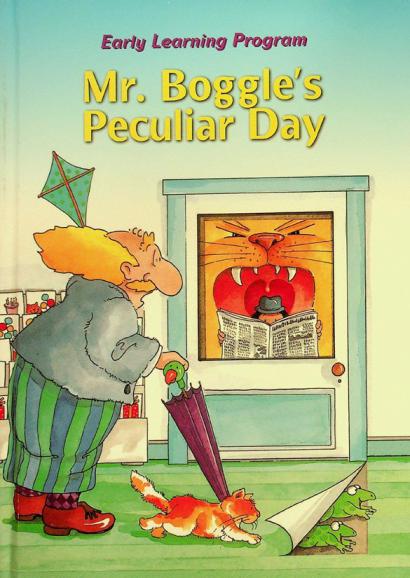
Mr. Boggle's peculiar day
Three episodes feature Mr. Boggle, whose befuddled ways cause him and the reader many surprises, some of which can be viewed through holes in the pages.

Merging Minds and Machines: The Role of Advancing AI in Robotics
The relentless pursuit of creating intelligent robotic systems has led to a symbiotic relationship between human inventiveness and artificial intelligence (AI). Artificial intelligence is a theory. It is the development of computer systems that are able to perform tasks that would require human intelligence. This abstract explores the pivotal role that AI plays in advancing the capabilities and applications of robotic systems. The integration of AI algorithms and machine learning techniques has launched robotics beyond mere automation, enabling machines to modify, alter, adjust, learn, and interact with the world in ways previously deemed science fiction. Design fictions that vividly imagines future scenarios of AI or robotics in use offer a means both to explain and query the technological possibilities. Examples of these tasks are visual perception, speech recognition, decision-making, and translation between languages. The three key dimensions of AI’s role in robotics are Cognitive Augmentation, Human-Robot Collaboration, and Autonomous Intelligence. The abstract also discusses the societal implications of this AI-driven advancement in robotic systems, including ethical considerations, job market impacts, and the democratization of access to advanced technology. The convergence of human intellect and artificial intelligence in robotics marks a transformative era where machines become not just tools, but companions, collaborators, and cognitive extensions of human capabilities. Researchers are taking inspiration from the brain and considering alternative architectures in which networks of artificial neurons and synapses process information with high speed and adaptive learning capabilities in an energy-efficient, scalable manner. The indispensable role of AI in shaping the future of robotic systems and bridging the gap between human potential and machine capabilities is highlighted. The major impact of this synergy reverberates across industries, promising the world where robots become not just mechanical contraptions / defective apparatus but intelligent partners in our journey of progress.
Journal Article

Color illusions : visual tricks, fantastic facts, and impossible puzzles
Featuring pullout tabs, flaps, a multi-use decoder with 3D glasses, plus an amazing pop-up rainbow, this interactive volume lets readers uncover hidden images, blend their own colors, and learn color-based jokes and tricks to fool friends and family.
Book

Memory of the multitude and representation in AI-generated images of war
This study addresses how AI-generated images of war are changing the making of memory. Instead of asking how AI-generated images affect individual recall, we focus on how they communicate specific representations, recognising that such portrayals can cultivate particular assumptions and beliefs. Drawing on memory of the multitude, visual social semiotics, and cultivation/desensitisation theories, we analyse how visual generative AI mediates the representation of the Russia-Ukraine war. Our corpus includes 200 images of the Russia-Ukraine war generated from 23 prompts across proprietary and open-source visual generative AI systems. The findings indicate that visual generative AI tends to present a sanitised view of the war. Critical aspects, such as death, injury, and suffering of children and refugees are often excluded. Furthermore, a disproportional focus on urban areas misrepresents the full scope of the war. Visual generative AI, we argue, introduces a new dimension to memory making in that it blends documentation with speculative fiction by synthesising the multitude embedded within the visual memory of war archives, historical biases, representational limitations, and commercial risk aversion. By foregrounding the socio-technical and discursive dimensions of synthetic war content, this study contributes to an interdisciplinary dialogue on collective memory at the intersection of visual communication studies, media studies, and memory studies by providing empirical insights into how generative AI mediates the visual representation of war through human-archival-mechanistic entanglements.
Journal Article