
Catalogue Search | MBRL


Are you sure you want to remove the book from the shelf?

{{itemTitle}}
2,125
result(s) for
"Visual perception History."
Sort by:

Renaissance Theories of Vision
How are processes of vision, perception, and sensation conceived in the Renaissance? How are those conceptions made manifest in the arts? The essays in this volume address these and similar questions to establish important theoretical and philosophical bases for artistic production in the Renaissance and beyond. The essays also attend to the views of historically significant writers from the ancient classical period to the eighteenth century, including Plato, Aristotle, Plotinus, St Augustine, Ibn Sina (Avicenna), Ibn al-Haytham (Alhazen), Ibn Sahl, Marsilio Ficino, Nicholas of Cusa, Leon Battista Alberti, Gian Paolo Lomazzo, Gregorio Comanini, John Davies, Rene Descartes, Samuel van Hoogstraten, and George Berkeley. Contributors carefully scrutinize and illustrate the effect of changing and evolving ideas of intellectual and physical vision on artistic practice in Florence, Rome, Venice, England, Austria, and the Netherlands. The artists whose work and practices are discussed include Fra Angelico, Donatello, Leonardo da Vinci, Filippino Lippi, Giovanni Bellini, Raphael, Parmigianino, Titian, Bronzino, Johannes Gumpp and Rembrandt van Rijn. Taken together, the essays provide the reader with a fresh perspective on the intellectual confluence between art, science, philosophy, and literature across Renaissance Europe.
eBook


Early Modern Eyes
In bringing together work on optic theory, ethnography, and the visual cultures of Christianity, this volume offers a sense of the richness and the complexity of early modern thinking about the human eye. The seven case studies explore the relationship between vision and knowledge, taking up such diverse artifacts as an emblem book, a Jesuit mariological text, Calvin's Institutes, Las Casas's Apologia, Hans Staden's True History, the Codex Telleriano-Remensis, and an exegetical painting by Herri met de Bles. Argued from different disciplinary perspectives, these essays pose crucial questions about the eyes, asking how they were construed as instruments of witnessing, perception, representation, cognition, and religious belief.Contributors include: Tom Conley, Walter Melion, José Rabasa, Lee Palmer Wandel, Michel Weemans, Nicolás Wey Gómez, and Neil Whitehead.
eBook

Seeing Motion
The central focus of this publication is the synthesis of science and art in the field of visual perception, in particular how early 19th century perceptual research into illusions, kinetic illusory figures, and illusory movement influenced the apparative / machine, kinetic art of the 20th century and the computer-generated visual art of the 21st.
eBook

As far as the eye can see : a history of seeing
From the mastery of fire a million years ago, humans repeatedly invented new ways to see their surroundings, each other and themselves. Artificial light, early art, mirrors, writing, lenses, printing, photography, film, television, smartphones. These tools didn't just add to our visual repertoire, they shaped Western culture and made us who we are. This volume traces the history of seeing using eleven inventions, from the first evolutionary stirrings of sight to the present. It reveals that with each new invention that changed how or what we see, we changed ourselves, and the world around us.
Book

Citizen Spectator
In this richly illustrated study, the first book-length exploration
of illusionistic art in the early United States, Wendy Bellion
investigates Americans' experiences with material forms of visual
deception and argues that encounters with illusory art shaped their
understanding of knowledge, representation, and subjectivity
between 1790 and 1825. Focusing on the work of the well-known Peale
family and their Philadelphia Museum, as well as other
Philadelphians, Bellion explores the range of illusions encountered
in public spaces, from trompe l'oeil paintings and drawings at art
exhibitions to ephemeral displays of phantasmagoria, \"Invisible
Ladies,\" and other spectacles of deception.
Bellion reconstructs the elite and vernacular sites where such art
and objects appeared and argues that early national exhibitions
doubled as spaces of citizen formation. Within a post-Revolutionary
culture troubled by the social and political consequences of
deception, keen perception signified able citizenship. Setting
illusions into dialogue with Enlightenment cultures of science,
print, politics, and the senses, Citizen Spectator
demonstrates that pictorial and optical illusions functioned to
cultivate but also to confound discernment. Bellion reveals the
equivocal nature of illusion during the early republic, mapping its
changing forms and functions, and uncovers surprising links between
early American art, culture, and citizenship.
eBook

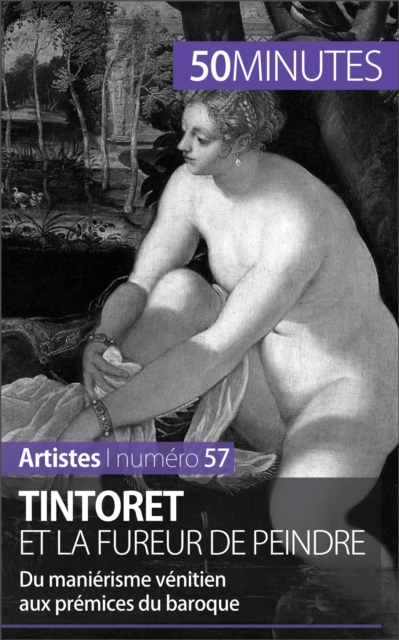
Tintoret et la fureur de peindre: Du manierisme venitien aux premisses du baroque
Decryptez l'art de Tintoret en moins d'une heure !Depuis Le Miracle de saint Marc, toile qui marque sa reconnaissance officielle, jusqu'a sa fameuse Derniere Cene, les A uvres de Tintoret temoignent toutes de la fureur de peindre qui anime l'artiste venitien. Influence par Titien, Michel-Ange et Veronese, il sera a son tour une source d'inspiration majeure pour d'autres grands noms de la peinture tels que le Greco ou Rubens.Ce livre vous permettra d'en savoir plus sur : * Le contexte culturel dans lequel Tintoret s'inscrit * La vie de l'artiste et son parcours * Les caracteristiques et specificites de son art * Une selection d'A uvres-cles de Tintoret * Son impact dans l'histoire de l'artLe mot de l'editeur : Dans ce numero de la serie 50MINUTES | Artistes, Eliane Reynold de Seresin brosse le portrait de l'un des plus grands artistes venitiens de tous les temps : Tintoret. Apres une biographie complete dans laquelle on aborde egalement la personnalite du peintre, impetueux et passionne, l'auteure analyse les principaux ingredients de son succes, images a l'appui. On se penche ainsi sur ses jeux avec la perspective, sur la dimension dramatique de ses tableaux ou encore sur son travail de l'ombre et de la lumiere. Dans ce numero, nous avons tenu a mettre l'accent sur le role majeur de Tintoret dans la transition entre l'art manieriste de la fin de la Renaissance et l'avenement du baroque. Stephanie FeltenA PROPOS DE LA SERIE 50MINUTES | ArtistesLa serie Artistes de la collection 50MINUTES aborde plus de cinquante artistes qui ont profondement marque l'histoire de l'art, du Moyen Age a nos jours. Chaque livre a ete concu a la fois pour les passionnes d'art et pour les amateurs curieux d'en savoir davantage en peu de temps. Nos auteurs analysent avec precision les A uvres des plus grands artistes tout en laissant place a toutes les interpretations.
eBook