
Catalogue Search | MBRL


Are you sure you want to remove the book from the shelf?

{{itemTitle}}
2,244
result(s) for
"Visual perception in literature."
Sort by:


Victorian Literature and the Victorian Visual Imagination
Nineteenth-century British culture frequently represented the eye as the preeminent organ of truth. These essays explore the relationship between the verbal and the visual in the Victorian imagination. They range broadly over topics that include the relationship of optical devices to the visual imagination, the role of photography in changing the conception of evidence and truth, the changing partnership between illustrator and novelist, and the ways in which literary texts represent the visual. Together they begin to construct a history of seeing in the Victorian period. This title is part of UC Press's Voices Revived program, which commemorates University of California Press's mission to seek out and cultivate the brightest minds and give them voice, reach, and impact. Drawing on a backlist dating to 1893, Voices Revived makes high-quality, peer-reviewed scholarship accessible once again using print-on-demand technology. This title was originally published in 1995.
eBook


The Primacy of Vision in Virgil's Aeneid
One of the masterpieces of Latin and, indeed, world literature, Virgil's Aeneid was written during the Augustan \"renaissance\" of architecture, art, and literature that redefined the Roman world in the early years of the empire. This period was marked by a transition from the use of rhetoric as a means of public persuasion to the use of images to display imperial power. Taking a fresh approach to Virgil's epic poem, Riggs Alden Smith argues that the Aeneid fundamentally participates in the Augustan shift from rhetoric to imagery because it gives primacy to vision over speech as the principal means of gathering and conveying information as it recounts the heroic adventures of Aeneas, the legendary founder of Rome. Working from the theories of French phenomenologist Maurice Merleau-Ponty, Smith characterizes Aeneas as a voyant-visible, a person who both sees and is seen and who approaches the world through the faculty of vision. Engaging in close readings of key episodes throughout the poem, Smith shows how Aeneas repeatedly acts on what he sees rather than what he hears. Smith views Aeneas' final act of slaying Turnus, a character associated with the power of oratory, as the victory of vision over rhetoric, a triumph that reflects the ascendancy of visual symbols within Augustan society. Smith's new interpretation of the predominance of vision in the Aeneid makes it plain that Virgil's epic contributes to a new visual culture and a new mythology of Imperial Rome.
eBook


Epic Visions
This wide-ranging, interdisciplinary collection explores different ways of visualising Greek and Roman epic from Homer to Statius, in both ancient and modern culture. The book presents new perspectives on Homer, Virgil, Ovid, Lucan, Valerius Flaccus and Statius, and covers the re-working of epic matter in tragedy, opera, film, late antique speeches of praise, story-boarding, sculpture and wall-painting. The chapters use a variety of methods to address the relationship between narrative and visuality, exploring how and why epic has inspired artists, authors and directors and offering fresh visual interpretations of epic texts. Themes and issues discussed include: intermediality, ekphrasis and panegyric, illusion and deception, imagery and deferral, alienation and involvement, the multiplicity of possible visual responses to texts, three-dimensionality, miniaturisation, epic as cultural capital, and the specificity of genres, both literary and visual.
eBook


Staging Spectatorship in the Plays of Philip Massinger
The playwrights composing for the London stage between 1580 and 1642 repeatedly staged plays-within and other metatheatrical inserts. Such works present fictionalized spectators as well as performers, providing images of the audience-stage interaction within the theatre. They are as much enactments of the interpretive work of a spectator as of acting, and as such they are a potential source of information about early modern conceptions of audiences, spectatorship and perception. This study examines on-stage spectatorship in three plays by Philip Massinger, head playwright for the King's Men from 1625 to 1640. Each play presents a different form of metatheatrical inset, from the plays-within of The Roman Actor (1626), to the masques-within of The City Madam (1632) to the titular miniature portrait of The Picture (1629), moving thematically from spectator interpretations of dramatic performance, the visual spectacle of the masque to staged 'readings' of static visual art. All three forms present a dramatization of the process of examination, and allow an analysis of Massinger's assumptions about interpretation, perception and spectator response.
Contents: Introduction; 'What do wee acte to day?': plays within the play: The Roman Actor; 'For your sport / You shall see a masterpiece': masques-within in The Picture, The Guardian and The City Madam; 'Speculations / On cheating pictures': visual art as dramatic inset: The Picture; Conclusion: 'Make your howse the stage on which weel act / Our comick sceane': trials and paradramatic scenes; Bibliography; Index.
Joanne Rochester, Assistant Professor of English, University of Saskatchewan, Canada
eBook

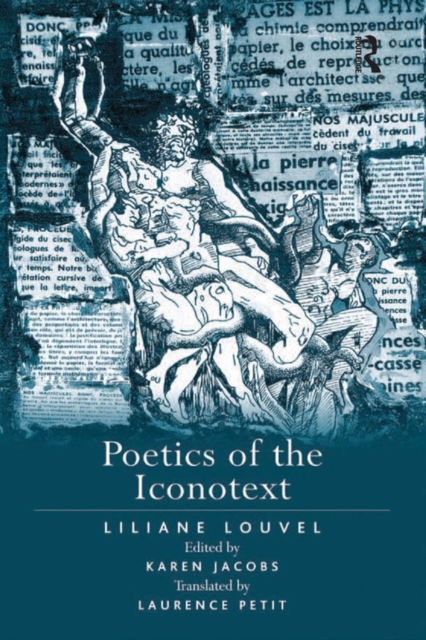
Poetics of the Iconotext
Poetics of the Iconotext makes available for the first time in English the theories of the respected French text/image specialist, Professor Liliane Louvel. A consolidation of the most significant theoretical materials of Louvel's two acclaimed books, L'Oeil du Texte: Texte et image dans la littérature anglophone and Texte/Image: Images à lire, textes à voir, this newly conceived work introduces English readers to the most current thinking in French text/image theory and visual studies. Focusing on the full spectrum of text/image relations, from medieval illuminated manuscripts to digital books, Louvel begins by introducing key terms and situating her work in the context of significant debates in text/image studies. Part II introduces Louvel's s typology of pictorial saturation through which she establishes a continuum along which to measure the effect of the most figurative to the most literal images upon writerly and readerly textual 'spaces.' Part III adopts a phenomenological approach towards the reading-viewing experience as expressed in conceptual categories that include the trace, focal range, synesthesia, and rhythm and speed. The result is a provocative interplay of the categorical and the subjective that invites readers to think at once more precisely and more inventively about texts, images, and the intersections between the two.
eBook