
Catalogue Search | MBRL


Are you sure you want to remove the book from the shelf?

{{itemTitle}}
62
result(s) for
"Vittoria Colonna"
Sort by:

Renaissance woman : the life of Vittoria Colonna
\"A biography of Vittoria Colonna, confidante of Michelangelo, scion of one of the most powerful families of her era, and a pivotal figure in the Italian Renaissance\"--Amazon.com.
Book

Widow City
Widow City: Gender, Emotion, and Community in the Italian Renaissance investigates the ever-evolving role of the widow in medieval and early modern Italian literature, from canonical authors such as Dante, Petrarch, and Boccaccio, to the numerous widowed writers who rose to prominence in the sixteenth century—including Vittoria Colonna, Veronica Gambara, and Francesca Turina—and radically changed the conversation on public mourning. Engaging with broader intellectual discussions around gender, the history of emotions, the politics of mourning, and the construction of community, Widow City argues that widows served as key models demonstrating to readers not just how to mourn, but how to live well after devastating loss. At the same time, widows were figures of great anxiety: their status as unattached women, and the public performance of their grief, were viewed as very real threats to the stability of the social order. They are thus key to broader intellectual understandings of community and civic life in the Italian Middle Ages and Renaissance.
eBook

Between Repentance and Desire: Women Poets and the Word in Early Modern Italy
In early modern Italy, lyric poets of spiritual verse experimented with engaging and depicting the divine Word in novel ways. They aestheticized bodies, including that of Christ, and they imagined eroticized encounters between themselves and the Word made flesh. This article examines the sensual spiritual poetry of three early modern Italian women who, between 1530 and 1630, dedicated themselves to crafting and reinvigorating the poetic word and to expressing and (re)presenting the divine Word. Exploring the introspective and subjective spiritual lyrics of Vittoria Colonna (1492–1547), Laura Battiferri (1523–1589), and Francesca Turini Bufalini (1553–1641) in the context of the Italian literary Renaissance and Counter-Reformation, it aims to highlight and to elucidate the conflation of the sacred and the erotic in their verse. In so doing, this article reveals how these early modern female poets deployed the sensual strategically in their verse to elevate the erotic and how they raised the Italian religious lyric to new literary heights by spiritualizing the dominant poetic idiom.
Journal Article

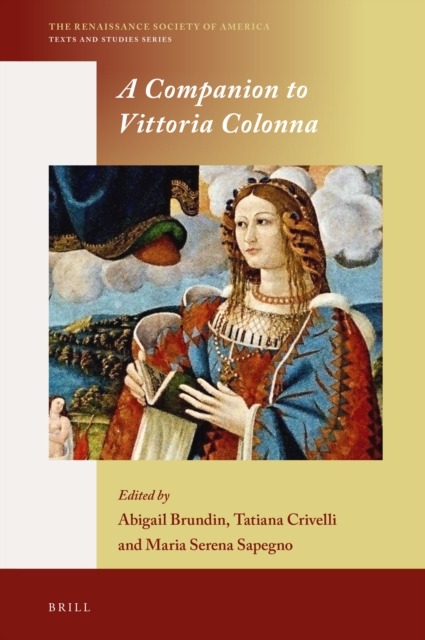
A Companion to Vittoria Colonna
Vittoria Colonna (1490-1547) was the genre-defining secular woman writer of Renaissance Italy, whose literary model helped to establish a decorous and wholly assimilated voice for women within the field of Italian literature. The Companion to Vittoria Colonna brings together an international and interdisciplinary group of leading scholars to assess Colonna's contribution, both as a writer, a role model, and a contributor to important religious debates of the era. This book, while amply fulfilling the remit of providing a useful and comprehensive handbook to meet the needs of students and scholars at earlier and advanced levels, aims in addition to do more than this, by drawing into a single volume for the first time scholarship from across disciplines in which Vittoria Colonna's influence has been felt, including literary criticism, religious history, history of art and music.Contributors are: Abigail Brundin, Stephen Bowd, Emidio Campi, Eleonora Carinci, Adriana Chemello, Virginia Cox, Tatiana Crivelli, Maria Forcellino, Gaudenz Freuler, Anne Piéjus, Diana Robin, Helena Sanson, and Maria Serena Sapegno.
eBook
The Virgin Mary in the Early Modern Italian Writings of Vittoria Colonna, Lucrezia Marinella, and Eleonora Montalvo
The Marian writings of the Roman poet Vittoria Colonna (1490/92–1547), the Venetian polemicist Lucrezia Marinella (1579–1653),1 and the Florentine educator Eleonora Montalvo (1602–1659) present an accessible model of the Virgin Mary in the early modern period that both lay and religious women could emulate in order to strengthen their individual spirituality. While the Catholic Church encouraged women to accept and imitate an ideal of the Virgin Mary’s character traits and behavior for the good of society, these three women writers constructed a more fruitful narrative of the Virgin’s life and experience that included elements and imagery that would empower women to enhance their personal practice of meditation.
Journal Article

Vittoria Colonna: Soneti
Pesnico Vittorio Collona (1492–1547) literarna zgodovina običajno (in upravičeno) uvršča v tok petrarkizma, a je izjemen pojav, ne le zato ker so ženski glasovi v 15. stoletju razmeroma redki, temveč zaradi pesniške izjemnosti, katere pomen presega zgodovinsko dobo njenega življenja. Izvirala je iz mogočnega aristokratskega rodu. V tem okolju je bila deležna vrhunske humanistične izobrazbe, vse življenje se je gibala v različnih eminentnih kulturnih krogih na italijanskem ozemlju, v katerih je igrala zelo dejavno in pomembno vlogo: skratka, bila je izjemna intelektualka v specifičnem okolju renesančne družbe. Že v mladih letih se je uveljavila kot pesnica, sčasoma pa je postala eno najslavnejših pesniških imen 16. stoletja. Njena poezija, napisana v sonetni formi, se po vsebini deli na dve veliki temi: ljubezen in duhovno življenje, tretja, epistolarna poezija, je minorna.
Journal Article
Phenomenology of Revelation: Faith, Truth, and the Darkness of God in Sixteenth-Century Italy
This essay unfolds a phenomenology of revelation in sixteenth-century Italy and elucidates its undergirding concepts of faith, truth, and divine darkness. Analyzing visual and verbal works by Michelangelo Buonarroti (1475–1564) and poetry by Vittoria Colonna (1490–1547) and Muzio Sforza (1542–1597), this study offers a portrait of faith as embodied experience. Darkness emerges from these analyses as a condition of faith, a place or space beyond the senses and a state of emptiness achieved through closing them, a precondition for spiritual visions or divine union, and the only proportional means for approaching the transcendent divine.
Journal Article

The Paradox of Shape: On the Representation of Women in the Sixteenth Century
In the third part of his Dialogus de viris et foeminis aetate nostra florentibus, Paolo Giovio lists over one hundred illustrious women of his time and paints an unusual picture of Italian society. The catalogue is not a review of the virtues or superiority of women but rather an account of the political use of female representations. Women are associated with the political status of a city, and all references to the physicality of women illustrate the paradox of politics itself. The female body is used as a test case to examine the exercise of power and to demonstrate the reasons for different political strategies in different courts before the dramatic Sack of Rome in 1527. Through an analysis of the Dialogus and comparison with other contemporary treatises on female figures, this article highlights the political use of the female shape, described and paradoxically modified, according to government strategy. A salient example is the ambiguous representation of Vittoria Colonna, seen by Paolo Giovio as the model for women in the Renaissance.
Journal Article
