
Catalogue Search | MBRL


Are you sure you want to remove the book from the shelf?

{{itemTitle}}
1,519
result(s) for
"Voice computing."
Sort by:

The sound of the future : the coming age of voice technology
\"Voice is the next technology--remarkably similar in potential impact to the Internet and mobile computing--poised to change the way the world works. Tobias Dengel is in the vanguard of this breakthrough, understanding the deep, wide-ranging implications voice will have for every industry. And here he connects the dots about this emerging paradigm to vividly illustrate how business leaders can stay ahead of the game, rather than scrambling to catch up, as voice technology gradually reveals its power, creating a host of new winners and losers. Using fascinating, colorful stories, Dengel explains how the \"voice-first\" experience is becoming part of the global technology mainstream, exploring the ways voice will do a better job of serving basic human needs such as safety, speed, accuracy, convenience, and fun, as well as making it possible for hundreds of millions of people around the planet to participate more fully and productively in today's high-tech world by making interactions with technology virtually effortless. A pervasive technology like the Internet and mobile, voice, with applications in marketing, sales, service, manufacturing, and logistics, will change the way we work at every level and every function, driving down costs, boosting productivity, and enabling the creation of entirely new business models. This is not simply about Siri and Alexa. They are the tantalizing but incomplete precursors of the ultimate interface that will make technology easier, faster, more accurate, and more human\"-- Provided by publisher.
BOOK

Interconnecting smart objects with IP : the next Internet
Interconnecting Smart Objects with IP: The Next Internet explains why the Internet Protocol (IP) has become the protocol of choice for smart object networks. IP has successfully demonstrated the ability to interconnect billions of digital systems on the global Internet and in private IP networks. Once smart objects can be easily interconnected, a whole new class of smart object systems can begin to evolve. The book discusses how IP-based smart object networks are being designed and deployed. The book is organized into three parts. Part 1 demonstrates why the IP architecture is well suited to smart object networks, in contrast to non-IP based sensor network or other proprietary systems that interconnect to IP networks (e.g. the public Internet of private IP networks) via hard-to-manage and expensive multi-protocol translation gateways that scale poorly. Part 2 examines protocols and algorithms, including smart objects and the low power link layers technologies used in these networks. Part 3 describes the following smart object network applications: smart grid, industrial automation, smart cities and urban networks, home automation, building automation, structural health monitoring, and container tracking. Shows in detail how connecting smart objects impacts our lives with practical implementation examples and case studies Provides an in depth understanding of the technological and architectural aspects underlying smart objects technology Offers an in-depth examination of relevant IP protocols to build large scale smart object networks in support of a myriad of new services
eBook
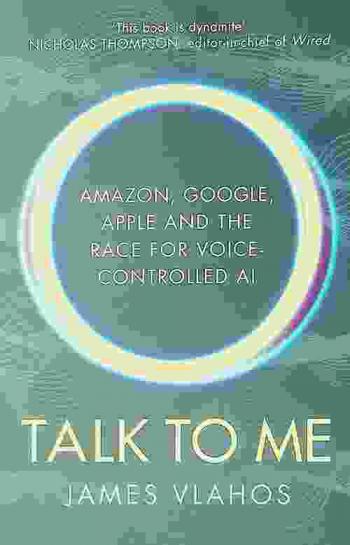
Talk to me : Amazon, Google, Apple and the race for voice-controlled AI
The next great technological disruption is coming. The titans of Silicon Valley are racing to build the last, best computer that the world will ever need. They know that whoever successfully creates it will revolutionise our relationship with technology and make billions of dollars in the process. They call it conversational AI. Computers that can speak and think like humans do may seem like the stuff of science fiction, but they are rapidly moving towards reality. In Talk to Me, veteran tech journalist James Vlahos meets the researchers at Google, Amazon and Apple who are leading the way to a voice computing revolution. He explores how voice tech will transform every sector of society handing untold new powers to businesses, upending traditional notions of privacy, revolutionising access to information, and fundamentally altering the way we understand human consciousness. And he even tries to understand the significance of the revolution firsthand - by building a chatbot version of his terminally ill father. Vlahos's research leads him to one fundamental question: What happens when our computers become as articulate, compassionate, and creative as we are?

Feasibility of Mental Health Triage Call Priority Prediction Using Machine Learning
Background: Optimum efficiency and responsiveness to callers of mental health helplines can only be achieved if call priority is accurately identified. Currently, call operators making a triage assessment rely heavily on their clinical judgment and experience. Due to the significant morbidity and mortality associated with mental illness, there is an urgent need to identify callers to helplines who have a high level of distress and need to be seen by a clinician who can offer interventions for treatment. This study delves into the potential of using machine learning (ML) to estimate call priority from the properties of the callers’ voices rather than evaluating the spoken words. Method: Phone callers’ speech is first isolated using existing APIs, then features or representations are extracted from the raw speech. These are then fed into a series of deep learning neural networks to classify priority level from the audio representation. Results: Development of a deep learning neural network architecture that instantly determines positive and negative levels in the input speech segments. A total of 459 call records from a mental health helpline were investigated. The final ML model achieved a balanced accuracy of 92% correct identification of both positive and negative instances of call priority. Conclusions: The priority level provides an estimate of voice quality in terms of positive or negative demeanor that can be simultaneously displayed using a web interface on a computer or smartphone.
Journal Article

Talk to me : how voice computing will transform the way we live, work, and think
\"A New York Times Magazine writer explores the Next Big Thing in tech--the impending revolution in voice recognition--and shows how it will upend Silicon Valley and transform how we use computers, the Web, and much more\"-- Provided by publisher.
BOOK


State of the Art in AI Applied to Ambient Intelligence
We are moving towards a future where environments respond to human preferences and needs.In this world, smart devices equipped with intelligent features and the capability to sense, communicate with and support humans in daily activities will be unremarkable.
eBook

AALIANCE Ambient Assisted Living Roadmap
In this publication a roadmap on Ambient Assisted Living (AAL) is presented. It is produced by the European Ambient Assisted Living Innovation Alliance, or AALIANCE project, funded under the 7th European Framework Programme. In the first chapter new developing trends in AAL are looked at from different perspectives and barriers to their implementation are discussed. This is followed by a detailed discussion of the application domains; AAL4persons (Chapter 2), AAL@community (Chapter 3), AAL@work (Chapter 4) and a detailed presentation of the enabling technologies - sensing, reasoning, acting, interaction and communication - (Chapter 5). The final chapter presents a way to set up an AAL system (Chapter 6). This resulted in a document that can be considered as the technology roadmap for AAL.
eBook

Workshop Proceedings of the 7th International Conference on Intelligent Environments
This book presents the workshop proceedings of the 7th International Conference on Intelligent Environments (IE 2011), held in Nottingham, United Kingdom, in July 2011. The workshops provide a forum for scientists, researchers and engineers from both industry and academia to engage in discussion on newly emerging or rapidly evolving topics which have yet to reach conferences or journals.The seven workshops included in the conference address a diverse set of topics. The formats are equally diverse, ranging from lectures to practical sessions, and comprising over 80 presentations in total. The workshops and the areas they address are as follows: AITAmI'11, the special relevance of AI technology to the goals of ambient intelligence and practical applications; CS'11, the use of science fiction stories grounded in current science and engineering research as a means to motivate and direct research into new technologies; HCIAmI'11, an exploration of multidisciplinary human centric interfaces for ambient intelligence applications; IC'11, the next-generation intelligent campus environment; SciT'11, establishing a multidisciplinary forum using the creative arts as a means of conveying scientific achievements to a wider audience; SOOW'11, smart offices and other intelligent workplaces and finally, WISHWell'11, an exploration of pervasive healthcare technology solutions within the hospital and home.Providing a picture of the latest ideas and innovations in the field, this book will be of interest to all those whose work involves the use or creation of intelligent environments.
eBook

Ambient Intelligence Perspectives
Ambient Intelligence Perspectives contains selected papers from the first international ambient Intelligence Forum - AmIF 2008 in Hradec Králové, Czech Republic. The forum is intended as the beginning of a series of rather broadly oriented discussion opportunities for discussing interdisciplinary, if not transdisciplinary aspects of rapidly evolving areas of Ambient Intelligence. Its aims were to review and discuss recent advances and promising research trends in AmI technology, intelligent environments, methods, middleware development, as well as applications in areas such as healthcare, product lifecycle and transport services. The intention to provide an opportunity of a very broad interaction among a wide rank of authors coming from different surroundings means a great enrichment to all participants and gives ground to the success of the conference. Finally it led towards an interesting choice of three invited and twenty-five contributed papers, which are published in this book. All papers were carefully reviewed by the international program committee. Participants from twelve countries contributed to the scientific program and established a fruitful discussion atmosphere.
eBook