
Catalogue Search | MBRL


Are you sure you want to remove the book from the shelf?

{{itemTitle}}
163,419
result(s) for
"Voices"
Sort by:


Stroboscopy and High-Speed Imaging of the Vocal Function
Stroboscopy and High-Speed Imaging of the Vocal Function, Second Edition presents a complete picture of the art and science of stroboscopy. This unique professional resource includes not only comprehensive coverage of the imaging process, but also the disease process that exists in benign lesions, cancer, and neuropathology. Comparisons of normal images with pathologies are included to enhance readers' diagnostic skills, and the use of stroboscopic images before and after therapy to determine results enhances their clinical skills. The book also covers the entire range of laryngeal imaging for diagnostics, including rigid endoscopy, videostroboscopy, fiberoptic laryngoscopy, and high-speed imaging.
eBook


Voice Flows to and around Leaders: Understanding When Units Are Helped or Hurt by Employee Voice
In two studies, we develop and test theory about the relationship between speaking up, one type of organizational citizenship behavior, and unit performance by accounting for where employee voice is flowing. Results from a qualitative study of managers and professionals across a variety of industries suggest that voice to targets at different formal power levels (peers or superiors) and locations in the organization (inside or outside a focal unit) differs systematically in terms of its usefulness in generating actions to a unit's benefit on the issues raised and in the likely information value of the ideas expressed. We then theorize how distinct voice flows should be differentially related to unit performance based on these core characteristics and test our hypotheses using time-lagged field data from 801 employees and their managers in 93 units across nine North American credit unions. Results demonstrate that voice flows are positively related to a unit's effectiveness when they are targeted at the focal leader of that unit—who should be able to take action—whether from that leader's own subordinates or those in other units, and negatively related to a unit's effectiveness when they are targeted at coworkers who have little power to effect change. Together, these studies provide a structural framework for studying the nature and impact of multiple voice flows, some along formal reporting lines and others that reflect the informal communication structure within organizations. This research demonstrates that understanding the potential performance benefits and costs of voice for leaders and their units requires attention to the structure and complexity of multiple voice flows rather than to an undifferentiated amount of voice.
Journal Article

Voice Training and Therapy With a Semi-Occluded Vocal Tract: Rationale and Scientific Underpinnings
Contact author: Ingo R. Titze, 1101 13th Street, Denver, CO 80204-5319. Email: ititze{at}dcpa.org
PURPOSE: Voice therapy with a semi-occluded vocal tract has a long history. The use of lip trills, tongue trills, bilabial fricatives, humming, and phonation into tubes or straws has been hailed by clinicians, singing teachers, and voice coaches as efficacious for training and rehabilitation. Little has been done, however, to provide the scientific underpinnings. The purpose of the study was to investigate the underlying physical principles behind the training and therapy approaches that use semi-occluded vocal tract shapes.
METHOD: Computer simulation, with a self-oscillating vocal fold model and a 44 section vocal tract, was used to elucidate sourcefilter interactions for lip and epilarynx tube semi-occlusions.
RESULTS: A semi-occlusion in the front of the vocal tract (at the lips) heightens sourcetract interaction by raising the mean supraglottal and intraglottal pressures. Impedance matching by vocal fold adduction and epilarynx tube narrowing can then make the voice more efficient and more economic (in terms of tissue collision).
CONCLUSION: The efficacious effects of a lip semi-occlusion can also be realized for nonoccluded vocal tracts by a combination of vocal fold adduction and epilarynx tube adjustments. It is reasoned that therapy approaches are designed to match the glottal impedance to the input impedance of the vocal tract.
KEY WORDS: voice therapy, voice training, singing, resonant voice, voice efficiency
CiteULike Connotea Del.icio.us Digg Facebook Reddit Technorati Twitter What's this?
Journal Article
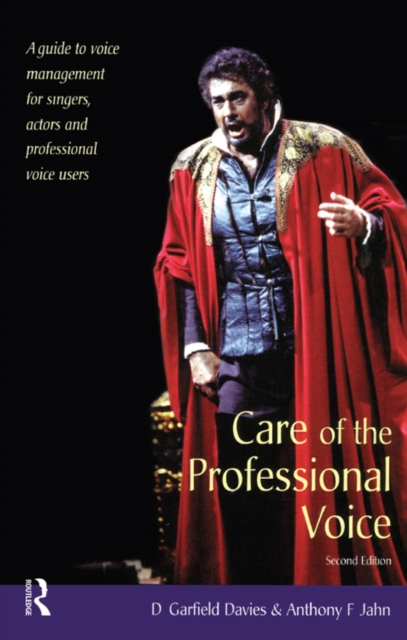
Care of the Professional Voice
Singer and actors are a unique group of performers, relying almost entirely on their voice for the professional livelihood. Jet lag, amplification, allergens, stress, pollution, and vocal strain all affect vocal performance. Written for the performer, the teacher, and the vocal coach, Care of the Professional Voiceoffers clear explanations and medical advice on vocal problems and vocal health. Careof the Professional Voice is written by experts in laryngology in the United States and Great Britain. This second edition includes a singer's guide to self-diagnosis.
eBook

Perception of Physical Demand, Mental Demand, and Performance: A Comparison of Two Voice Interventions for Parkinson's Disease
The purpose of the study was to examine the effect of two voice intervention approaches for hypophonia secondary to Parkinson's disease (PD) on self-reported measures of physical demand, mental demand, and vocal performance.
Thirty-four persons with hypophonia secondary to PD were assigned to one of three groups: Lee Silverman Voice Treatment (LSVT) LOUD (
= 12), SpeechVive (
= 12), and nontreatment clinical control (
= 10). The LSVT LOUD and the SpeechVive participants received 8 weeks of voice intervention following the standardized protocol previously described for each approach. To confirm the effectiveness of each voice intervention, sound pressure level (dB SPL) data were analyzed for the experimental and control participants for a monologue sample obtained pretreatment, midtreatment, and posttreatment. During the voice intervention period, the LSVT LOUD and the SpeechVive participants were instructed to complete a modified version of the National Aeronautics and Space Administration Task Load Index rating scale to indicate the mental and physical demand required to complete the intervention activities, and to indicate how well they performed in completing the assigned vocal tasks.
The LSVT LOUD and the SpeechVive participants demonstrated a significant posttreatment increase in SPL (dB), in comparison to the clinical controls, thus confirming a positive intervention effect. The LSVT LOUD participants reported significantly higher ratings of physical and mental demand over the course of treatment, in comparison to the SpeechVive participants.
Consideration of the mental and physical demand associated with two voice intervention approaches, commonly used for PD, may help to foster improved therapeutic compliance and treatment outcomes.
Journal Article
An Updated Theoretical Framework for Vocal Hyperfunction
Purpose The purpose of this viewpoint article is to facilitate research on vocal hyperfunction (VH). VH is implicated in the most commonly occurring types of voice disorders, but there remains a pressing need to increase our understanding of the etiological and pathophysiological mechanisms associated with VH to improve the prevention, diagnosis, and treatment of VH-related disorders. Method A comprehensive theoretical framework for VH is proposed based on an integration of prevailing clinical views and research evidence. Results The fundamental structure of the current framework is based on a previous (simplified) version that was published over 30 years ago (Hillman et al., 1989). A central premise of the framework is that there are two primary manifestations of VH-phonotraumatic VH and nonphonotraumatic VH-and that multiple factors contribute and interact in different ways to cause and maintain these two types of VH. Key hypotheses are presented about the way different factors may contribute to phonotraumatic VH and nonphonotraumatic VH and how the associated disorders may respond to treatment. Conclusions This updated and expanded framework is meant to help guide future research, particularly the design of longitudinal studies, which can lead to a refinement in knowledge about the etiology and pathophysiology of VH-related disorders. Such new knowledge should lead to further refinements in the framework and serve as a basis for improving the prevention and evidence-based clinical management of VH.
Journal Article

Classification of laryngeal diseases including laryngeal cancer, benign mucosal disease, and vocal cord paralysis by artificial intelligence using voice analysis
Voice change is often the first sign of laryngeal cancer, leading to diagnosis through hospital laryngoscopy. Screening for laryngeal cancer solely based on voice could enhance early detection. However, identifying voice indicators specific to laryngeal cancer is challenging, especially when differentiating it from other laryngeal ailments. This study presents an artificial intelligence model designed to distinguish between healthy voices, laryngeal cancer voices, and those of the other laryngeal conditions. We gathered voice samples of individuals with laryngeal cancer, vocal cord paralysis, benign mucosal diseases, and healthy participants. Comprehensive testing was conducted to determine the best mel-frequency cepstral coefficient conversion and machine learning techniques, with results analyzed in-depth. In our tests, laryngeal diseases distinguishing from healthy voices achieved an accuracy of 0.85–0.97. However, when multiclass classification, accuracy ranged from 0.75 to 0.83. These findings highlight the challenges of artificial intelligence-driven voice-based diagnosis due to overlaps with benign conditions but also underscore its potential.
Journal Article

The Use of Voice Control in 3D Medical Data Visualization Implementation, Legal, and Ethical Issues
Voice-controlled devices are becoming increasingly common in our everyday lives as well as in medicine. Whether it is our smartphones, with voice assistants that make it easier to access functions, or IoT (Internet of Things) devices that let us control certain areas of our home with voice commands using sensors and different communication networks, or even medical robots that can be controlled by a doctor with voice instructions. Over the last decade, systems using voice control have made great progress, both in terms of accuracy of voice processing and usability. The topic of voice control is intertwined with the application of artificial intelligence (AI), as the mapping of spoken commands into written text and their understanding is mostly conducted by some kind of trained AI model. Our research had two objectives. The first was to design and develop a system that enables doctors to evaluate medical data in 3D using voice control. The second was to describe the legal and ethical issues involved in using AI-based solutions for voice control. During our research, we created a voice control module for an existing software called PathoVR, using a model taught by Google to interpret the voice commands given by the user. Our research, presented in this paper, can be divided into two parts. In the first, we have designed and developed a system that allows the user to evaluate 3D pathological medical serial sections using voice commands. In contrast, in the second part of our research, we investigated the legal and ethical issues that may arise when using voice control in the medical field. In our research, we have identified legal and ethical barriers to the use of artificial intelligence in voice control, which need to be answered in order to make this technology part of everyday medicine.
Journal Article