
Catalogue Search | MBRL


Are you sure you want to remove the book from the shelf?

{{itemTitle}}
506
result(s) for
"Vows."
Sort by:

Vows : the modern genius of an ancient rite
\"From the bestselling author of Home Comforts comes the story of our wedding vows-what they mean and why they still matter. In the West, marrying is so thoroughly identified with ceremonial promises that \"taking vows\" is a synonym for getting married. So, it's a surprise to realize that this custom is actually a historical and anthropological oddity. Most of the world, for most of history, married without making promises. And there's a reason for that. Marriage by vow presupposes free choice, and free choice makes a love-match possible. It is a very modern arrangement. Vows is both a moving memoir of two marriages and a thoughtful meditation on marriage itself. Cheryl Mendelson tackles the sociology of commitment through our most traditional promises and shows why they endure. In considering the kind of marriage these vows entail, she helps answer some of life's most urgent and personal of questions: Could I, would I, or should I make these promises to someone? Using history and literature, the book describes the parameters of the behavior that traditional vows promise and, in doing so, answers a whole series of other questions: Why did wedding-by-vow arise only in the West? Why are they recited in weddings around the world today? Why have these vows lasted for nearly a thousand years? Why does the kind of marriage promised in the vows survive?\"-- Provided by publisher.
Book

By Force and Fear
An unwilling, desperate nun trapped in the cloister, unable to gain release: such is the image that endures today of monastic life in early modern Europe. InBy Force and Fear, Anne Jacobson Schutte demonstrates that this and other common stereotypes of involuntary consignment to religious houses-shaped by literary sources such as Manzoni's The Betrothed-are badly off the mark.
Drawing on records of the Congregation of the Council, held in the Vatican Archive, Schutte examines nearly one thousand petitions for annulment of monastic vows submitted to the Pope and adjudicated by the Council during a 125-year period, from 1668 to 1793. She considers petitions from Roman Catholic regions across Europe and a few from Latin America and finds that, in about half these cases, the congregation reached a decision. Many women and a smaller proportion of men got what they asked for: decrees nullifying their monastic profession and releasing them from religious houses. Schutte also reaches important conclusions about relations between elders and offspring in early modern families. Contrary to the picture historians have painted of increasingly less patriarchal and more egalitarian families, she finds numerous instances of fathers, mothers, and other relatives (including older siblings) employing physical violence and psychological pressure to compel adolescents into \"entering religion.\" Dramatic tales from the archives show that many victims of such violence remained so intimidated that they dared not petition the pope until the agents of force and fear had died, by which time they themselves were middle-aged. Schutte's innovative book will be of great interest to scholars of early modern Europe, especially those who work on religion, the Church, family, and gender.
eBook

Sisters and Brothers of the Common Life
The Devotio Moderna, or Modern Devout, puzzled their contemporaries. Beginning in the 1380s in market towns along the Ijssel River of the east-central Netherlands and in the county of Holland, they formed households organized as communes and forged lives centered on private devotion. They lived on city streets alongside their neighbors, managed properties and rents in common, and worked in the textile and book trades, all the while refusing to profess vows as members of any religious order or to acquire spouses and personal property as lay citizens. They defended their self-designed style of life as exemplary and sustained it in the face of opposition, their women labeled \"beguines\" and their men \"lollards,\" both meant as derogatory terms. Yet the movement grew, drawing in women and schoolboys, priests and laymen, and spreading outward toward Münster, Flanders, and Cologne.
The Devout were arguably more culturally significant than the Lollards and Beguines, yet they have commanded far less scholarly attention in English. John Van Engen's magisterial book keeps the Modern Devout at its center and thinks through their story anew. Few interpreters have read the Devout so insistently within their own time and space by looking to the social and religious conditions that marked towns and parishes in northern Europe during the fifteenth century and examining the widespread upheavals in cultural and religious life between the 1370s and the 1440s. InSisters and Brothers of the Common Life, Van Engen grasps the Devout in their humanity, communities, and beliefs, and places them firmly within the urban societies of the Low Countries and the cultures we call late medieval.
eBook

The Fragility of Restoring Full Ordination for Tibetan ITsunmas/I
Drawing from interviews with tsunmas (Tib. btsun ma, nun) living and practicing in Geluk, Kagyu, and Sakya institutions in Bihar, Himachal Pradesh, Ladakh, and Uttarakhand, India, between March 2017 and February 2019, this case study foregrounds tsunmas’ heterogenous insights into the most ideal and acceptable ways for restoring gelongma (Tib. dge slong ma, Skt. bhikṣunī, fully ordained nun) vows. I argue that fragility, the quality of being breakable, underlies the history of gelongma vows in Tibet. Fragility, however, can also be generative. In this regard, fragility also signifies the possibility of restoring gelongma ordination for some tsunmas who are interested in receiving gelongma vows in India. This article examines Tibetan and Himalayan tsunmas’ perspectives on the possible ways of restoring gelongma ordination for women in the Tibetan Buddhist tradition. Since the lineage of gelongmas ceased in Tibet, some tsunmas see this fragility as prohibiting restoration of gelongma ordination unless there is a way to re-establish these vows through the Mūlasarvāstivāda Vinaya, the monastic code adopted in Tibet, whereas other tsunmas perceive this fragility as an opportunity for other possibilities for gelongma vow restoration through innovative ritual practices such as dual-Vinaya ordination.
Journal Article

The Vow-Curse in Ancient Jewish Texts
Uttering a vow was an important and popular religious practice in ancient Judaism. It is mentioned frequently in biblical literature, and an entire rabbinic tractate, Nedarim, is devoted to this subject. In this article, I argue that starting from the Second Temple period, alongside the regular use of the vow, vows were also used as an aggressive binding mechanism in interpersonal situations. This practice became so popular that in certain contexts the vow became synonymous with the curse, as in a number of ossuaries in Jerusalem and in the later Aramaic incantation bowls. Moreover, this semantic expansion was not an isolated Jewish phenomenon but echoed both the use of the anathema in the Pauline epistles and contemporary Greco-Roman and Babylonian magical practices.
Journal Article
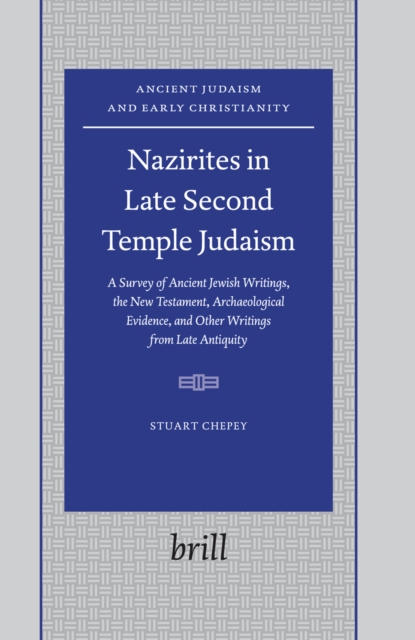
Nazirites in late Second Temple Judaism: a survey of ancient Jewish writings, the New Testament, archaeological evidence, and other writings from late antiquity
Nazirites appear in a number of sources relevant to Judaism of the late Second Temple period. This book surveys the pertinent evidence and assesses what it reveals regarding the role of the Nazirite within Judaism of the late Second Temple and early Christian era.The survey is arranged according to three primary sections: \"Direct Evidence for Nazirites\"; \"Possible and Tangential Evidence for Nazirites\"; and a final section, \"Making Sense of the Evidence.\" It concludes by arguing that the role of the Nazirite portrayed in sources was that of a religious devotee, and concomitant with biblical law, Nazirite devotion typically involved flexibility, personal freedom of expression, and adaptation to outside cultural norms.Those interested in the Nazirite vow as portrayed in the New Testament and other relevant sources will find this study useful, as will those interested in Bible translation and interpretation in late Second Temple and early rabbinic literature.
eBook
Revisiting the Institution of Bnay and Bnoth Qyōmo in the Syriac Tradition
A group of Syriac Christian believers existed during the fourth century called the Bnay Qyōmo (with their female counterparts known as the Bnoth Qyōmo): the Sons and Daughters of the Covenant. There has been considerable controversy about the nature of this archaic Syrian monastic movement or, as it is known to some scholars, the Syriac “Proto-Monastic Tradition”. The controversy has not only been about the name, but also the origin, habits, and ascetic way of life of the Bnay Qyōmo. The intention of the present article is not to elaborate on the various terminology used to describe the Bnay Qyōmo or the nature of their vows and expected duties as introduced by Aphrahat and other Syrian Fathers, for these have been studied by many scholars. Rather, the intention of this article is to review some of the material discussing this group by key Syriac Fathers to present a fresh reading of the historical record to better apprize the order’s regulations and its social and ecclesiastical roles within the Syriac-speaking Church during the fourth and fifth centuries AD. The main Syriac writers who dealt with this topic were Aphrahat, known as “the Persian Sage” (ca. 260–345), and Rabūla, Bishop of Edessa (flor. 420s). Whilst the order appears to have declined by about the eighth century, understanding the roles of the Bnay Qyōmo during the earlier period (the focus of this writing) is crucial for explaining the development of the Syriac Tradition.
Journal Article

Legislating the Lips
The Temple Scroll (11QTa 53:11–54:5) and Damascus Document (CD 16:6–12) each appropriate legislation concerning vows and oaths from Deut 23:22–24 and Num 30:3–17. Lawrence H. Schiffman, who has offered the only at-length comparison of these appropriations, characterizes these halakhot as incongruent and links this conclusion with his position that the Temple Scroll is Sadducean and the Damascus Document comes from a later Sadducean splinter group. However, my analysis leads to a different conclusion. I demonstrate that the authors of the Temple Scroll and Damascus Document evidence distinct aims in their appropriations of shared base texts, but not necessarily incongruence nor intentional divergence.
Journal Article

AUGUSTUS MAKES A VOW: COMMENTS ON DIO 55.31.2–3
This article examines a report in Dio of a vow made by Augustus in response to a prophecy. It establishes the setting as a festival for the Magna Mater rather than ludi magni, as has recently been suggested. Based on calendar entries and a passage from Ovid, the article then associates the content of the vow with altars of Ceres and Ops established in 7 c.e.
Journal Article