
Catalogue Search | MBRL


Are you sure you want to remove the book from the shelf?

{{itemTitle}}
10,185
result(s) for
"WORLD TRADE ORGANIZATION"
Sort by:


International Trade and Developing Countries
A keen analysis of how and why countries bargain together in groups in world affairs, and why such coalitions are crucial to individual developing nations. It also reveals the effects these negotiating blocs are having on world affairs.
Successful coalition building has proven to be a difficult and expensive process. Allies are often not obvious and need to be carefully identified. Large numbers do not necessarily entail a proportionate increase in influence. And the weak have the choice of teaming up against or jumping on the bandwagon with the strong. Even after it has been organised, collective action entails costs of many kinds.
This book investigates the relevance and workability of coalitions as instruments of bargaining power for the weak. More specifically, this analyzes the coalition strategies of developing countries at the inter-state level, particularly in the context of international trade.
Given the nature of this enquiry, this new study uses theoretical and empirical methods to complement each other. The theoretical approach draws from a plethora of writings: formal theories of clubs and coalitions, theories of domestic political economy and theories of international relations. The empirical analysis of comparable coalitions becomes necessary to assist in this theorising, so the greater part of the book focuses mainly (though not exclusively) on coalitions involving developing countries on the issue-area of trade in services. Through the case-studies of the Uruguay Round and an analytical overview of more recent coalitions, this text fills an important gap in the literature of international political economy and international relations where most GATT/WTO-based coalitions have eluded record.
This book will be of great interest to all students of international relations, politics and globalization.
eBook


A World of False Promises: International Labour Organization, World Health Organization, and the Plea of Workers Under Neoliberalism
Occupational health and safety is poorly served by United Nations agencies designated to protect workers: the World Health Organization (WHO) and the International Labor Organization (ILO). The neoliberal programs initially adopted by the United Nations supported institutions of social protection and regulation and expanded worker protections and union growth. Neoliberalism later became synonymous with globalism and shared in its international success. The fundamental change under neoliberalism was the exchange and accumulation of capital. The major beneficiaries of neoliberalism, at the expense of workers, were large transnational corporations and wealthy investors. During this period, WHO and ILO activities in support of workers declined. As neoliberalism ultimately became neoconservatism, occupational health and safety was purposely ignored, and labor was treated with hostility. Neoliberalism had evolved into a harsh economic system detrimental to labor and labor rights. The United Nations is now in decline, taking with it the trivial WHO and ILO programs. Replacements for the WHO and ILO programs must be developed. It is not enough to call for renewed funding, given the United Nations’ failure to direct the global effort to protect workers. A new direction must be found.
Journal Article


RULES AND VALUES IN INTERNATIONAL ADJUDICATION: THE CASE OF THE WTO APPELLATE BODY
Current political challenges facing the WTO Appellate Body raise fundamental questions about the relationship between rules and values in international adjudication. This article applies insights from legal philosophy to identify the role values should play in WTO adjudication. It argues that nothing about the specifics of WTO law would justify excluding values from adjudication; that the doctrinal, political and institutional context of WTO adjudication makes a positivist account of the role of values untenable; but an anti-positivist account requires complementing established economic accounts of WTO law's purpose with an account of fairness and justice in trade and trade regulation.
Journal Article


The EU, World Trade Law and the Right to Food
In recent years the European Union has developed a comprehensive strategy to conclude free trade agreements which includes not only prominent trade partners such as Canada, the United States and Japan but also numerous developing countries. This book looks at the existing WTO law and at the new EU free trade agreements with the Caribbean and sub-Saharan Africa through the lens of the human right to adequate food. It shows how the clauses on the import and export of food included in recent free trade agreements limit the capacity of these countries to implement food security policies and to respect their human rights obligations. This outcome appears to be at odds with international human rights law and dismissive of existing human rights references in EU-founding treaties as well as in treaties between the EU and developing states. Yet, the book argues against the conception in human rights literature that there is an inflexible agenda encoded in world trade law which is fundamentally conflictual with non-economic interests. The book puts forward the idea that the European Union is perfectly placed to develop a narrative of globalisation considering other areas of public international law when negotiating trade agreements, and argues that the EU does have the competences and influence to uphold a role of international leadership in designing a sustainable global trading system. Will the EU be ambitious enough? A timely contribution to the growing academic literature on the relation between world trade law and international human rights law, this book imagines a central role for the EU in reconciling these two areas of international law. Studies in International Trade and Investment Law: Volume 20
eBook
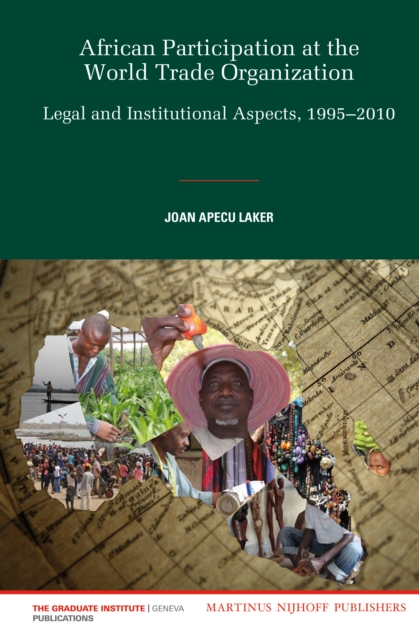
African participation at the World Trade Organization : legal and institutional aspects, 1995-2010
Through substantive investigation, African Participation at the World Trade Organization: Legal and Institutional Aspects, 1995-2010 offers thorough explanations for the nominal, minimal, and largely ineffective activity of African members in the WTO, focusing on the three core areas of regular committee work, dispute settlement and negotiations, and considering the Group's size, compared to non-African Members. Fundamentally, the research examines the longstanding and continuing question in the Multilateral Trading System revolving around the substantive quality and effectiveness of African participation in a rules-based Multilateral Trading System with a balance of rights and obligations. The book is a must-read for anyone interested in the factors, motivations and explanations that have underpinned the behavior of African countries in the GATT/WTO system of trade rules.
eBook