
Catalogue Search | MBRL


Are you sure you want to remove the book from the shelf?

{{itemTitle}}
1,305
result(s) for
"WWII"
Sort by:

Call of Duty WWII field manual
\"A wholly immersive in-world take on the blockbuster Call of Duty(R) series. Acclaimed for its immersive gameplay and thrilling storylines, Call of Duty(R) has captivated millions of players worldwide since the release of its first game in 2003. Call of Duty(R) Field Manual is an engrossing collector's item for fans of the series. Presented as an official combat-issued handbook that has been misplaced by its owner, the book pairs stunning original illustrations with an engaging narrative that showcases the statistics and history of the essential units, vehicles, weapons, and battlegrounds.\"-- Provided by publisher.
Book
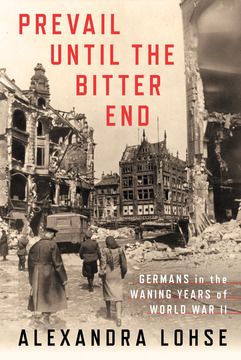
Prevail until the Bitter End
In Prevail until the Bitter
End , Alexandra Lohse explores the gossip and
innuendo, the dissonant reactions and perceptions of Germans to the
violent dissolution of the Third Reich. Mobilized for
total war, soldiers and citizens alike experienced an unprecedented
convergence of military, economic, social, and political crises.
But even in retreat, the militarized national community unleashed
ferocious energies, staving off defeat for over two years and
continuing a systematic murder campaign against European Jews and
others. Was its faith in the Führer never shaken by the prospect of
ultimate defeat?
Lohse uncovers how Germans experienced life and death,
investigates how mounting emergency conditions affected their
understanding of the nature and purpose of the conflagration, and
shows how these factors influenced the people's relationship with
the Nazi regime. She draws on Nazi morale and censorship reports,
features citizens' private letters and diaries, and incorporates a
large body of Allied intelligence, including several thousand
transcripts of surreptitiously recorded conversations among German
prisoners of war in Western Allied captivity.
Lohse's historical reconstruction helps us understand how
ordinary Germans interpreted their experiences as both the victims
and perpetrators of extreme violence. We are immersively drawn into
their desolate landscape: walking through bombed-out streets,
scrounging for food, burning furniture, listening furtively to
Allied broadcasts, unsure where the truth lies. Prevail until
the Bitter End is about the stories that Germans told
themselves to make sense of this world in crisis.
eBook

Toposul Emoțiilor – Un Itinerariu De La Război La Comunism
What the present paper advances is the creation of a living context through which the protagonist-creator, Axente Creangă, from Luntrea lui Caron / Caron’s Boat by Lucian Blaga, accumulates the depths of private life during the World War II, as well as during the early days of communism. The action takes place exclusively in the Transylvanian space, which we analyzed through a quantitative study aimed at the level of emotions in these two important historical periods and the placement of the work in an interdependent relationship with all the events that took place.
Journal Article
Human Rights in Canada
This book shows how human rights became the primary language for social change in Canada and how a single decade became the locus for that emergence. The author argues that the 1970s was a critical moment in human rights history—one that transformed political culture, social movements, law, and foreign policy. Human Rights in Canada is one of the first sociological studies of human rights in Canada. It explains that human rights are a distinct social practice, and it documents those social conditions that made human rights significant at a particular historical moment. A central theme in this book is that human rights derive from society rather than abstract legal principles. Therefore, we can identify the boundaries and limits of Canada’s rights culture at different moments in our history. Until the 1970s, Canadians framed their grievances with reference to Christianity or British justice rather than human rights. A historical sociological approach to human rights reveals how rights are historically contingent, and how new rights claims are built upon past claims. This book explores governments’ tendency to suppress rights in periods of perceived emergency; how Canada’s rights culture was shaped by state formation; how social movements have advanced new rights claims; the changing discourse of rights in debates surrounding the constitution; how the international human rights movement shaped domestic politics and foreign policy; and much more. In addition to drawing on secondary literature in law, history, sociology, and political science, this study looked to published government documents, litigation and case law, archival research, newspapers, opinion polls, and materials produced by non-governmental organizations.
eBook

Polish Jewish Culture Beyond the Capital
Polish Jewish Culture beyond the Capital: Centering the
Periphery is a path-breaking exploration of the diversity and
vitality of urban Jewish identity and culture in Polish lands from
the second half of the nineteenth century to the outbreak of the
Second World War (1899-1939). In this multidisciplinary essay
collection, a cohort of international scholars provides an
integrated history of the arts and humanities in Poland by
illuminating the complex roles Jews in urban centers other than
Warsaw played in the creation of Polish and Polish Jewish culture.
Each essay presents readers with the extraordinary production and
consumption of culture by Polish Jews in literature, film, cabaret,
theater, the visual arts, architecture, and music. They show how
this process was defined by a reciprocal cultural exchange that
flourished between cities at the periphery-from Lwów and Wilno to
Kraków and Łódź-and international centers like Warsaw, thereby
illuminating the place of Polish Jews within urban European
cultures. Companion website (https://polishjewishmusic.iu.edu)
eBook

Holding Their Breath
Holding Their Breath uncovers
just how close Britain, the United States, and Canada came to
crossing the red line that restrained chemical weapon use during
World War II. Unlike in World War I, belligerents did not
release poison gas regularly during the Second World War. Yet, the
looming threat of chemical warfare significantly affected the
actions and attitudes of these three nations as they prepared their
populations for war, mediated their diplomatic and military
alliances, and attempted to defend their national identities and
sovereignty.
The story of chemical weapons and World War II begins in the
interwar period as politicians and citizens alike advocated to ban,
to resist, and eventually to prepare for gas use in the next war.
M. Girard Dorsey reveals, through extensive research in
multinational archives and historical literature, that although
poison gas was rarely released on the battlefield in World War II,
experts as well as lay people dedicated significant time and energy
to the weapon's potential use; they did not view chemical warfare
as obsolete or taboo.
Poison gas was an influential weapon in World War II, even if
not deployed in a traditional way, and arms control, for various
reasons, worked. Thus, what did not happen is just as important as
what did. Holding Their Breath provides insight into these
potentialities by untangling World War II diplomacy and chemical
weapons use in a new way.
eBook

An Annotated WWII Underwater Archaeology Bibliography
With four decades of WWII underwater archaeology publications, the time is nigh to create a comprehensive bibliography and conduct an analysis of trends within the growing subfield. This paper presents a decade-by-decade analysis of academic publications accessible through a number of search engines and databases. It analyzes the papers through the categories of author gender, heritage type, region, and focus. Finally, it provides the data set by which this analysis was accomplished in a comprehensive bibliography.
Journal Article
Forgetting Аbout Тraumatic Past? On the Position of Film Music Composers in Post-WWII Germany
This paper presents selected German film music composers who were active in Germany during the inter-war period as musicians trying to regain their position and renegotiate their role in the German post-war society marked by trauma and transition processes. Film music composers were believed to have stayed above politics and associated with a “harmless” type of music; therefore, they could adapt to the new situation comparatively more easily, particularly since the Allies had already treated musicians ambivalently. While pinpointing the reasons behind such a lenient attitude towards film music composers, the paper also touches on those rare cases when film music composers were actually accused of supporting the Nazi system.
Journal Article

Forgetting аbout traumatic past? On the position of film music composers in post-WWII germany
This paper presents selected German film music composers who were active in Germany during the inter-war period as musicians trying to regain their position and renegotiate their role in the German post-war society marked by trauma and transition processes. Film music composers were believed to have stayed above politics and associated with a ?harmless? type of music; therefore, they could adapt to the new situation comparatively more easily, particularly since the Allies had already treated musicians ambivalently. While pinpointing the reasons behind such a lenient attitude towards film music composers, the paper also touches on those rare cases when film music composers were actually accused of supporting the Nazi system.
Journal Article

Women-only WWII Military Reenactment Associations in Czechia: Between Authenticity and Emancipation
Historical military reenactment as a popular phenomenon is becoming a prime focus for many scholars. However, the androcentric nature of military reenactment has led to the underrepresentation of women in WWII military reenactment in Czechia. In recent years, the number of female reenactors has risen, resulting in the creation of women-only reenactment associations. In this text, I build on the existing literature on female military reenactment and try to capture the processes of historical change regarding the cultural content of Czech WWII reenactment, within the framework of post-positivist oral history. The processes include: 1) the redirection of the focus from purely combat reenactment and performances to wider and more inclusive representations of military experiences, and 2) the promotion of women's perspectives and their further empowerment within the community, which ultimately has led to the emergence of woman-only reenactment associations. Here, I present the interpretation of newly-recorded oral history narratives of Czech female military reenactors, capturing their historical subjectivities as well as the above-mentioned processes.
Journal Article