
Catalogue Search | MBRL


Are you sure you want to remove the book from the shelf?

{{itemTitle}}
28
result(s) for
"Wahlkampffinanzierung"
Sort by:

Small change
Reformers lament that, with every effort to regulate the sources of campaign funding, candidates creatively circumvent the new legislation. But in fact, political fundraisers don't need to look for loopholes because, as Raymond J. La Raja proves, legislators intentionally design regulations to gain advantage over their partisan rivals. La Raja traces the history of the U.S. campaign finance system from the late nineteenth century through the passage of the Bipartisan Campaign Reform Act (BCRA) of 2002. Then, using the 2004 presidential election as a case study, he compares the ways in which Democrats and Republicans adapted their national fund-raising and campaigning strategies to satisfy BCRA regulations. Drawing upon this wealth of historical and recent evidence, he concludes with recommendations for reforming campaign finance in ways that promote fair competition among candidates and guarantee their accountability to voters.
eBook

Multiethnic coalitions in Africa : business financing of opposition election campaigns
Why are politicians able to form electoral coalitions that bridge ethnic divisions in some countries and not others? This book answers this question by presenting a theory of pecuniary coalition building in multi-ethnic countries governed through patronage. Focusing on sub-Saharan Africa, the book explains how the relative autonomy of business from state-controlled capital affects political bargaining among opposition politicians in particular. While incumbents form coalitions by using state resources to secure cross-ethnic endorsements, opposition politicians must rely on the private resources of business to do the same. This book combines cross-national analyses of African countries with in-depth case studies of Cameroon and Kenya to show that incumbents actively manipulate financial controls to prevent business from supporting their opposition. It demonstrates that opposition politicians are more likely to coalesce across ethnic cleavages once incumbents have lost their ability to blackmail the business sector through financial reprisals. Summary reprinted by permission of Cambridge University Press
eBook
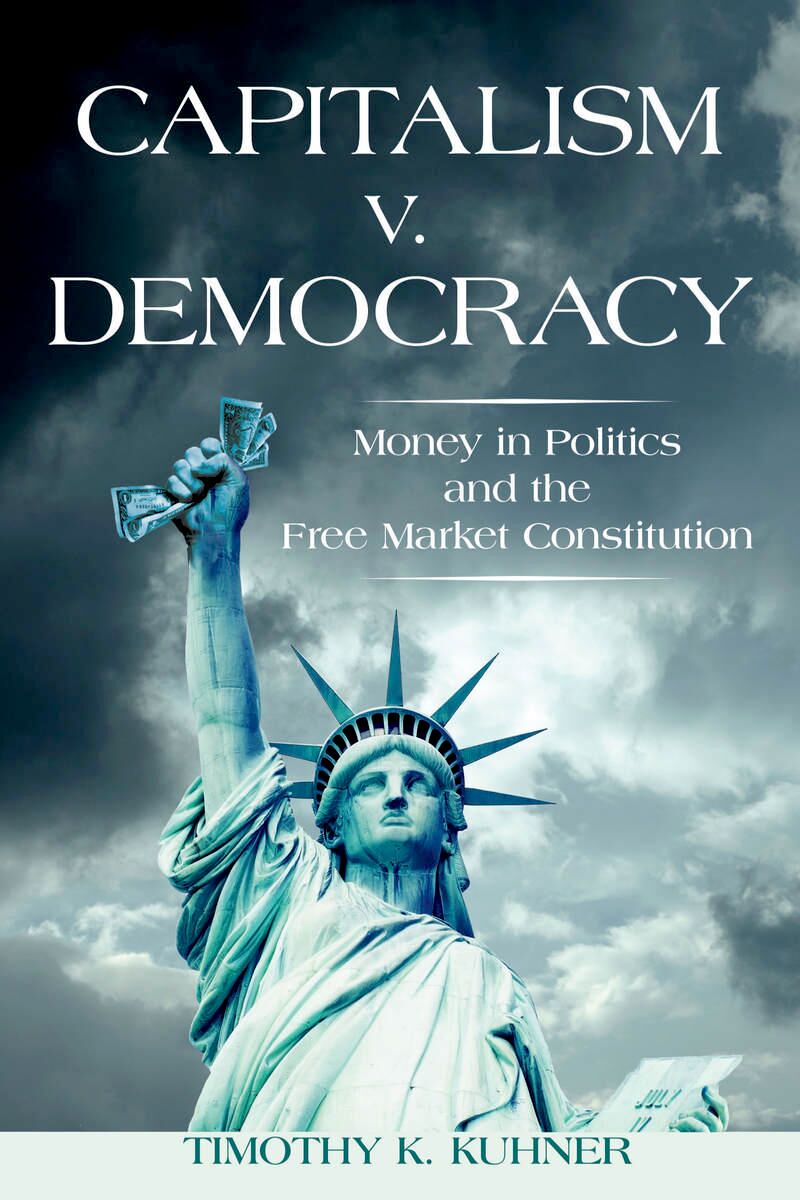
Capitalism v. democracy : money in politics and the free market constitution
As of the latest national elections, it costs approximately $1 billion to become president, $10 million to become a Senator, and $1 million to become a Member of the House. High-priced campaigns, an elite class of donors and spenders, superPACs, and increasing corporate political power have become the new normal in American politics. In Capitalism v. Democracy, Timothy Kuhner explains how these conditions have corrupted American democracy, turning it into a system of rule that favors the wealthy and marginalizes ordinary citizens. Kuhner maintains that these conditions have corrupted capitalism as well, routing economic competition through political channels and allowing politically powerful companies to evade market forces. The Supreme Court has brought about both forms of corruption by striking down campaign finance reforms that limited the role of money in politics. Exposing the extreme economic worldview that pollutes constitutional interpretation, Kuhner shows how the Court became the architect of American plutocracy.
Capitalism v. Democracy offers the key to understanding why corporations are now citizens, money is political speech, limits on corporate spending are a form of censorship, democracy is a free market, and political equality and democratic integrity are unconstitutional constraints on money in politics. Supreme Court opinions have dictated these conditions in the name of the Constitution, as though the Constitution itself required the privatization of democracy. Kuhner explores the reasons behind these opinions, reveals that they form a blueprint for free market democracy, and demonstrates that this design corrupts both politics and markets. He argues that nothing short of a constitutional amendment can set the necessary boundaries between capitalism and democracy.
eBook

Money in the House
Money in the House provides a compelling look at how the drive to raise campaign money has come to dominate congressional party politics. Author Marian Currinder examines the rise of member-to-member and member-to-party giving as part of a broader process that encourages ambitious House members to compete for power by raising money for the party and its candidates. As the margin between parties in the House has narrowed, the political environment has become fiercely competitive. Because electoral success is largely equated with fundraising success, the party that raises the most money is at a distinct advantage. In addition to relying on outside interests and individuals for campaign contributions, the congressional parties increasingly call on their own members to give for the good of the whole. As a result, lawmakers must devote ever-increasing amounts of time to fundraising. The fundraising expectations for members who wish to advance in the chamber are even higher. By requiring their members to raise and redistribute tremendous amounts of money in order to gain power in the chamber, the parties benefit from their members? ambitious pursuits. Currinder argues that the new `rule of money? is fundamentally altering the way House members pursue power and the way congressional parties define and reward loyalty.Contents1. Introduction: Redistributing Campaign Funds and Congressional Party Politics 2. Pursuing Ambition in a Parties Framework 3. The 1970s Reform Era: The Money Chase Begins 4. The 1980s: New Directions in Campaign Funding 5. A Republican Revolution in Politics and Money 6. Redistributing Campaign Money in a New Era
eBook

Congressional parties, institutional ambition, and the financing of majority control
Close competition for majority party control of the U.S. House of Representatives has transformed the congressional parties from legislative coalitions into partisan fundraising machines. With the need for ever increasing sums of money to fuel the ongoing campaign for majority control, both Republicans and Democrats have made large donations to the party and its candidates mandatory for members seeking advancement within party and congressional committee hierarchies.
Eric S. Heberlig and Bruce A. Larson not only analyze this development, but also discuss its implications for American government and democracy. They address the consequences of selecting congressional leaders on the basis of their fundraising skills rather than their legislative capacity and the extent to which the battle for majority control leads Congress to prioritize short-term electoral gains over long-term governing and problem-solving.
eBook

Subsidizing Democracy
In the wake ofCitizens United v. Federal Election Commission(2010), the case that allowed corporate and union spending in elections, many Americans despaired over the corrosive influence that private and often anonymous money can have on political platforms, campaigns, and outcomes at the federal and state level. InMcComish v. Bennett(2011), the Supreme Court declared unconstitutional the matching funds feature of so-called \"Clean Elections\" public financing laws, but there has been no strong challenge to the constitutionality of public funding as such. InSubsidizing Democracy, Michael G. Miller considers the impact of state-level public election financing on political campaigns through the eyes of candidates. Miller's insights are drawn from survey data obtained from more than 1,000 candidates, elite interview testimony, and twenty years of election data. This book is therefore not only an effort to judge the effects of existing public election funding but also a study of elite behavior, campaign effects, and the structural factors that influence campaigns and voters.
The presence of publicly funded candidates in elections, Miller reports, results in broad changes to the electoral system, including more interaction between candidates and the voting public and significantly higher voter participation. He presents evidence that by providing neophytes with resources that would have been unobtainable otherwise, subsidies effectively manufacture quality challengers. Miller describes how matching-funds provisions of Clean Elections laws were pervasively manipulated by candidates and parties and were ultimately struck down by the Supreme Court. A revealing book that will change the way we think about campaign funding,Subsidizing Democracyconcludes with an evaluation of existing proposals for future election policy in light of Miller's findings.
eBook
Limits and loopholes : the quest for money, free speech, and fair elections
From the authors of Legislative Labyrinth: Congress and Campaign Finance Reform. Elections, the basic mechanism of representative democracy, should be untainted by corruption and provide a platform for free speech. But running for office takes money--a lot of it, usually--which means campaign finance has become a pitched battle over the fundamental political values of free speech versus fair elections. With insiders′ perspectives, Farrar-Myers and Dwyre tell the story of what it took to pass campaign finance legislation, provide analysis of the subsequent court action, and explore the regulatory and electoral outcomes of reform efforts. Limits and Loopholes is a story about incremental policymaking and inter-branch struggle, about institutional design and unintended consequences, about the influence of interest groups and the media, and about the health of our representative democracy. Bringing together discussions of core values and the policymaking process, this book serves as an excellent case study that traces an issue from inception, through legislation and litigation, and finally to implementation.
eBook
Money, corruption, and political competition in established and emerging democracies
Money, Corruption, and Competition in Established and Emerging Democracies, edited by Jonathan Mendilow, investigates the effectiveness of public subsidization of political competition as an anti-corruption mechanism. The exponential growth of advertising and polling techniques, the need to reach wider publics, and the inability to raise commensurate funds from ordinary members confront parties with ever-increasing difficulty to budget their apparatus. The use of contribution solicitation from corporations and wealthy individuals, drawing on the unpaid use of public services as sources or the imposition of \"contributions\" from government employees and contractors, and the \"sale\" of policies, concessions, or access to policy makers are commonly perceived as solutions corrosive to democratic governance. Such solutions shade into one another. Even where provider–consumer connections are only implied, donations by corporations and rich donors involve the desire to surmount the democratic constraints of \"one man one vote\" in order to gain disproportionate influence on the policy making process. An alternative resolution of the budgetary conundrum adopted by most democracies is the subsidization of political competition.
This collection clarifies outcomes that are critical to an assessment of the ramifications for modern democracy. What do Western countries' experiences with public funding tell us about unforeseen changes in the role of parties and their behavior that are seen as additional costs of the public subsidization of political competition? What can we learn from experiments with subsidization in different contexts about possible pitfalls that should be taken into account, especially when public subsidies are adopted by new and emerging democracies? Answers to such questions are critical if democratic principles and institutions that were formed in an earlier age are to be adjusted to modern needs. In a politically divisive climate, the contributors to this essential collection provide thoughtful insight to some of the most important public and economic policy questions facing our world today.
eBook
Dark money, super PACs, and the 2012 election
More than two billion dollars. That’s how much money was spent in the 2012 presidential campaign—the most expensive campaign in history. Each party raised and spent more than one billion dollars as the traditional boundaries of campaign financing were ignored. Both parties could do so because they were playing in a game with new rules—rules that largely developed after the 2010 Supreme Court ruling known as Citizens United. That case removed many restrictions on donation limits, particularly for corporations and unions. The result was the development of a new set of political players called “Super PACs” that were allowed to enter the political arena and spend an unlimited amount of money on behalf of clients. This book looks at how Super PACs raised and spent money and influenced the 2012 election. It provides an insightful look at how both right- and left-leaning groups approached the election and impacted the political process.
eBook

The Change Election
The 2008 election was an extraordinary event that represented change at many levels. The candidates' innovative campaigns changed how funds were raised, how voters were mobilized, and how messages were communicated through advertising and the internet. Parties and interest groups played their own important role in this historic election. InThe Change Election, David Magleby assembles a team of accomplished political scientists to provide an in-depth analysis of this groundbreaking presidential election. These scholars through a set of compelling case studies examine the competition for votes in a dozen competitive House and Senate contests and for the White House in five states: Ohio, North Carolina, New Hampshire, Colorado, and New Mexico.
Backed by a wealth of data, and extensive interviews, the contributors offer an up-close look at the interactions of candidates' individual skills and personalities with the larger political forces at work in the election year. The book offers insights into the rapidly evolving organizational and technical aspects of campaigning. The dramatic success Obama and other candidates had in raising money-especially from small donors-is addressed along with how money was raised and spent by the candidates, party committees, and interest groups competing for votes.
Building on a tested methodology,The Change Electionexplores the interplay of money and electioneering. Magleby builds on more than a decade of prior studies to show the ways participants in our electoral process have adapted to statutory and judicial decisions and how the 2008 election has the potential to transform American electoral politics.
eBook