
Catalogue Search | MBRL


Are you sure you want to remove the book from the shelf?

{{itemTitle}}
15
result(s) for
"Wallace, Alfred Russel, 1823-1913."
Sort by:

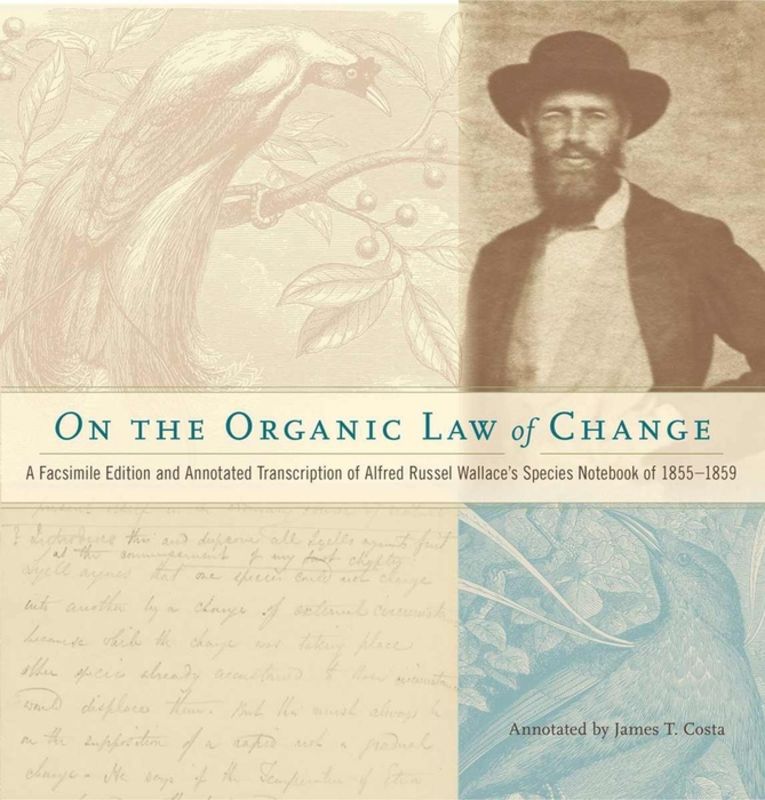
On the organic law of change : a facsimile edition and annotated transcription of Alfred Russel Wallace's Species notebook of 1855-1859
A giant of the discipline of biogeography and co-discoverer of natural selection, Alfred Russel Wallace was the most famous naturalist in the world when he died in 1913. To mark the centennial of Wallace's death, James Costa offers an elegant edition of the \"Species Notebook\" of 1855-1859, which Wallace kept during his legendary expedition in peninsular Malaysia, Indonesia, and western New Guinea. Presented in facsimile with text transcription and annotations, this never-before-published document provides a new window into the travels, personal trials, and scientific genius of the co-discoverer of natural selection.
In one section, headed \"Note for Organic Law of Change\"--an extended critique of geologist Charles Lyell's anti-evolutionary arguments--Wallace sketches a book he would never write, owing to the unexpected events of 1858. In that year he sent to Charles Darwin an essay announcing his discovery of the mechanism for species change: natural selection. Darwin's friends Lyell and the botanist Joseph Hooker proposed a \"delicate arrangement\": a joint reading at the Linnean Society of his essay with Darwin's earlier private writings on the subject. Darwin would publish On the Origin of Species in 1859, to much acclaim; pre-empted, Wallace's first book on evolution waited two decades, but by then he had abandoned his original concept.
On the Organic Law of Change realizes in spirit the project Wallace left unfinished, and asserts his stature as not only a founder of biogeography and the preeminent tropical biologist of his day but as Darwin's equal among the pioneers of evolution.
eBook

The Heretic in Darwin's Court
During their lifetimes, Alfred Russel Wallace and Charles Darwin shared credit and fame for the independent and near-simultaneous discovery of natural selection. Together, the two men spearheaded one of the greatest intellectual revolutions in modern history, and their rivalry, usually amicable but occasionally acrimonious, forged modern evolutionary theory. Yet today, few people today know much about Wallace. The Heretic in Darwin's Court explores the controversial life and scientific contributions of Alfred Russel Wallace—Victorian traveler, scientist, spiritualist, and co-discoverer with Charles Darwin of natural selection. After examining his early years, the biography turns to Wallace’s twelve years of often harrowing travels in the western and eastern tropics, which place him in the pantheon of the greatest explorer-naturalists of the nineteenth century. Tracing step-by-step his discovery of natural selection—a piece of scientific detective work as revolutionary in its implications as the discovery of the structure of DNA—the book then follows the remaining fifty years of Wallace’s eccentric and entertaining life. In addition to his divergence from Darwin on two fundamental issues—sexual selection and the origin of the human mind—he pursued topics that most scientific figures of his day conspicuously avoided, including spiritualism, phrenology, mesmerism, environmentalism, and life on Mars. Although there may be disagreement about his conclusions, Wallace’s intellectual investigations into the origins of life, consciousness, and the universe itself remain some of the most inspired scientific accomplishments in history. This authoritative biography casts new light on the life and work of Alfred Russel Wallace and the importance of his twenty-five-year relationship with Charles Darwin.
eBook

Natural Selection and Beyond
Alfred Russel Wallace was one of the nineteenth century's most potent intellectual forces. In this rich and varied collection, writers from a range of fields explore Wallace's work - and influence today - as biologist, collector, and a Victorian deeply engaged with the social, political, and philosophical issues of the age.
eBook


Wallace's Sphinx Moth: The Long-Tongued Insect Predicted by Darwin
\"[Charles] Darwin predicted that the orchid would be pollinated by a long-tongued moth, when naturalist Alfred Russel Wallace described the orchid in 1867, he said some of the larger species from the the Sphingidae family of moths (known as sphinx moths or hawk moths) had proboscises almost as long as the nectary of Angraecum sesquipedale. The two naturalists were proved right when such a long-tongued moth was found in Madagascar...More recently, the moth was determined to have the longest insect tongue.\" (Live Science) Learn more about Wallace's sphinx moth.
Newspaper Article