
Catalogue Search | MBRL


Are you sure you want to remove the book from the shelf?

{{itemTitle}}
3,448
result(s) for
"Walter Benjamin"
Sort by:

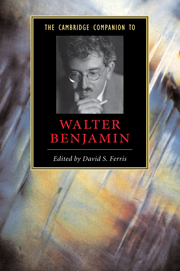
The Cambridge Companion to Walter Benjamin
This Companion offers a comprehensive introduction to the work and thought of the highly influential twentieth-century critic and theorist Walter Benjamin. The volume provides examinations of the different aspects of Benjamin's work that have had a significant effect on contemporary critical and historical thought. Topics discussed by experts in the field include Benjamin's relation to the avant-garde movements of his time, the form of the work of art, his theories on language and mimesis, modernity, his relation to Brecht and the Frankfurt School, his significance and relevance to modern cultural studies, his formative interpretation of Romanticism, and his autobiographical writings. The volume is aimed at readers who may be coming to Benjamin for the first time or who have some knowledge of Benjamin but would like to know more about the issues and concepts central to his work. Additional material includes a guide to further reading and a chronology.
eBook


Walter Benjamin and the Aesthetics of Film
This is the first monograph to thoroughly analyse Benjamin's film writings, contextualizing them within his oeuvre whilst also paying attention to the various films, actors, and directors that sparked his interest.
eBook


Benjamin's Library
In Benjamin’s Library, Jane O. Newman offers, for the first time in any language, a reading of Walter Benjamin’s notoriously opaque work, Origin of the German Tragic Drama that systematically attends to its place in discussions of the Baroque in Benjamin’s day. Taking into account the literary and cultural contexts of Benjamin’s work, Newman recovers Benjamin’s relationship to the ideologically loaded readings of the literature and political theory of the seventeenth-century Baroque that abounded in Germany during the political and economic crises of the Weimar years. To date, the significance of the Baroque for Origin of the German Tragic Drama has been glossed over by students of Benjamin, most of whom have neither read it in this context nor engaged with the often incongruous debates about the period that filled both academic and popular texts in the years leading up to and following World War I. Armed with extraordinary historical, bibliographical, philological, and orthographic research, Newman shows the extent to which Benjamin participated in these debates by reconstructing the literal and figurative history of sixteenth- and seventeenth-century books that Benjamin analyzes and the literary, art historical and art theoretical, and political theological discussions of the Baroque with which he was familiar. In so doing, she challenges the exceptionalist, even hagiographic, approaches that have become common in Benjamin studies. The result is a deeply learned book that will infuse much-needed life into the study of one of the most influential thinkers of the twentieth century.
eBook

Studying film with Andrâe Bazin
The impact of French film critic Andrâe Bazin (1918-1958) on the development of film studies, though generally acknowledged, remains contested. Although he was a passionate initiator of film culture during his lifetime, his ideas have been challenged, defended and revived throughout his afterlife. 'Studying Film with Andrâe Bazin' offers an entirely original interpretation of major concepts from Bazin's legacy, such as auteur theory, realism, film language and the influence of film on other arts (poetry and painting in particular). By examining mostly unknown and uncollected texts, Blandine Joret explains Bazin's methodology and adopts it in a contemporary reading, linking his ideas to major philosophical and scientific frameworks as well as more recent media practices such as advertising, CGI, 3D cinema and Virtual Reality. In tune with 21st-century concerns in media culture and film studies, this book addresses a wide readership of film scholars, students and cinephiles.
Book
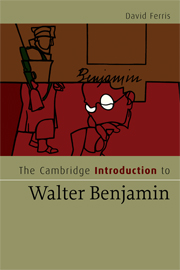
The Cambridge Introduction to Walter Benjamin
For students of modern criticism and theory, Walter Benjamin's writings have become essential reading. His analyses of photography, film, language, history, allegory, material culture, the poet Charles Baudelaire, and his vast examination of the social, political and historical significance of the Arcades of nineteenth-century Paris have left an enduring and important critical legacy. This volume examines in detail a substantial selection of his important critical writings on these topics from 1916 to 1940 and outlines his life in pre-war Germany, his association with the Frankfurt School, and the dissemination of his ideas and methodologies into a variety of academic disciplines since his death. David Ferris traces the development of Benjamin's key critical concepts and provides students with an accessible overview of the life, work and thought of one of the twentieth-century's most important literary and cultural critics.
eBook

Walter Benjamin : an introduction to his work and thought
\"Acknowledged only by a small circle of intellectuals during his lifetime, Benjamin is now a major figure whose work is essential to an understanding of modernity. Steiner traces the development of Benjamin's thought chronologically through his writings on philosophy, literature, history, politics, the media, art, photography, cinema, technology, and theology. Walter Benjamin reveals the essential coherence of its subject's thinking while also analyzing the controversial or puzzling facets of Benjamin's work. That coherence, Steiner contends, can best be appreciated by placing Benjamin in his proper context as a member of the German philosophical tradition and a participant in contemporary intellectual debates.\" \"As Benjamin's writing attracts more and more readers in the English-speaking world, Walter Benjamin will be a valuable guide to this fascinating body of work.\"--Jacket.
BOOK
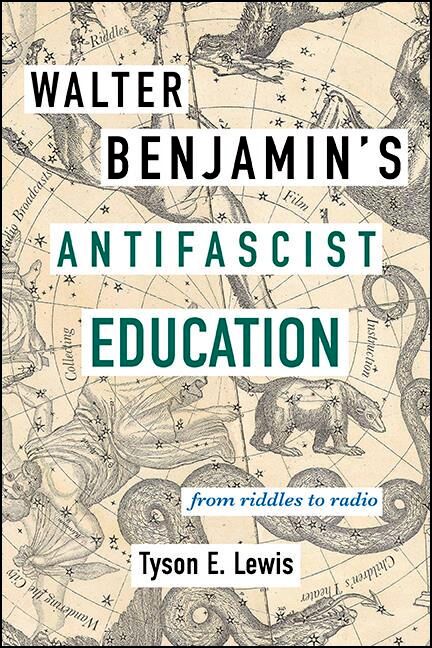
Walter Benjamin's Antifascist Education
\"Walter Benjamin's Antifascist Education is the first comprehensive analysis of educational themes across the entirety of the critical theorist's diverse writings. Starting with Benjamin's early reflections on teaching and learning, Tyson E. Lewis argues that the aesthetic and cultural forms to which Benjamin so often turned-namely, radio broadcasts, children's theatrical productions, collections, cityscapes, public cinemas, and word games-swell with educational potentialities. What emerges from Lewis's reading is a constellational curriculum composed of minor practices such as poor teaching, absentminded learning, and nondurational studying. This curriculum carries political significance, offering an antidote to past and present forms of fascist manipulation, hardness, and coldness. Walter Benjamin's Antifascist Education is a testimony to Benjamin's belief that \"everyone is an educator and everyone needs to be educated and everything is education.\"\"--.
eBook