
Catalogue Search | MBRL


Are you sure you want to remove the book from the shelf?

{{itemTitle}}
1,390
result(s) for
"War Forecasting."
Sort by:


Global Demographic Change and Its Implications for Military Power
What is the impact of demographics on the prospective production of military power and the causes of war? This monograph analyzes this issue by projecting working-age populations through 2050; assessing the influence of demographics on manpower, national income and expenditures, and human capital; and examining how changes in these factors may affect the ability of states to carry out military missions.
eBook


Getting to war
This book shows how to predict wars. More specifically, it tells us how to anticipate in a timely fashion the scope and extent of interstate conflict. By focusing on how all governments—democratic or not—seek to secure public support before undertaking risky moves such as starting a war, Getting to War provides a methodology for identifying a regime's intention to launch a conflict well in advance of the actual initiation. The goal here is the identification of leading indicators of war. Getting to War develops such a leading political indicator by a systematic examination of the ways in which governments influence domestic and international information flows. Regardless of the relative openness of the media system in question, we can accurately gauge the underlying intentions of those governments by a systematic analysis of opinion-leading articles in the mass media. This analysis allows us to predict both the likelihood of conflict and what form of conflict—military or diplomatic/economic—will occur. Theoretically, this book builds on a forty-year-old insight by Karl Deutsch—that all governments seek to mobilize public opinion through mass media and that careful analysis of such domestic media activity could provide an \"early warning network\" of international conflict. By showing how to tap the link between conflict initiation and public support, this book provides both a useful tool for understanding crisis behavior as well as new theoretical insights on how domestic politics help drive foreign policy. Getting to War will be of interest to political scientists who study international disputes and national security as well as social scientists interested in media studies and political communication. General readers with an interest in military or diplomatic history—particularly U.S. history—will find that Getting to War provides an entirely new perspective on how to understand wars and international crises.
eBook


America and the Future of War
Throughout the world today there are obvious trouble spots that have the potential to explode into serious conflicts at any time in the immediate or distant future.This study examines what history suggests about the future possibilities and characteristics of war and the place that thinking about conflict deserves in the formation of American.
eBook


War with Iran
War With Iran: Political, Military and Economic Consequences provides readers both a history of Iran’s relationship with the West and an expert’s estimation of what the political, human and financial costs of full-scale war with Iran might be. Authors Geoffrey Kemp and John Allen Gay of the Center for the National Interest utilize their years studying and informing America’s foreign policy in the Middle East to bring to life the possible outcomes of an American military intervention in Iran. Such a decision would not only have catastrophic consequences on the Persian Gulf, but would also endanger the whole world’s delicate economy by heightening instability in a fragile but resource-rich region. Written for anyone with an interest in the future of American foreign policy, War With Iran explores what every player has at stake in the current crisis by analyzing every tension adjacent to it; from America’s staunch support of Israel to Iran’s own dogged pursuit of advanced nuclear capabilities. Controversial, timely and thoroughly researched, this story stands as a preliminary caution against what would be a devastating meltdown of diplomacy, for which—if peace be the goal—there is always time.
eBook

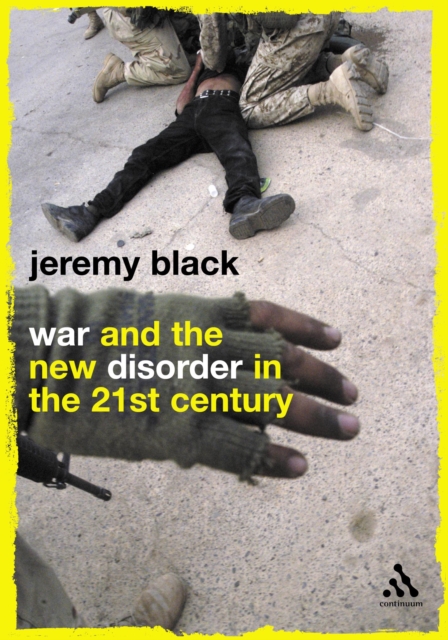
War and the new disorder in the 21st century
The second edition of Jeremy Black's War has been completely revised in the light of recent events in Iraq and Afghanistan. Jeremy Black's book prophetically explores the realities of war in a globalized world where growing prosperity can increase the likeliehood of conflict and American power is likely to be increasingly challenged. In his five new chapters Black conducts his argument in terms of New World Disorder, specifically the failure of Western models of globalisation to engage support. There is extensive discussion of military structures in the West, as they are `reconfigured` to take account of new political realities. Black considers that the USA is an `eccentric` military power and developments in the USA should not be treeated as a paradigm for those elsewhere. Instead, growing lawlessness accross much of the world will be the main factor for consideration, specifically in the failure to maintain order/control in Sub Saharan Africa, South Asia and Latin America.
eBook