
Catalogue Search | MBRL


Are you sure you want to remove the book from the shelf?

{{itemTitle}}
2,705
result(s) for
"War on Terror"
Sort by:

A war like no other : the Constitution in a time of terror
\"Owen Fiss has been a leading legal scholar for over thirty years, yet before 2001 it would have seemed unlikely for him to write about national security and the laws of war; his focus was civil procedure and equal protection, but when the War on Terror began to shroud legal proceedings in secrecy, he realized that the bulwarks of procedure that shield the individual from the awesome power of the state were dissolving, perhaps irreparably, and that it was time for him to speak up. The ten chapters in this volume cover the major legal battlefronts of the War on Terror from Guantánamo to drones, with a focus on the constitutional implications of those new tools. The underlying theme is Fiss's concern for the offense done to the U.S. Constitution by the administrative and legislative branches of government in the name of public safety and the refusal of the judiciary to hold the government accountable. A War Like No Other will be an essential intellectual foundation for all concerned about constitutional rights and the law in a new age. \"-- Provided by publisher.
Book

Border walls
Two decades after the fall of the Berlin Wall, why are the notable democracies of the United States, India, and Israel building massive walls and fences on their borders? Despite predictions of a borderless world through globalization, these three countries alone have built security barriers totaling an astonishing 5,700 kilometers in length. In this groundbreaking work, Reece Jones analyzes how these controversial walls were justified, their impact on those living behind them, and the long-term effects of the hardening of political boundaries. Border Walls is a bold, important intervention that demonstrates that the exclusion and violence necessary to secure the borders of the modern state often undermine the very ideals of freedom and democracy the barriers are meant to protect.
eBook

The Bin Laden Papers
An inside look at al-Qaeda from 9/11 to the death of its
founder-told through the words of Bin Laden and his closest
circle Usama Bin Laden's greatest fear was not capture or
death, but the exposure of al-Qaeda's secrets. At great risk to
themselves and the entire mission, the U.S. Special Operations
Forces, who carried out the Abbottabad raid that killed Bin Laden,
took an additional eighteen minutes to collect Bin Laden's hard
drives and thereby expose al-Qaeda's secrets. In this
ground-breaking book, Nelly Lahoud dives into Bin Laden's files and
meticulously distills the nearly 6,000 pages of Arabic private
communications. For the first time, al-Qaeda's closely guarded
secrets are laid bare, shattering misconceptions and revealing how
and what Bin Laden communicated with his associates, his plans for
future attacks, and al-Qaeda's hostility toward countries such as
Saudi Arabia, Iran, and Pakistan. Lahoud presents firsthand
accounts of al-Qaeda from 9/11 until the elimination of Bin Laden,
as told through his own words and those of his family and closest
associates.
eBook

America Unbound: The Bush Revolution in Foreign Policy
George W. Bush has launched a revolution in American foreign policy. He has redefined how America engages the world, shedding the constraints that friends, allies, and international institutions impose on its freedom of action. He has insisted that an America unbound is a more secure America. How did a man once mocked for knowing little about the world come to be a foreign policy revolutionary? In America Unbound, Ivo H. Daalder and James M. Lindsay dismiss claims that neoconservatives have captured the heart and mind of the president. They show that George W. Bush has been no one's puppet. He has been a strong and decisive leader with a coherent worldview that was evident even during the 2000 presidential campaign. Daalder and Lindsay caution that the Bush revolution comes with significant risks. Raw power alone is not enough to preserve and extend America's security and prosperity in the modern world. The United States often needs the help of others to meet the challenges it faces overseas. But Bush's revolutionary impulse has stirred great resentment abroad. At some point, Daalder and Lindsay warn, Bush could find that America's friends and allies refuse to follow his lead. America will then stand alone-a great power unable to achieve its most important goals.
eBook

The Discourse of Propaganda
In the early 1990s, false reports of Iraqi soldiers in Kuwait
allowing premature infants to die by removing them from their
incubators helped to justify the Persian Gulf War, just as spurious
reports of weapons of mass destruction later undergirded support
for the Iraq War in 2003. In The Discourse of Propaganda ,
John Oddo examines these and other such cases to show how
successful wartime propaganda functions as a discursive
process.
Oddo argues that propaganda is more than just misleading
rhetoric generated by one person or group; it is an elaborate
process that relies on recontextualization, ideally on a massive
scale, to keep it alive and effective. In a series of case studies,
he analyzes both textual and visual rhetoric as well as the social
and material conditions that allow them to circulate, tracing how
instances of propaganda are constructed, performed, and repeated in
diverse contexts, such as speeches, news reports, and popular,
everyday discourse.
By revealing the agents, (inter)texts, and cultural practices
involved in propaganda campaigns, The Discourse of
Propaganda shines much-needed light on the topic and
challenges its readers to consider the complicated processes that
allow propaganda to flourish. This book will appeal not only to
scholars of rhetoric and propaganda but also to those interested in
unfolding the machinations motivating America's recent military
interventions.
eBook

Ex Parte Milligan Reconsidered
At the very end of the Civil War, a military court convicted
Lambdin P. Milligan and his coconspirators in Indiana of fomenting
a general insurrection and sentenced them to hang. On appeal, in
Ex parte Milligan the US Supreme Court sided with the
conspirators, ruling that it was unconstitutional to try American
citizens in military tribunals when civilian courts were open and
functioning-as they were in Indiana. Far from being a relic of the
Civil War, the landmark 1866 decision has surprising relevance in
our day, as this volume makes clear. Cited in four Supreme Court
decisions arising from the wars in Afghanistan and Iraq, Ex
parte Milligan speaks to constitutional questions raised by
the war on terror; but more than that, the authors of Ex parte
Milligan Reconsidered contend, the case affords an
opportunity to reevaluate the history of wartime civil liberties
from the Civil War era to our own. After the Civil War, critics of
Reconstruction pointed to Milligan as an example of the
Republican Party's abuse of federal power; even historians
sympathetic to Lincoln have found it necessary to apologize for his
administration's record on civil liberties during the Civil War.
However, the authors of this volume argue that this distorts the
nineteenth-century understanding of the Bill of Rights, neglects
international law entirely, and, equally striking, ignores the
experience of African Americans. In reviving Milligan , the
Supreme Court has implicitly cast Reconstruction as a \"war on
terror\" in which terrorist insurgencies threatened and eventually
halted the assertion of black freedom by the Republican Party, the
Union Army, and African Americans themselves. Returning African
Americans to the center of the story, and recognizing that Lincoln
and Republicans were often forced to restrict white civil liberties
in order to establish black civil rights and liberties, Ex parte
Milligan Reconsidered suggests an entirely different
account of wartime civil liberties, one with profound implications
for US racial history and constitutional law in today's war on
terror.
eBook

American Global Strategy and the 'War on Terrorism'
Contemporary international events, and indeed even the US presidential election, demonstrate the continuing need for debate and discourse over the direction and emphases of US foreign policy. Following the success of the original hardback publication, this revised and updated paperback re-conceptualizes the 'war on terrorism' and analyzes the nature of American domestic and international policy-making within the context of historical and structural constraints upon US policy. American Global Strategy and the 'War on Terrorism' addresses a wide range of themes that are crucial to understanding the 9/11 crisis and to formulating an affective American and global foreign and security policy to deal with that crisis. This study should be read by contemporary policy makers and scholars of foreign policy.
eBook

9/11 and the War on Terror
This interdisciplinary study of how 9/11 and the ‘war on terror’ were represented during the Bush era, shows how culture often functioned as a vital resource, for citizens attempting to make sense of momentous historical events that frequently seemed beyond their influence or control. Illustrated throughout, the book discusses representation of 9/11 and the war on terror in Hollywood film, the 9/11 novel, mass media, visual art and photography, political discourse, and revisionist historical accounts of American ‘empire’, between the September 11 attacks and the Congressional midterm elections in 2006. As well as prompting an international security crisis, and a crisis in international governance and law, David Holloway suggests the culture of the time also points to a ‘crisis’ unfolding in the institutions and processes of republican democracy in the United States. His book offers a cultural and ideological history of the period, showing how culture was used by contemporaries to debate, legitimise, qualify, contest, or repress discussion, about the causes, consequences and broader meanings of 9/11 and the war on terror.
eBook

Biopolitics of the war on terror
This book overturns existing understandings of the origins and futures of the War on Terror for the purposes of International Relations theory. It demonstrates why this is not a war in defence of the integrity of human life, but a war over the political constitution of life in which the limitations of liberal accounts of humanity are a fundamental cause of the conflict. The question of the future of humanity is posed by this war, but only in the sense that its resolution depends on our abilities to move beyond the limits of dominant understandings of the human and its politics. Theorising with and beyond the works of Foucault, Deleuze, Baudrillard, Virilio and Negri, this book examines the possibilities for such a movement. What forms does human life take, it asks, when liberal understandings of humanity are no longer understood as horizons to strive for, but impositions against which the human must struggle in order to fulfil its destiny? What forms does the human assume when war against liberal regimes becomes the determining condition of its possibility? Answers to such questions are pressing, this book argues, if we earnestly desire an escape from the current impasses of international politics.
eBook
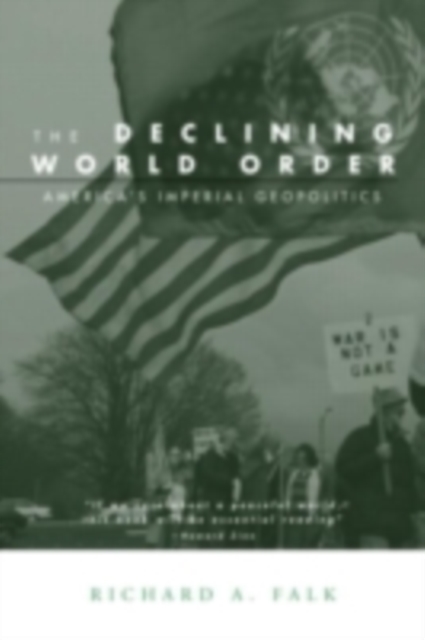
The Declining World Order
This work delineates the impact of terrorism--and the American response--on the basic structure of international relations, the dimming prospects for global reform and the tendency to override the role of sovereign territorial states. Falk examines the changing role of the state, the relevance of institutions, the role of individuals and the importance of the worldwide religious resurgence, with its positive and negative implications. He also considers the post-modern geopolitics of the Bush presidency, with its emphasis on the militarization of space, the control of oil in the Middle East, and its reliance on military capabilities so superior to that of other states as to make any challenge impractical.
eBook