
Catalogue Search | MBRL


Are you sure you want to remove the book from the shelf?

{{itemTitle}}
566
result(s) for
"Ward, Barbara"
Sort by:
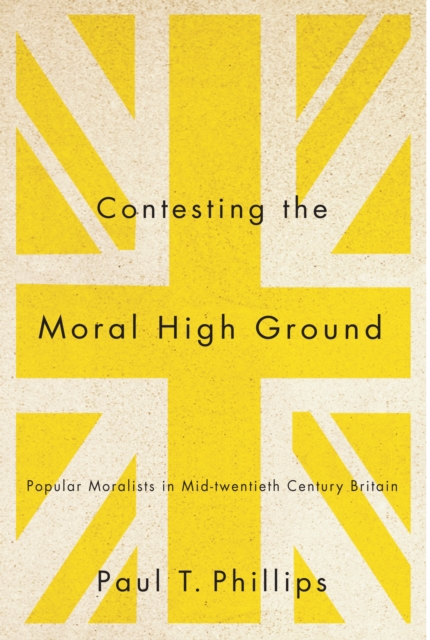
Contesting the Moral High Ground
In mid-twentieth century Britain, four intellectuals - Julian Huxley, Bertrand Russell, Malcolm Muggeridge, and Barbara Ward - held sway over popular conceptions of morality. While Huxley and Russell championed ideas informed by agnosticism and atheism, Muggeridge and Ward were adherents to Christianity. In Contesting the Moral High Ground, Paul Phillips reveals how this fundamental dichotomy was representative of British society at the time, and how many of the ideologies promoted by these four moralists are still present today. As world-class public figures in an open forum of debate, Huxley, Russell, Muggeridge, and Ward all achieved considerable public attention, particularly during the turbulent 1960s. Phillips captures the rebellious spirit of the time, detailing how these thinkers exploited the popular media to disseminate ideas on prevailing social issues - from justice and world peace to protection of the environment. Phillips skilfully traces the foundations of their thought to their earlier careers and social movements of previous generations, and shows how many of their approaches were adopted by a host of present-day groups from the Christian Right and Left to the New Atheists and environmentalists. A significant contribution to British intellectual history, Contesting the Moral High Ground provides new insights into the moral philosophies of four of Britain's most influential minds in the twentieth century.
eBook

Global Divisions: The Spatial Imagination of Barbara Ward
Abstract
The article examines the international thought of the British economist Barbara Ward (1914–1981) through her spatial imagination. It argues that Ward used categories such as East, West, North and South to discuss existing cleavages in world political and economic affairs. Through an examination of her political thought from the late 1930s to the late 1960s, the article shows how these spatial imaginaries were influenced by imperial and civilizational hierarchies. Moreover, the article argues that these divisions were, for her, a rhetorical tool to advance her vision of world unity, discussed through the notions of “spaceship earth” and “planetary community”. In her writings on economic growth and equality, Ward emphasized the importance of spirituality and ideas and identified the spiritual foundation of the proposed new planetary order with Christianity, a religious creed which supposedly provided a unifying universal morality. Ward’s work demonstrates both the promises and profound contradictions of planetary visions rooted in Western-centric moral frameworks. Her legacy invites critical reflection on how efforts to imagine planetary community can unwittingly reproduce the very inequalities they aim to overcome.
Journal Article

Eco-Development: Rethinking the Roots of Environmentalism in the Global South
In the fall of 1974, only a few months after the United Nations (UN) adopted the Declaration for the Establishment of a New International Economic Order (NIEO), a grouping of leading intellectuals from across the Global South converged in Mexico for the Cocoyoc Conference. Under the auspices of the UN, the collective issued the Cocoyoc Declaration—a radical manifesto intended to provide an environmental framework for the NIEO. In a period when oil shocks and limitations to extractivism forced leaders to rethink the very nature of international development, the Cocoyoc Declaration articulated a vision of eco-development for the Global South. An intellectual history of Cocoyoc challenges the prevailing historical narrative of a monolithic Global South reluctant to embrace environmental regulations. Instead, the Cocoyoc Conference represented a seminal gathering of experts from Latin America, Africa, and Asia who embraced environmental consciousness as a powerful source for rethinking and reforming international development. In its aftermath, Cocoyoc helped to legitimate and establish new academic centers dedicated to environmental research in Mexico. Archival research into the lives of economists Ignacy Sachs and Enrique Leff reveals the tensions bound up with environmentalism and development from the perspective of postcolonial nations.
Journal Article

The Lingering Impact of Colonization on Pakistan: Negative or Positive?
The British rule had a lasting Impact on the lives of the Indian people. They exploited the Indian territory for their own interests and left the land in more disorder and confusion than they found it in as (1) their attitude of superiority shattered the confidence of the people, (2) their agrarian revolution did not help improve yield and caused landholdings to become more fragmented, (3) the Indian industry was not protected and many traditional ones were ruined , (4) education was not made easily accessible , (5) construction of railways although improved transportation however was not done keeping the Indian interests but the British interests in mind and (6) the new political system which lacked personal element was not more effective than the old one. [PUBLICATION ABSTRACT]
Journal Article
CBS EVENING NEWS For December 8, 2025, CBS
Why do Waymo`s self-driving taxis keep blowing past stopped school buses? The financial risks of one popular type of senior living community are examined. After almost a year defined by fire, Altadena, California, is now ready to be seen in a different light. President Trump fires back at Marjorie Taylor Greene after the Republican congresswoman`s interview with 60 Minutes. What was found in Luigi Mangione`s bag that convinced the police he murdered the CEO of UnitedHealthcare? Paramount Skydance launches a hostile takeover bid for Warner Bros. Discovery topping $100 billion. Frosty weather hits the country.
Transcript

Nurturing a Culture of Self-restraint
illustration
Franck Amalric graduated from the Ecole Polytechnique and the Ensaé (National School of Statistics and Economic Administration) in France, and holds a PhD in economics from Harvard University. Franck was Programme Director at the Society for International Development in Rome during six years. In this function, he developed and managed numerous projects touching various aspects of sustainable development (sustainable livelihoods, food security, conflicts over access to natural resources, North-South relations). He then joined UBS in Switzerland (18 months) as Senior Economist, where he set up a strategy for the development of socially responsible investment products. Subsequently he was head of Research of the Centre for Corporate Responsibility and Sustainability linked with the University of Zurich. Back in France since 2005, he now works as a health economist.
Journal Article