
Catalogue Search | MBRL


Are you sure you want to remove the book from the shelf?

{{itemTitle}}
26
result(s) for
"Warsaw (Poland) Biography."
Sort by:


The House at Ujazdowskie 16
In a turn-of-the-century, once elegant building at 16 Ujazdowskie Avenue in the center of Warsaw, 10 Jewish families began reconstructing their lives after the Holocaust. While most surviving Polish Jews were making their homes in new countries, these families rebuilt on the rubble of the Polish capital and created new communities as they sought to distance themselves from the memory of a painful past. Based on interviews with family members, intensive research in archives, and the families' personal papers and correspondence, Karen Auerbach presents an engrossing story of loss and rebirth, political faith and disillusionment, and the persistence of Jewishness.
eBook

The doctors of the Warsaw Ghetto
\"Based on years of archival research, \"The Doctors of the Warsaw Ghetto\" is the most detailed study ever undertaken into the fate of more than 800 Jewish doctors who devoted themselves, in many cases until the day they died, to the care of the sick and the dying in the Ghetto. The functioning of the Ghetto hospitals, clinics and laboratories is explained in fascinating detail. Readers will learn about the ground-breaking research undertaken in the Ghetto as well as about the underground medical university that prepared hundreds of students for a career in medicine; a career that, in most cases, was to be cut brutally short within weeks of them completing their first year of studies\"-- Provided by publisher.
BOOK

Anna Braude-Heller, Seen From a Distance
Dr. Anna Braude-Heller, a pediatrician, worked for many years as director of the Bersohn and Bauman Hospital for Jewish children in Warsaw. She supervised this institution up to its last moments, remaining with her young charges until the final liquidation of the Warsaw Ghetto in spring 1943. This article attempts to present both her private life and her career as a consistent path of conscious decisions. It is based on different historical sources, from medical documentation (including her prewar medical articles), through interwar press detailing her activism and involvement in many philanthropic actions, and memoirs from and of the wartime period. One of the most important references is her article, written in the Warsaw Ghetto, concerning the effects of long-standing hunger among children in the hospital she directed.
Journal Article

A light in the darkness : Janusz Korczak, his orphans, and the Holocaust
\"From National Book Award finalist Albert Marrin comes the ... story of Janusz Korczak, the heroic Polish Jewish doctor who devoted his life to children, perishing with them in the Holocaust\"--Provided by publisher.
Book

What Time and Sadness Spared
Roma Ben-Atar resisted until late in life the urging of her family to share the memories of her Nazi-era experiences. The Holocaust exerted a dark pressure on all of their lives but was never openly discussed. It was only when her granddaughter insisted on hearing the whole truth, with a directness partly generational, that Mrs. Ben-Atar agreed to tell her story.
What Time and Sadness Sparedis a journey of both loss and endurance, moving with shocking speed from a carefree adolescence in upper-middle-class Warsaw to the horrors of the Final Solution. The young girl sees her neighborhood transformed into a ghetto populated by skeletal figures both alive and dead. Unbelievably, things only grow worse as this ruin gives way to the death factories of Majdanek and Auschwitz and the death marches of 1945. Life in the camps changes her in less than a day, as if \"the person in my body was a stranger I had never met.\" Her only consolation is to lie on her wooden bunk, no mattress, and speak to the soul of her mother, who, like virtually her entire family, had already been swept away. Roma must summon astonishing powers of adaptation simply to survive, bringing her finally through the wreckage of postwar Europe and to an entirely new life in Israel.
In this unique family collaboration Roma Ben-Atar's son Doron, a historian who brings with him fluency in psychoanalysis, contributes through his commentary an awareness of the difficulties presented by historical narrative and memory. A visitor to the much-changed sites in which his mother grew up and was interned by the Nazis, he also voices the perspective of the survivors' children and their ambivalence over being \"protected\" from this past. As the generation that endured the camps passes from this world, What Time and Sadness Spared illustrates with particular urgency the historical responsibilities of the survivors' descendants, who must become the new vessels for a story that will not remain alive on its own but demands our courage and curiosity.
eBook

What time and sadness spared : mother and son confront the Holocaust
As the generation that endured the camps passes from this world, What Time and Sadness Spared illustrates with particular urgency the historical responsibilities of the survivors' descendants, who must become the new vessels for a story that will not remain alive on its own but demands our courage and curiosity.
eBook
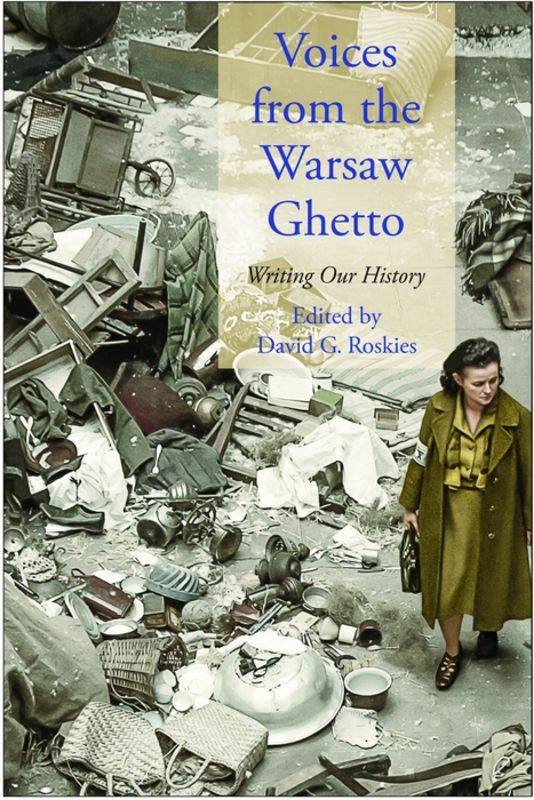
Voices from the Warsaw Ghetto
The powerful writings and art of Jews living in the Warsaw Ghetto
Hidden in metal containers and buried underground during World War II, these works from the Warsaw Ghetto record the Holocaust from the perspective of its first interpreters, the victims themselves. Gathered clandestinely by an underground ghetto collective called Oyneg Shabes, the collection of reportage, diaries, prose, artwork, poems, jokes, and sermons captures the heroism, tragedy, humor, and social dynamics of the ghetto. Miraculously surviving the devastation of war, this extraordinary archive encompasses a vast range of voices-young and old, men and women, the pious and the secular, optimists and pessimists-and chronicles different perspectives on the topics of the day while also preserving rapidly endangered cultural traditions. Described by David G. Roskies as \"a civilization responding to its own destruction,\" these texts tell the story of the Warsaw Ghetto in real time, against time, and for all time.
eBook

Memory is our Home
Memory is Our Home' is a powerful biographical memoir based on the diaries of Roma Talasiewicz-Eibuszyc, who grew up in Warsaw before and during World War I and who, after escaping the atrocities of World War II, was able to survive in the vast territories of Soviet Russia and Uzbekistan.Translated by her own daughter, interweaving her own recollections as her family made a new life in the shadows of the Holocaust in Communist Poland after the war and into the late 1960s, this book is a rich, living document, a riveting account of a vibrant young woman's courage and endurance.A forty-year recollection of love and loss, of hopes and dreams for a better world, it provides richly-textured accounts of the physical and emotional lives of Jews in Warsaw and of survival during World War II throughout Russia. This book, narrated in a compelling, unique voice through two generations, is the proverbial candle needed to keep memory alive.
eBook

Brush with Death, A
Recounts the author’s experiences during the Holocaust, from the time of the Nazi invasion of Poland to the liberation of the Theresienstadt concentration camp by the Red Army in 1945. In this memoir Morris Wyszogrod recounts his experiences from the time of the Nazi invasion of Poland to the liberation of the Theresienstadt concentration camp in 1945. He describes in detail the time he spent in the Warsaw Ghetto; his work as an artist for various Luftwaffe personnel at the Warsaw military airport; his experiences at the BudzynŒ concentration camp, where he was assigned to decorate the living quarters of the SS and to produce drawings at an orgiastic Oktoberfest; his removal to PÂaszoŒw, where he was put to work digging up mass graves and burning the bodies to eliminate the evidence of Nazi war crimes; his witnessing of the firebombing of Dresden in February 1945; and his subsequent liberation at Theresienstadt by the Red Army in May 1945. Just as an artist may register what she or he sees against a sensitive visual and moral template, so Wyszogrod doubly registered what he saw and felt, both in his drawings and in his memories.
eBook