
Catalogue Search | MBRL


Are you sure you want to remove the book from the shelf?

{{itemTitle}}
117
result(s) for
"Warsaw Ghetto"
Sort by:

Violent Space
For Nazi Germany, the ghetto was a conceptual tool used to
facilitate social and political exclusion and further their
anti-Jewish campaign. For the Jews who lived in them, the ghettos
became the center of their lives-even though they were also sites
of immense suffering.
Combining thorough historical research with an interdisciplinary
analysis of the relationship between space and violence,
Violent Space provides a unique insight into the history
and the socio-spatial topography of the Jewish ghetto in
German-occupied Warsaw (1939-1943). Using rare archival materials
and firsthand accounts, many of which have never been translated
into English, Anja Nowak traces out the trauma that the space of
the ghetto inflicted on its Jewish inhabitants, and how it
alienated, disoriented, and harmed them.
While the physical ghetto-its buildings, boundaries, and
streets-has been reabsorbed and redefined by modern-day Warsaw's
urban structure, Violent Space shows us that its presence
still lingers in the narratives of those who were forced into this
first phase of the Holocaust.
eBook

A Struggle Unparalleled in Human History
Rather, they died as part of a broader struggle for Jewish survival, and for human freedom and dignity. [...]by linking the partisans’ fight to the struggle for human liberty, survivors sought acceptance into American life, likening their cause to that of all Americans. [...]its Yiddish publications were principally concerned with events that had transpired in Poland and Lithuania, and in commemorating figures that loomed large in the Bundist collective memory, such as Warsaw Ghetto fighters Michal (Mikhl) Klepfisz and Abrasha Blum, and particularly the Bundist representative in the Polish Government-in-Exile, Shmuel Artur Zygielboym.11 The centrality of the uprising in the survivors’ collective memory is made clear in a pamphlet published by the Katsetler Farband in 1952 that argued that Jews the world over should unite in establishing April 19 as the annual Holocaust memorial date. To this end, it also made sure that its memorial evenings would take place on Sunday. Because WAGRO was concerned with unity among survivors and Jews, and was nominally non-political, it made sense that it would follow the lead of the Israel memorial authority.45 Moreover, despite its ostensibly apolitical nature, WAGRO inclined toward Zionism, in contrast with the Bundist-leaning Katsetler Farband. The rituals, symbols, and language developed around the Warsaw Ghetto Uprising would stick, as American society at large continued to remember the destruction of European Jewry. [...]recently, the general assumption that underpinned historical writing on Holocaust memory in the United States was that survivors overwhelmingly kept quiet about their experiences, as American Jews were not interested in hearing the difficult stories.
Journal Article

“Don’t Give Up Your Ration Card”: Beggars, Noise, and the Purpose of Music in the Warsaw Ghetto
From its 1940 establishment to the Great Deportation of 1942, accounts from the Warsaw Ghetto testify to the misery of beggars within its walls, who drew attention to their plight using songs, cries, shouts, and other sounds. Diaries, reports, and song texts from the ghetto, alongside memoirs and testimonies, reveal beggars’ struggles—as well as non-beggars’ often hostile reactions to their songs and other sounds. Drawing on scholarship in sensory history and cultural histories of the Holocaust, this article reveals that these reactions perpetuated established critiques of shund (artistic “trash”) and tapped into longstanding anxieties about the Jewish community’s status as modern, civilized, and European. However, certain beggars’ songs overcame listeners’ hostility by directly confronting inequality and ghetto authorities’ abuses of power. Beggars and their music were intrinsic to the Warsaw Ghetto’s soundscape, and the debates they engendered reveal how Polish Jews imagined their community’s future, even amid its destruction .
Journal Article
Propaganda in the Best and Purest Sense of the Word
[...]this essay contributes to previous discussions of the Americanization of the Holocaust, a term used to denote the persistence, appropriation, and transformation of the Holocaust in American culture. First lauded by Jews, for Jews, in multiple publications, the uprising was eventually lionized for a broader American audience. First Chaim dies smiling and then Dovid quietly passes. By the end, Wishengrad had conveyed that the Jewish dead were suffering martyrs who died by fire, but had beforehand risen to the occasion and should be celebrated; for example, they offered spiritual resistance, “stood their ground,” and “vindicated their birthright” (33). [...]they were Jews with guns” (45), emphasized with an exclamation point in the script, which demonstrated that Jews were in fact willing to fight when supplied with weapons, a counter to stereotypes of weak, bookish Jews who shy from battle, uttered by Zelbel in The Second Battle of the Warsaw Ghetto.
Journal Article

Holy Week
At the height of the Nazi extermination campaign in the Warsaw Ghetto, a young Jewish woman, Irena, seeks the protection of her former lover, a young architect, Jan Malecki. By taking her in, he puts his own life and the safety of his family at risk. Over a four-day period, Tuesday through Friday of Holy Week 1943, as Irena becomes increasingly traumatized by her situation, Malecki questions his decision to shelter Irena in the apartment where Malecki, his pregnant wife, and his younger brother reside. Added to his dilemma is the broader context of Poles' attitudes toward the \"Jewish question\" and the plight of the Jews locked in the ghetto during the final moments of its existence.
Few fictional works dealing with the war have been written so close in time to the events that inspired them. No other Polish novel treats the range of Polish attitudes toward the Jews with such unflinching honesty.
Jerzy Andrzejewski's Holy Week ( Wielki Tydzien, 1945), one of the significant literary works to be published immediately following the Second World War, now appears in English for the first time.
This translation of Andrzejewski's Holy Week began as a group project in an advanced Polish language course at the University of Pittsburgh. Class members Daniel M. Pennell, Anna M. Poukish, and Matthew J. Russin contributed to the translation; the instructor, Oscar E. Swan, was responsible for the overall accuracy and stylistic unity of the translation as well as for the biographical and critical notes and essays.
eBook
The Jewish Heroes of Warsaw
[...]at the conclusion of his lecture, Mendelsohn spoke of the Jewish Fighting Organization that “led the struggle.” According to Berman, Zuckerman, and Guzik, the Jewish National Committee was composed of various Zionist parties and youth movements, including “General Zionist, Poale Zion Right, Poale Zion Left, Hechalutz, Hashomer Hazair, Dror, Akiba, and Gordonia.” The actual starting date of the uprising (14th of Nisan) was problematic as it was also the eve of Passover. [...]the 27th of Nisan, when the uprising was still taking place, was selected by the Knesset, to take place eight days before Israel’s Independence Day (on the 5th of Iyyar). “First Anniversary of Battle of Warsaw Ghetto Commemorated; State Dept.
Journal Article
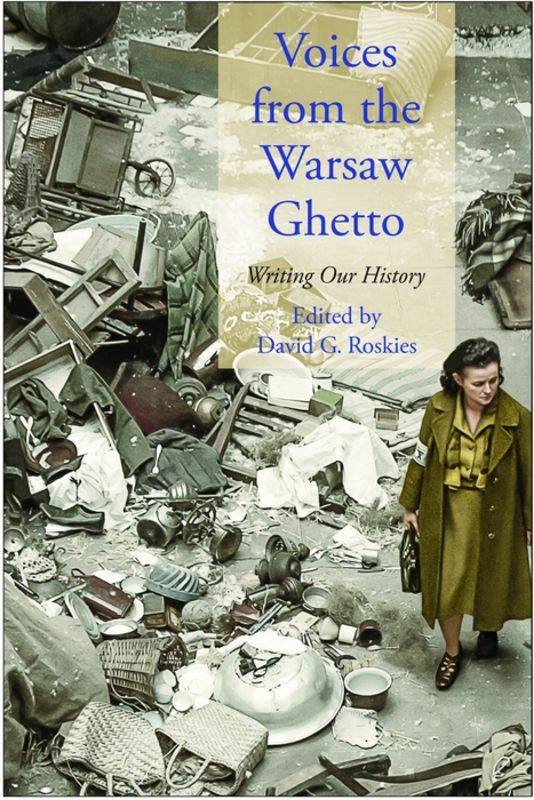
Voices from the Warsaw Ghetto
The powerful writings and art of Jews living in the Warsaw Ghetto
Hidden in metal containers and buried underground during World War II, these works from the Warsaw Ghetto record the Holocaust from the perspective of its first interpreters, the victims themselves. Gathered clandestinely by an underground ghetto collective called Oyneg Shabes, the collection of reportage, diaries, prose, artwork, poems, jokes, and sermons captures the heroism, tragedy, humor, and social dynamics of the ghetto. Miraculously surviving the devastation of war, this extraordinary archive encompasses a vast range of voices-young and old, men and women, the pious and the secular, optimists and pessimists-and chronicles different perspectives on the topics of the day while also preserving rapidly endangered cultural traditions. Described by David G. Roskies as \"a civilization responding to its own destruction,\" these texts tell the story of the Warsaw Ghetto in real time, against time, and for all time.
eBook

Marek Edelman's Bundist Humanitarianism: Theme and Variations from the Warsaw Uprising to Solidarity
This article discusses the multivalent identities of Dr. Marek Edelman—the last surviving commandant of the Warsaw Ghetto Uprising and its only leader to remain in Poland after the war. Imbued with the values of the Bund, especially its insistence on the primacy of human dignity, Edelman continued living by the Bundist ethos, pursuing his medical work and humanitarian activities, eventually translating this ethos into the values of Polish anti-communist dissidents embodied by the Solidarity movement. Based on multiple primary sources, this essay analyzes key aspects of Edelman's performed identities, such as his concept of patriotism (originating in the concept of doikayt or here and now ), his reinterpretations of the particular vs. universal significance of the Warsaw Ghetto Uprising, his contextualization and minimization of antisemitism in Poland, and his contentious and demonstrative relation to religion. It traces the development of these self-expressions within shifting political exigencies and implied expectations of Polish audiences for whom Edelman became a symbol of the Polish insurrectionary tradition. While Edelman's social and political activism was deeply rooted in his Bundist formation, he was also not immune from modifying his expressions of identity and his (re-)interpretations of historical events in the direction of more patriotic, \"Polish\" narratives that resonated with the Solidarity movement activists, who formed Edelman's milieu in his later life.
Journal Article
Writing Hunger in a Modernist Key in the Warsaw Ghetto: Leyb Goldin's “Chronicle of a Single Day”
This article elaborates a close reading of Leyb Goldin's “Chronicle of a Single Day” (Khronik fun a mes-les), an experimental and densely intertextual autobiographical text written in the Warsaw ghetto in August 1941 and preserved in Emanuel Ringelblum's Oyneg Shabes archive. Goldin's text self-consciously sifts the resources of European literature—and above all of modernist prose—in search of models for interpreting and articulating the extreme experience of the ghetto. By using the resources of Jewish and European literature as a lens through which to interpret the related experiences of human consciousness at its breaking point precipitated by starvation and of radical exclusion from the cosmopolitan cultural community that many eastern European Jews had embraced, Goldin's text highlights the importance of attending to the literary dimension of Holocaust literature rather than approaching it merely as empirical documentation. This reading of Goldin aims to underscore the historical importance of Holocaust literature as literature, that is, how literary reading can afford a fuller and more complex appreciation of the ways Holocaust victims interpreted and lent meanings to their experiences.
Journal Article
The Warsaw Ghetto Uprising at Nuremberg
[...]although Walsh gestured acknowledgment of Jewish “resistance,” the American prosecutor offered no details of the formation, motivations, or operational tactics of the Jewish Fighting Organization, which organized the revolt, and no profile of its members, and not one of the surviving Jewish fighters was summoned to the witness stand to testify. According to our theory, these killings must be tied up with previous stages of the crime, constituting the last link in a chain of criminal acts of the conspiracy to destroy the Jewish people.” Polish prosecutors put three key actors in the Jewish revolt, including the iconic Marek Edelman, on the witness stand, where they offered compelling testimony about the suffering of the ghetto’s inhabitants as well as the heroism of Jewish fighters. [...]both Justice Robert H. Jackson, chief counsel of the American prosecution, in his opening address, and Major William F. Walsh, in his presentation of “the Jewish case,” alluded to Jewish “resistance” in open court at Nuremberg.
Journal Article