
Catalogue Search | MBRL


Are you sure you want to remove the book from the shelf?

{{itemTitle}}
70,416
result(s) for
"Water Environmental aspects."
Sort by:

Save water every day
Introduces the concept of the Earth's water cycle, explains how we use water, and offers ways kids can help conserve it.
Book
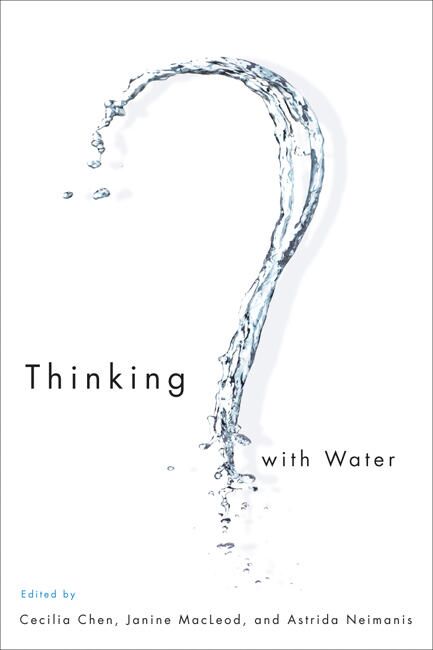
Thinking with Water
As a life-giving but also potentially destructive substance, water occupies a prominent place in the imagination. At the same time, water issues are among the most troubling ecological and social concerns of our time. Water is often studied only as a \"resource,\" a quantifiable and instrumentalized substance. Thinking with Water instead invites readers to consider how water - with its potent symbolic power, its familiarity, and its unique physical and chemical properties - is a lively collaborator in our ways of knowing and acting. What emerges is both a rich opportunity to encourage more thoughtful environmental engagement and a challenge to common oppositions between nature and culture. Drawing from a pool of contributors with diverse backgrounds, Thinking with Water presents the work of critics, scholars, artists, and poets in an invitation to pay more attention to the aqueous aspects of our lives. Contributors include: Ælab (Gisèle Trudel, UQÀM and Stéphane Claude, Oboro), Stacy Alaimo (University of Texas at Arlington), Andrew Biro (Acadia University), Mielle Chandler (York University), Cecilia Chen (Concordia University), Dorothy Christian (University of British Columbia), Adam Dickinson (poet, Brock University), Max Haiven (Nova Scotia College of Art and Design), Janine MacLeod (York University), Daphne Marlatt (poet, British Columbia), Don McKay (poet, Newfoundland), Emily Rose Michaud (Artist, Wakefield, Qc.), Astrida Neimanis (Linköping University), Sarah Renshaw (artist, Rhode Island), Shirley Roburn (Concordia University), Melanie Siebert (poet, University of Victoria), Jennifer B. Spiegel (Concordia University), Veronica Strang (Durham, UK), Rae Staseson (Concordia University), Rita Wong (Emily Carr University of Art and Design), and Peter C. van Wyck (Concordia University).
eBook

Tapping the oceans : seawater desalination and the political ecology of water
Tapping the Oceans provides a detailed analysis of the political and ecological debates facing water desalination in the twenty-first century. Water supplies for cities around the world are undergoing profound geographical, technological and political transformations. Increasingly, water-stressed cities are looking to the oceans to fix unreliable, contested and over-burdened water supply systems. Yet the use of emerging desalination technologies is accompanied by intense debates on their economic cost, governance, environmental impact and poses wider questions for the sustainable and just provision of urban water. Through a series of cutting-edge case studies and multi-subject approaches, this book explores the perspectives, disputes and politics surrounding water desalination on a broad geographical scale. As the first book of its kind, this unique work will appeal to those researching water and infrastructure issues in the fields of political ecology, geography, environmental science and sustainability. Industry and water managers who wish to understand the political debates around desalination technology more fully will also find this an informative read.
Book

Environmental flows
Environmental Flows describes the timing, quality, and quantity of water flows required to sustain freshwater and estuarine ecosystems and the human well-being and livelihoods that depend upon them. It answers crucial questions about the flow of water within and between different kinds of ecosystems. What happens when the flow or the availability of water is curtailed or diverted, either naturally or by human activity? How will climate change alter the availability of water and impact aquatic ecosystems? Methodological developments from the simplest hydrological formulas to large-scale frameworks that inform water management make this book a must-read for water managers and freshwater and estuarine ecologists contending with ever-changing conditions influencing the flow of water.
eBook

Water : exploring the blue planet
\"This book provides insight into water and creates a more profound understanding of the current water predicament. It focuses on the health of our planet surrounding water and uses technologically advanced sytems to reveal the damage and destruction brought on by humans. Focus is put on our attempts to control water and our reckless actions that threaten water availability.\"-- Provided by publisher.
Book
The Indus Basin of Pakistan
This study, Indus basin of Pakistan: the impacts of climate risks on water and agriculture was undertaken at a pivotal time in the region. The weak summer monsoon in 2009 created drought conditions throughout the country. This followed an already tenuous situation for many rural households faced with high fuel and fertilizer costs and the impacts of rising global food prices. Then catastrophic monsoon flooding in 2010 affected over 20 million people, devastating their housing, infrastructure, and crops. Damages from this single flood event were estimated at US dollar 10 billion, half of which were losses in the agriculture sector. Notwithstanding the debate as to whether these observed extremes are evidence of climate change, an investigation is needed regarding the extent to which the country is resilient to these shocks. It is thus timely, if not critical, to focus on climate risks for water, agriculture, and food security in the Indus basin of Pakistan.
eBook

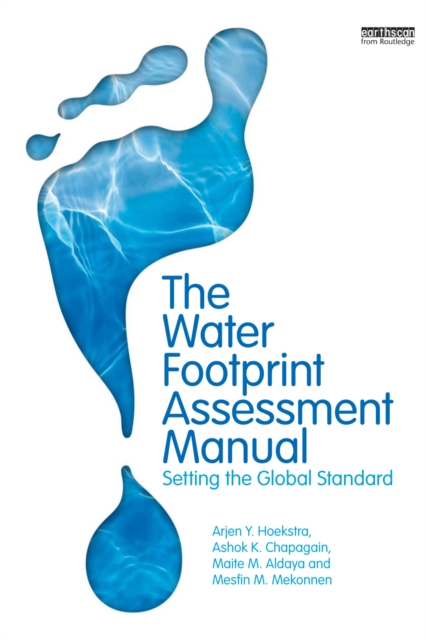
water footprint assessment manual
People use lots of water for drinking, cooking and washing, but significantly more for producing things such as food, paper and cotton clothes. The water footprint is an indicator of water use that looks at both direct and indirect water use of a consumer or producer. Indirect use refers to the 'virtual water' embedded in tradable goods and commodities, such as cereals, sugar or cotton. The water footprint of an individual, community or business is defined as the total volume of freshwater that is used to produce the goods and services consumed by the individual or community or produced by the business.
This book offers a complete and up-to-date overview of the global standard on water footprint assessment as developed by the Water Footprint Network. More specifically it:
Provides a comprehensive set of methods for water footprint assessment
Shows how water footprints can be calculated for individual processes and products, as well as for consumers, nations and businesses
Contains detailed worked examples of how to calculate green, blue and grey water footprints
Describes how to assess the sustainability of the aggregated water footprint within a river basin or the water footprint of a specific product
Includes an extensive library of possible measures that can contribute to water footprint reduction
eBook

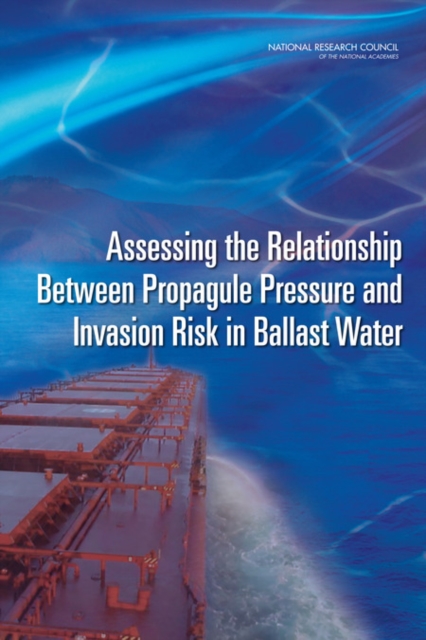
Assessing the Relationship Between Propagule Pressure and Invasion Risk in Ballast Water
The human-mediated introduction of species to regions of the world they could never reach by natural means has had great impacts on the environment, the economy, and society. In the ocean, these invasions have long been mediated by the uptake and subsequent release of ballast water in ocean-going vessels. Increasing world trade and a concomitantly growing global shipping fleet composed of larger and faster vessels, combined with a series of prominent ballast-mediated invasions over the past two decades, have prompted active national and international interest in ballast water management.
Assessing the Relationship Between Propagule Pressure and Invasion Risk in Ballast Water informs the regulation of ballast water by helping the Environnmental Protection Agency (EPA) and the U.S. Coast Guard (USCG) better understand the relationship between the concentration of living organisms in ballast water discharges and the probability of nonindigenous organisms successfully establishing populations in U.S. waters. The report evaluates the risk-release relationship in the context of differing environmental and ecological conditions,including estuarine and freshwater systems as well as the waters of the three-mile territorial sea. It recommends how various approaches can be used by regulatory agencies to best inform risk management decisions on the allowable concentrations of living organisms in discharged ballast water in order to safeguard against the establishment of new aquatic nonindigenous species, and to protect and preserve existing indigenous populations of fish, shellfish, and wildlife and other beneficial uses of the nation's waters.
Assessing the Relationship Between Propagule Pressure and Invasion Risk in Ballast Water provides valuable information that can be used by federal agencies, such as the EPA, policy makers, environmental scientists, and researchers.
eBook