
Catalogue Search | MBRL


Are you sure you want to remove the book from the shelf?

{{itemTitle}}
3,732
result(s) for
"Water resources development Case studies."
Sort by:

America's fight over water
This book inquires into the relations between society and its natural environment by examining the historical discourse around several cases of state building in the American West: the construction of three high dams from 1928 to 1963.
Part One: Departures 1. Introduction 2. Political and Environmental Sociology: The Möbias Strip of Society and Nature 3. Water in the American West Part Two: Investigations 4. In the Beginning There was Boulder: A Natural Menace Becomes a Natural Resource 5. Grand Coulee: 'Mightiest Thing Ever Built by Man' 6. Glen Canyon: Last of the High Dams 7. Conclusion: Toward an Arrival. Maps. References.
Kevin Wehr is Assistant Professor in the Department of Sociology at the California State University, Sacramento.
eBook

Water management and public participation : case studies from the Yamuna River Basin, India
Integrated Water Resources Management (IWRM) is an approach that promotes the coordinated development and management of water, land and related resources, in order to maximize economic and social welfare in an equitable manner without compromising the sustainability of vital ecosystems. Without public interest and participation, successful implementation of IWRM plans for river basin cannot be possible. Further to this, management at the watershed level to assure water supplies to support livelihood (i.e. domestic water, irrigation, industries, etc.) and sustainable groundwater development requires water augmentation through water conservation structures, and pollution control will also play a vital role. In India, because of limited period of rainfall during Monsoon (i.e. three to four months), water conservation and rainwater harvesting have been practiced since ancient days in order to meet water demands throughout the year. These structures are generally constructed and operated through the public participation. Keeping in view of the importance of public partnership, the role of public partnership in context of water-related awareness and practices has been investigated in different parts of the Yamuna River basin. The investigation evaluates the impact of various water conservation devices on livelihood; compares the performance of recently developed water conservation structures with ancient structures; examines spatial variation of water-related problems in the basin; and proposes an institutional setup for effective governance.
Book
Involuntary Resettlement
Among development assistance agencies, the World Bank has led the way in policies to mitigate the impact of large-scale engineering projects on local populations, particularly in the building of dams.
eBook

Out of the mainstream : water rights, politics and identity
\"Water is not only a source of life and culture. It is also a source of power, conflicting interests and identity battles. Rights to materially access, culturally organize and politically control water resources are poorly understood by mainstream scientific approaches and hardly addressed by current normative frameworks. These issues become even more challenging when law and policy-makers and dominant power groups try to grasp, contain and handle them in multicultural societies. The struggles over the uses, meanings and appropriation of water are especially well-illustrated in Andean communities and local water systems of Peru, Chile, Ecuador, and Bolivia, as well as in Native American communities in south-western USA. The problem is that throughout history, these nation-states have attempted to 'civilize' and bring into the mainstream the different cultures and peoples within their borders instead of understanding 'context' and harnessing the strengths and potentials of diversity. This book examines the multi-scale struggles for cultural justice and socio-economic re-distribution that arise as Latin American communities and user federations seek access to water resources and decision-making power regarding their control and management. It is set in the dynamic context of unequal, globalizing power relations, politics of scale and identity, environmental encroachment and the increasing presence of extractive industries that are creating additional pressures on local livelihoods. While much of the focus of the book is on the Andean Region, a number of comparative chapters are also included. These address issues such as water rights and defence strategies in neighbouring countries and those of Native American people in the southern USA, as well as state reform and multi-culturalism across Latin and Native America and the use of international standards in struggles for indigenous water rights. This book shows that, against all odds, people are actively contesting neoliberal globalization and water power plays. In doing so, they construct new, hybrid water rights systems, livelihoods, cultures and hydro-political networks, and dynamically challenge the mainstream powers and politics.\"--Publisher's description.
Book

River basin trajectories: societies, environments and development
Using a variety of case studies, this book provides an overview of how societies have gradually developed their water resources and furthers our understanding of how such resources can be managed successfully or unsuccessfully. Discussing how and why particular options are selected, and why a particular course of events eventually prevails, the book stresses the importance of context and a multidisciplinary approach in moving towards sustainable and equitable development.
eBook

Water policy for sustainable development
The shortage of fresh water is likely to be one of the most pressing issues of the twenty-first century. A UNESCO report predicts that as many as 7 billion people will face shortages of drinking water by 2050. Here, David Lewis Feldman examines river-basin management cases around the world to show how fresh water can be managed to sustain economic development while protecting the environment. He argues that policy makers can employ adaptive management to avoid making decisions that could harm the environment, to recognize and correct mistakes, and to monitor environmental and socioeconomic changes caused by previous policies.
To demonstrate how adaptive management can work, Feldman applies it to the Delaware, Susquehanna, Apalachicola-Chattahoochee-Flint, Sacramento–San Joaquin, and Columbia river basins. He assesses the impacts of runoff pollution and climate change, the environmental-justice aspects of water management, and the prospects for sustainable fresh water management. Case studies of the Murray-Darling basin in Australia, the Rhine and Danube in Europe, the Zambezi in Africa, and the Rio de la Plata in South America reveal the impediments to, and opportunities for, adaptive management on a global scale.
Feldman's comprehensive investigation and practical analysis bring new insight into the global and political challenges of preserving and managing one of the planet's most important resources.
eBook
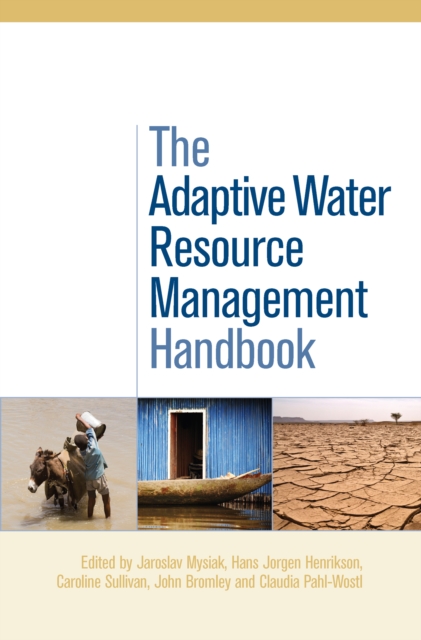
adaptive water resource management handbook
The complexity of current water resource management poses many challenges. Water managers need to solve a range of interrelated water dilemmas, such as balancing water quantity and quality, flooding, drought, maintaining biodiversity and ecological functions and services, in a context where human beliefs, actions and values play a central role. Furthermore, the growing uncertainties of global climate change and the long term implications of management actions make the problems even more difficult.
This book explains the benefits, outcomes and lessons learned from adaptive water management (AWM). In essence AWM is a way of responding to uncertainty by designing policy measures which are provisional and incremental, subject to subsequent modification in response to environmental change and other variables. Included are illustrative case studies from seven river basins from across Europe, West Asia and Africa: the Elbe, Rhine, Guadiana, Tisza, Orange, Nile and Amudarya. These exemplify the key challenges of adaptive water management, especially when rivers cross national boundaries, creating additional problems of governance.
eBook

Inter-Basin Water Transfer
Increasing demands for irrigation, domestic and industrial water have generated a massive growth world-wide in the number of large water infrastructure projects involving the transfer of water from basins considered to have surplus water to those where the demand for water has exceeded or is expected to exceed supplies. Using the experiences of projects in Australia, United States, Canada, China and India, this book examines case studies within the diverse geographical, climatic, economic, and policy regimes operating in these countries. It examines the water resources of Australia, the driest inhabited continent, and explores inter-basin water transfer projects in the United States, Canada, China and India, examining their benefits and impacts within these nations' contrasting economies and governance systems. This comprehensive and well-illustrated text will be of great interest to professionals and researchers in the fields of hydrology, water resources, and to those engaged in environmental science, policy and regulation.
eBook

The Multi-Governance of Water
As the governance of transboundary rivers becomes a subject of growing importance due to the increasing pressure on freshwater resources, this timely collection examines water scarcity and efforts to better manage rivers and river basins. Most specialists agree that states face many institutional inadequacies when dealing with shared resources and that new governance mechanisms are needed to improve water management. Using case studies of the Aral Sea basin and the Danube, Euphrates, and Mekong river basins, the contributors develop a new approach to water governance: the concept of multi-governance, an effort to collectively solve public problems by involving a series of relevant actors from the local to the global level, such as institutions, states, civil society, and business.
eBook