
Catalogue Search | MBRL


Are you sure you want to remove the book from the shelf?

{{itemTitle}}
56,243
result(s) for
"Water rights"
Sort by:
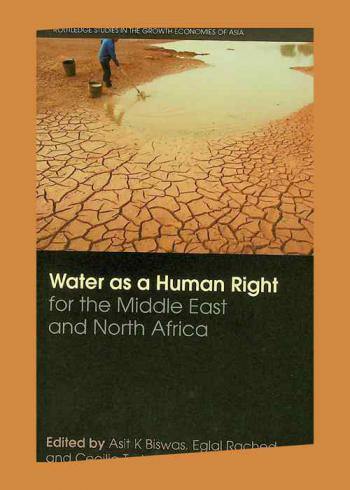
Water as a human right for the Middle East and North Africa
This text systematically and comprehensively analyzes the legal development of the concept of water as a human right and its implications for the national governments, as well as the impact of the implementation of this concept for international and national organizations.
Book

An improved pricing scheme for water rights trading based on the eBay auction model
【Objective】Water rights trading and the associated pricing mechanism are innovative strategies to enhance water use efficiency in regions facing freshwater scarcity. It is crucial to explore an effective pricing mechanism for water rights trading to stimulate market dynamics and foster intrinsic motivations for water conservation. This paper proposes a solution to address this issue.【Method】We proposed an innovative pricing mechanism and a specific algorithm for determining transaction prices, based on a second-price auction, with modifications inspired by eBay’s auction model. A numerical simulation was conducted using the Hetao Irrigation District in Inner Mongolia as a case study. Three auction participants were selected to simulate the bidding process, and their bidding strategies and price-setting behaviors were analyzed.【Result】The Phase I water rights trading project in the Hetao Irrigation District suffers from issues such as low transaction prices and insufficient compensation for stakeholders, due to the lack of a robust market selection mechanism. The auction rules and mechanisms proposed in this study can help protect sellers’ interests, encourage bidders to submit genuine bids, and foster mutually beneficial outcomes for both parties in the transaction.【Conclusion】The improved pricing mechanism for water rights trading, based on a second-price auction model, demonstrates strong adaptability in the context of public resource allocation. It provides a valuable algorithmic framework and serves as a reference for future water rights transaction projects nationwide.
Journal Article


Cornerstone at the Confluence
Signed on November 24, 1922, the Colorado River Compact is the
cornerstone of a proverbial pyramid-an elaborate body of laws
colloquially called the \"Law of the River\" that governs how human
beings use water from the river system dubbed the \"American Nile.\"
No fewer than forty million people have come to rely on the
Colorado River system in modern times-a river system immersed in an
unprecedented, unrelenting megadrought for more than two decades.
Attempting to navigate this \"new normal,\" policymakers are in the
midst of negotiating new management rules for the river system, a
process coinciding with the compact's centennial that must be
completed by 2026. Animated by this remarkable confluence of
events, Cornerstone at the Confluence leverages the
centennial year to reflect on the compact and broader \"Law of the
River\" to envision the future. It is a volume inviting dialogue
about how the Colorado River system's flows should be apportioned
given climate change, what should be done about environmental
issues such as ecosystem restoration and biodiversity protection,
and how long-standing issues of water justice facing Native
American communities should be addressed. In one form or another,
all these topics touch on the concept of \"equity\" embedded within
the compact-a concept that tees up what is perhaps the foundational
question confronted by Cornerstone at the Confluence: Who should
have a seat at the table of Colorado River governance?
eBook


Water and ritual : the rise and fall of classic Maya rulers
In the southern Maya lowlands, rainfall provided the primary and, in some areas, the only source of water for people and crops. Classic Maya kings sponsored elaborate public rituals that affirmed their close ties to the supernatural world and their ability to intercede with deities and ancestors to ensure an adequate amount of rain, which was then stored to provide water during the four-to-five-month dry season. As long as the rains came, Maya kings supplied their subjects with water and exacted tribute in labor and goods in return. But when the rains failed at the end of the Classic period (AD 850-950), the Maya rulers lost both their claim to supernatural power and their temporal authority. Maya commoners continued to supplicate gods and ancestors for rain in household rituals, but they stopped paying tribute to rulers whom the gods had forsaken. In this paradigm-shifting book, Lisa Lucero investigates the central role of water and ritual in the rise, dominance, and fall of Classic Maya rulers. She documents commoner, elite, and royal ritual histories in the southern Maya lowlands from the Late Preclassic through the Terminal Classic periods to show how elites and rulers gained political power through the public replication and elaboration of household-level rituals. At the same time, Lucero demonstrates that political power rested equally on material conditions that the Maya rulers could only partially control. Offering a new, more nuanced understanding of these dual bases of power, Lucero makes a compelling case for spiritual and material factors intermingling in the development and demise of Maya political complexity.
eBook
The human right to water : from concept to reality
The discourse on the human right to water presents deliberations on the concept, content and rationale for the right, with little attention to the practical question of translating the right into reality. This book aims to fill this void by focusing on 'realization' of the right by its holders, examining how effective the mechanisms are for 'implementing' the right in enabling its universal realization. In a quest to answer this question, the book draws a conceptual differentiation between 'implementation' and 'realization' of the right, arguing that unlike implementation - which is an objective process of creation - and implementation of measures such as legal frameworks, institutional structures or policy and action guidelines, realization of the right is a subjective process that extends much beyond. It takes shape within specific contextual settings which may include varied situations, yet remains neglected in the related academic and action forums. This book attempts to address this void by discussing some of the most significant contexts and the underlying problems and concerns that strongly influence realization of the human right to water. It contends that if the right is to be truly realized, these different contexts - which can be further classified as 'objective' and 'subjective' - must be understood, analysed and appropriately addressed before framing and implementing relevant action. The book further situates the human right to water discourse in a broader interdisciplinary perspective, expanding its scope beyond the narrower legal dimensions, linking it to the wider field of water resources management/governance. Through the novel ideas it proposes, the book makes an innovative and unique contribution in the field of human right to water which is of great scientific value.
Book

Classification and applicable conditions of water rights systems
This paper analyzes the classification and the hierarchical structure of water rights systems. Based on the water rights meta types which are the most basic elements of water rights system, the unit water rights systems and mixed water rights systems have been further determined. The unit water rights systems which are composed of water rights meta types are the smallest units that exist independently and maintain the characteristics of water rights systems. While the mixed water rights systems are the mixed mosaic of different unit systems. The unit water rights systems are chosen as research units because of their independence. Through collecting the data of objective influencing factors in research units and statistical analysis of these data, the threshold of all influencing factors for each unit water rights system have been estimated. Meanwhile, the applicable conditions of each unit water rights systems can be determined based on these thresholds.
Journal Article
Towards tradable water rights : water law and policy reform in China
\"This book provides a...legal examination of water rights arrangements and water rights trading in China. Although recent water reform in China has made substantial progress in policy development and practice, how its legal and institutional framework facilitates or hinders the application of tradable water rights remains less addressed in the existing scholarship. Against the backdrop of China's water reform and the wider international debate in water governance, this book aims to provide an innovative approach to the complex issue of water governance by critically analysing the recent legal and policy developments in China towards tradable water rights. It examines the deficiencies of the current systems for water rights arrangements and trading, explores how China may learn from and build on the international trends in water rights trading practice (mainly Australia and the US), and proposes legal and policy frameworks for defining and administering tradable water rights in China that underpin sustainable water use in the face of exacerbated water scarcity, variability, and uncertainty. All in all, the book proposes pragmatic strategies for China's water law and policy reform to move towards tradable water rights, which encompasses a comprehensive prescription from initialising and defining tradable water rights to administering water rights and trading. By reflecting on the deepening water reforms in both China and other jurisdictions, the book aims to contribute to the international water governance debate by exploring from a legal and policy perspective, how China, comparative to other cases around the world, can find a balanced combination of water allocation mechanisms to address its water challenges. It is hoped that the observations and proposed implications for China's water reform will contribute to developing a better understanding of the way in which experiences in water markets can be shared from jurisdiction to jurisdiction.\"-- Back cover.
BOOK

Damming the Gila
Unraveling a complex web of tension, distrust, and political
maneuvering, Damming the Gila continues the story of the
Gila River Indian Community's struggle for the restoration of its
water rights. This volume continues to chronicle the history of
water rights and activities on the Gila River Indian Reservation.
Centered on the San Carlos Irrigation Project and Coolidge Dam, it
details the history and development of the project, including the
Gila Decree and the Winters Doctrine. Embedded in the narrative is
the underlying tension between tribal growers on the Gila River
Indian Reservation and upstream users. Told in seven chapters, the
story underscores the idea that the Gila River Indian Community
believed the San Carlos Irrigation Project was first and foremost
for their benefit and how the project and the Gila Decree fell
short of restoring their water and agricultural economy.
Damming the Gila is the third in a trio of important
documentary works, beginning with DeJong's Stealing the
Gila and followed by Diverting the Gila. It continues
the story of the Gila River Indian Community's fight to regain
access to their water.
eBook