
Catalogue Search | MBRL


Are you sure you want to remove the book from the shelf?

{{itemTitle}}
27,142
result(s) for
"Wave mechanics."
Sort by:

What is a wave?
\"What Is a Wave? introduces readers to the science behind that question, explaining the physics behind the phenomenon through graphs and activities.\"--Provided by publisher.
Book
Fiber-optic communication systems, fourth edition
\"This book provides a comprehensive account of fiber-optic communication systems. The 3rd edition of this book is used worldwide as a textbook in many universities. This 4th edition incorporates recent advances that have occurred, in particular two new chapters. One deals with the advanced modulation formats (such as DPSK, QPSK, and QAM) that are increasingly being used for improving spectral efficiency of WDM lightwave systems. The second chapter focuses on new techniques such as all-optical regeneration that are under development and likely to be used in future communication systems. All other chapters are updated, as well.\"
eBook


Guided waves in structures for SHM
Understanding and analysing the complex phenomena related to elastic wave propagation has been the subject of intense research for many years and has enabled application in numerous fields of technology, including structural health monitoring (SHM).
eBook

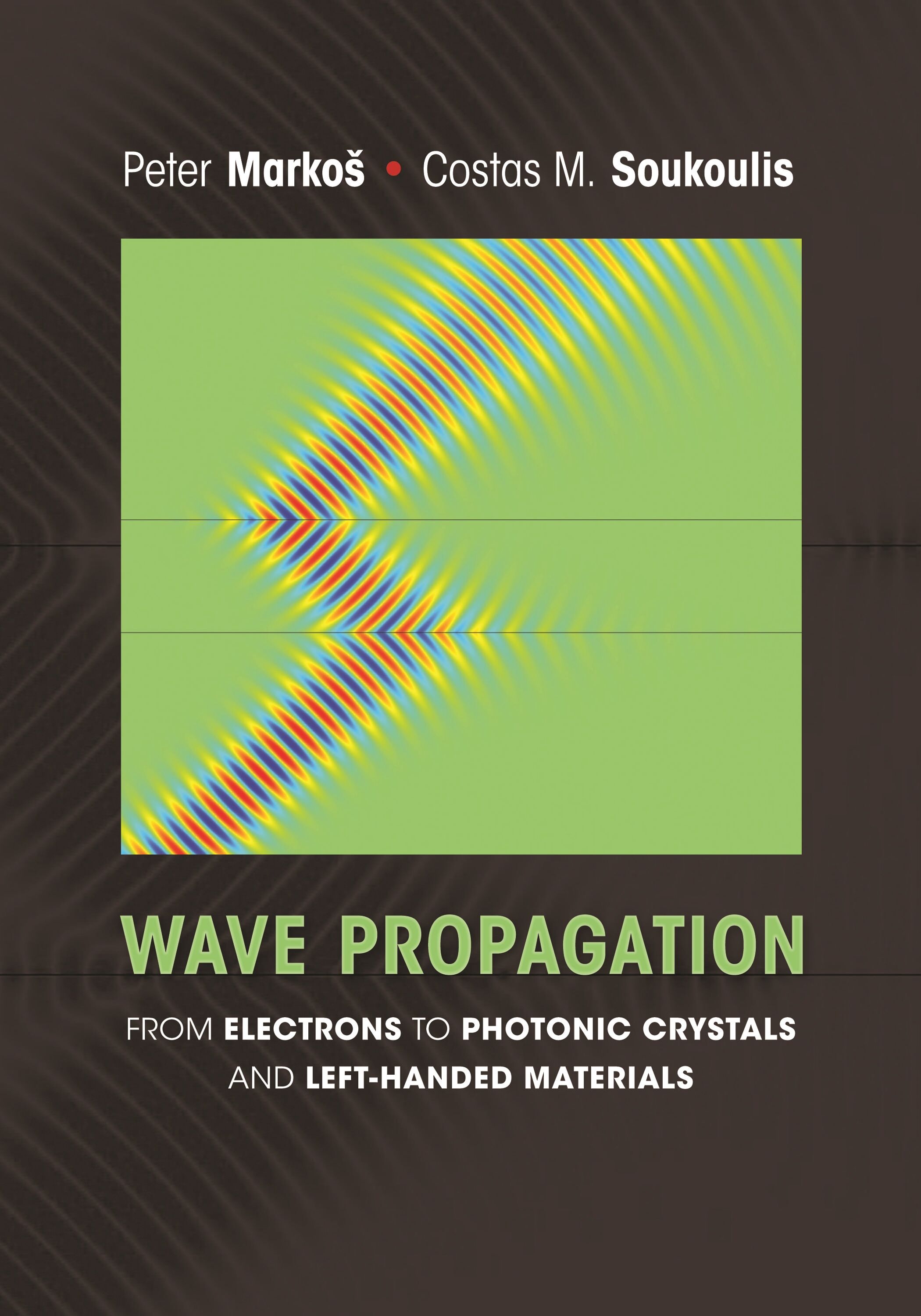
Wave Propagation
This textbook offers the first unified treatment of wave propagation in electronic and electromagnetic systems and introduces readers to the essentials of the transfer matrix method, a powerful analytical tool that can be used to model and study an array of problems pertaining to wave propagation in electrons and photons. It is aimed at graduate and advanced undergraduate students in physics, materials science, electrical and computer engineering, and mathematics, and is ideal for researchers in photonic crystals, negative index materials, left-handed materials, plasmonics, nonlinear effects, and optics.
Peter Markos and Costas Soukoulis begin by establishing the analogy between wave propagation in electronic systems and electromagnetic media and then show how the transfer matrix can be easily applied to any type of wave propagation, such as electromagnetic, acoustic, and elastic waves. The transfer matrix approach of the tight-binding model allows readers to understand its implementation quickly and all the concepts of solid-state physics are clearly introduced. Markos and Soukoulis then build the discussion of such topics as random systems and localized and delocalized modes around the transfer matrix, bringing remarkable clarity to the subject. Total internal reflection, Brewster angles, evanescent waves, surface waves, and resonant tunneling in left-handed materials are introduced and treated in detail, as are important new developments like photonic crystals, negative index materials, and surface plasmons. Problem sets aid students working through the subject for the first time.
eBook
Fractional calculus and waves in linear viscoelasticity : an introduction to mathematical models
This monograph provides a comprehensive overview of the author's work on the fields of fractional calculus and waves in linear viscoelastic media, which includes his pioneering contributions on the applications of special functions of the Mittag-Leffler and Wright types.It is intended to serve as a general introduction to the above-mentioned areas of mathematical modeling. The explanations in the book are detailed enough to capture the interest of the curious reader, and complete enough to provide the necessary background material needed to delve further into the subject and explore the research literature given in the huge general bibliography.This book is likely to be of interest to applied scientists and engineers.
eBook

OFDM for Underwater Acoustic Communications
A blend of introductory material and advanced signal processing and communication techniques, of critical importance to underwater system and network development
This book, which is the first to describe the processing techniques central to underwater OFDM, is arranged into four distinct sections: First, it describes the characteristics of underwater acoustic channels, and stresses the difference from wireless radio channels. Then it goes over the basics of OFDM and channel coding. The second part starts with an overview of the OFDM receiver, and develops various modules for the receiver design in systems with single or multiple transmitters. This is the main body of the book. Extensive experimental data sets are used to verify the receiver performance. In the third part, the authors discuss applications of the OFDM receiver in i) deep water channels, which may contain very long separated multipath clusters, ii) interference-rich environments, where an unintentional interference such as Sonar will be present, and iii) a network with multiple users where both non-cooperative and cooperative underwater communications are developed. Lastly, it describes the development of a positioning system with OFDM waveforms, and the progress on the OFDM modem development. Closely related industries include the development and manufacturing of autonomous underwater vehicles (AUVs) and scientific sensory equipment. AUVs and sensors in the future could integrate modems, based on the OFDM technology described in this book.
Contents includes: Underwater acoustic channel characteristics/OFDM basics/Peak-to-average-ratio control/Detection and Doppler estimation (Doppler scale and CFO)/Channel estimation and noise estimation/A block-by-block progressive receiver and performance results/Extensions to multi-input multi-output OFDM/Receiver designs for multiple users/Cooperative underwater OFDM (Physical layer network coding and dynamic coded cooperation)/Localization with OFDM waveforms/Modem developments
A valuable resource for Graduate and postgraduate students on electrical engineering or physics courses; electrical engineers, underwater acousticians, communications engineers
eBook
Adaptive processing of brain signals
In this book, the field of adaptive learning and processing is extended to arguably one of its most important contexts which is the understanding and analysis of brain signals. No attempt is made to comment on physiological aspects of brain activity; instead, signal processing methods are developed and used to assist clinical findings. Recent developments in detection, estimation and separation of diagnostic cues from different modality neuroimaging systems are discussed.
These include constrained nonlinear signal processing techniques which incorporate sparsity, nonstationarity, multimodal data, and multiway techniques.
Key features:
* Covers advanced and adaptive signal processing techniques for the processing of electroencephalography (EEG) and magneto-encephalography (MEG) signals, and their correlation to the corresponding functional magnetic resonance imaging (fMRI)
* Provides advanced tools for the detection, monitoring, separation, localising and understanding of functional, anatomical, and physiological abnormalities of the brain
* Puts a major emphasis on brain dynamics and how this can be evaluated for the assessment of brain activity in various states such as for brain-computer interfacing emotions and mental fatigue analysis
* Focuses on multimodal and multiway adaptive processing of brain signals, the new direction of brain signal research
eBook

High Accuracy Computing Methods
This book presents topics in a single source format using unified spectral theory of computing. With developments of DNS and LES, practitioners are rediscovering waves as important in fluid flows, and capturing these numerically is central to high accuracy computing. Analysis of waves and its use in numerical methods in propagating energy at the right velocity (dispersion effects) and with right amplitude (dissipation) are essential. Most industrial codes using Reynolds-averaged Navier–Stokes equations with turbulence models cannot conceive of capturing waves. The new themes covered in this book are:
• Correct error propagation analysis
• Practical compact schemes and global analysis tool
• Aliasing error and its alleviation
• Spurious upstream propagating q-waves
• Explanation of the Gibbs phenomenon
• New 1D and 2D filters for LES/DNS without SGS modelling
• Anisotropic skewed wave propagation
• Development and analysis of dispersion relation preservation (DRP) schemes
• Flow instabilities and wave propagation phenomena
eBook