
Catalogue Search | MBRL


Are you sure you want to remove the book from the shelf?

{{itemTitle}}
369
result(s) for
"Wealth Religious aspects."
Sort by:


Through the eye of a needle
Jesus taught his followers that it is easier for a camel to go through the eye of a needle than for a rich man to enter heaven. Yet by the fall of Rome, the church was becoming rich beyond measure.Through the Eye of a Needleis a sweeping intellectual and social history of the vexing problem of wealth in Christianity in the waning days of the Roman Empire, written by the world's foremost scholar of late antiquity.
Peter Brown examines the rise of the church through the lens of money and the challenges it posed to an institution that espoused the virtue of poverty and called avarice the root of all evil. Drawing on the writings of major Christian thinkers such as Augustine, Ambrose, and Jerome, Brown examines the controversies and changing attitudes toward money caused by the influx of new wealth into church coffers, and describes the spectacular acts of divestment by rich donors and their growing influence in an empire beset with crisis. He shows how the use of wealth for the care of the poor competed with older forms of philanthropy deeply rooted in the Roman world, and sheds light on the ordinary people who gave away their money in hopes of treasure in heaven.
Through the Eye of a Needlechallenges the widely held notion that Christianity's growing wealth sapped Rome of its ability to resist the barbarian invasions, and offers a fresh perspective on the social history of the church in late antiquity.
eBook

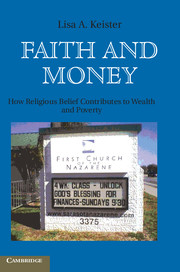
Faith and Money
For those who own it, wealth can have extraordinary advantages. High levels of wealth can enhance educational attainment, create occupational opportunities, generate social influence and provide a buffer against financial emergencies. Even a small amount of savings can improve security, mitigate the effects of job loss and other financial setbacks and improve well-being dramatically. Although the benefits of wealth are significant, they are not enjoyed uniformly throughout the United States. In the United States, because religion is an important part of cultural orientation, religious beliefs should affect material well-being. This book explores the way religious orientations and beliefs affect Americans' incomes, savings and net worth.
eBook

Faith and money : how religion contributes to wealth and poverty
\"For those who own it, wealth can have extraordinary advantages. High levels of wealth can enhance educational attainment, create occupational opportunities, generate social influence, and provide a buffer against financial emergencies. Even a small amount of savings can improve security, mitigate the effects of job loss and other financial setbacks, and improve well-being dramatically. Although the benefits of wealth are significant, they are not enjoyed uniformly throughout the United States. In the United States, because religion is an important part of cultural orientation, religious beliefs should affect material well-being. This book explores the way religious orientations and beliefs affect Americans' incomes, savings, and net worth\"--Provided by publisher.
Book
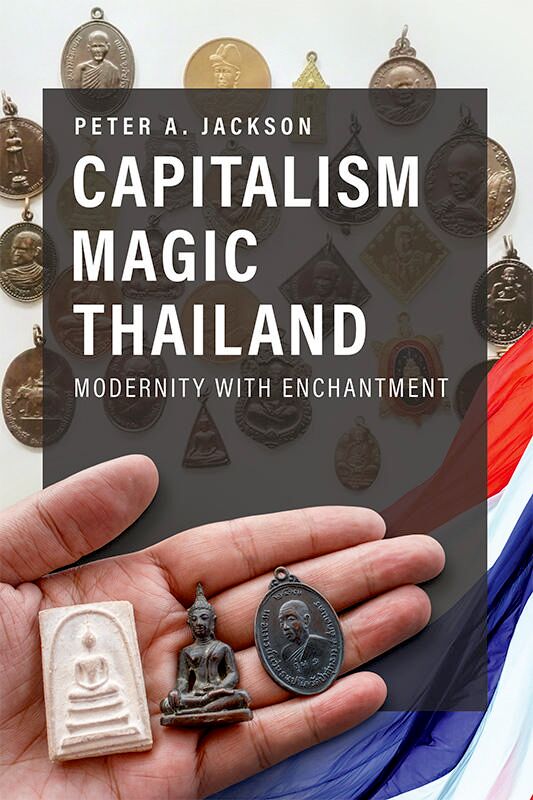
Capitalism magic Thailand : modernity with enchantment
By studying intersections among new cults of wealth, ritually empowered amulets and professional spirit mediumship—which have emerged together in Thailand's dynamic religious field in recent decades—Capitalism Magic Thailand explores the conditions under which global modernity produces new varieties of enchantment. Bruno Latour's account of modernity as a condition fractured between rationalizing ideology and hybridizing practice is expanded to explain the apparent paradox of new forms of magical ritual emerging alongside religious fundamentalism across a wide range of Asian societies. In Thailand, novel and increasingly popular varieties of ritual now form a symbolic complex in which originally distinct cults centred on Indian deities, Chinese gods and Thai religious and royal figures have merged in commercial spaces and media sites to sacralize the market and wealth production. Emerging within popular culture, this complex of cults of wealth, amulets and spirit mediumship is supported by all levels of Thai society, including those at the acme of economic and political power. New theoretical frameworks are presented in analyses that challenge the view that magic is a residue of premodernity, placing the dramatic transformations of cultic ritual centre stage in modern Thai history. It is concluded that modern enchantment arises at the confluence of three processes: neoliberal capitalism's production of occult economies, the auraticizing effects of technologies of mass mediatization, and the performative force of ritual in religious fields where practice takes precedence over doctrine.
eBook

Poverty and wealth in Judaism, Christianity, and Islam
This book gathers scholars from the three major monotheistic religions to discuss the issue of poverty and wealth from the varied perspectives of each tradition. It provides a cadre of values inherent to the sacred texts of Jews, Christians, and Muslims and illustrates how these values may be used to deal with current economic inequalities. Contributors use the methodologies of religious studies to provide descriptions and comparisons of perspectives from Judaism, Christianity, and Islam on poverty and wealth. The book presents citations from the sacred texts of all three religions. The contributors discuss the interpretations of these texts and the necessary contexts, both past and present, for deciphering the stances found there. Poverty and Wealth in Judaism, Christianity, and Islam identifies and details a foundation of common values upon which individual and institutional decisions may be made.
eBook

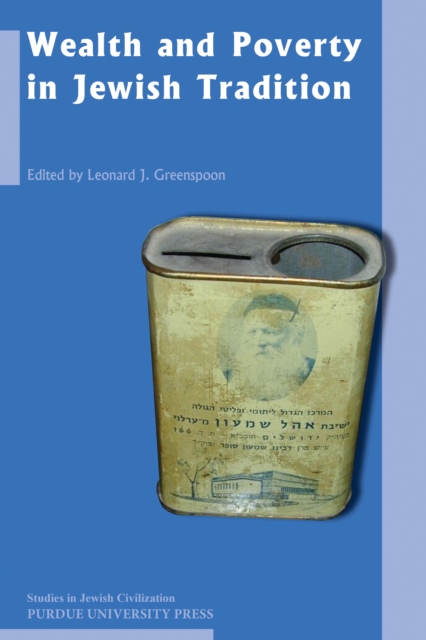
Wealth and Poverty in Jewish Tradition, Volume 26
Economic inequity is an issue of worldwide concern in the twenty-first century. Although these issues have not troubled all people at all times, they are nonetheless not new. Thus, it is not surprising that Judaism has developed many perspectives, theoretical and practical, to explain and ameliorate the circumstances that produce serious economic disparity. This volume offers an accessible collection of articles that deal comprehensively with this phenomenon from a variety of approaches and perspectives.Within this framework, the fourteen authors who contributed to Wealth and Poverty in Jewish Tradition bring a formidable array of experience and insight to uncover interconnected threads of conversation and activities that characterize Jewish thought and action. Among the questions raised, for which there are frequently multiple responses: Is the giving of tzedakah (generally, although imprecisely, translated as charity) a command or an impulse? Does the Jewish tradition give priority to the donor or to the recipient? To what degree is charity a communal responsibility? Is there something inherently ennobling or, conversely, debasing about being poor? How have basic concepts about wealth and poverty evolved from biblical through rabbinic and medieval sources until the modern period? What are some specific historical events that demonstrate either marked success or bitter failure? And finally, are there some relevant concepts and practices that are distinctively, if not uniquely, Jewish?It is a singular strength of this collection that appropriate attention is given, in a style that is both accessible and authoritative, to the vast and multiform conversations that are recorded in the Talmud and other foundational documents of rabbinic Judaism. Moreover, perceptive analysis is not limited to the past, but also helps us to comprehend circumstances among todays Jews. It is equally valuable that these authors are attuned to the differences between aspirations and the realities in which actual people have lived.
eBook