
Catalogue Search | MBRL


Are you sure you want to remove the book from the shelf?

{{itemTitle}}
9,571
result(s) for
"Web analytics"
Sort by:

Web Analytics for Knowledge Creation: A Systematic Review of Tools, Techniques, and Practices
Digitization efforts across the world have resulted in the need for businesses to own a website. All Fortune 500 companies run websites for either information dissemination or for transacting business. This has led to the increase in the number of websites as well as a growing competition to outdo each other. In order to gain competitive advantage, businesses need to have a detailed track of the activities going on their website to suffice their decisive knowledge. However, to monitor and to optimise the website performance, organisations need strong web analytics tools and skills. This work presents a comprehensive review of the web analytics tools and techniques, which are vital to report the website performance and usage. Present day practices of web analytics have been outlined from the perspective of business organisations, with suitable examples. A comparative analysis of the most important web analytics tools have been presented, including the free as well as subscription based tools. Future challenges and opportunities to web analytics practices have also been presented.
Journal Article

Customer segmentation using online platforms: isolating behavioral and demographic segments for persona creation via aggregated user data
We propose a novel approach for isolating customer segments using online customer data for products that are distributed via online social media platforms. We use non-negative matrix factorization to first identify behavioral customer segments and then to identify demographic customer segments. We employ a methodology for linking the two segments to present integrated and holistic customer segments, also known as personas. Behavioral segments are generated from customer interactions with online content. Demographic segments are generated using the gender, age, and location of these customers. In addition to evaluating our approach, we demonstrate its practicality via a system leveraging these customer segments to automatically generate personas, which are fictional but accurate representations of each integrated behavioral and demographic segment. Results show that this approach can accurately identify both behavioral and demographical customer segments using actual online customer data from which we can generate personas representing real groups of people.
Journal Article

Web Observatory Insights: Past, Current, and Future
In the present era of Big Data, with continuously increasing amounts of user-generated content, it is becoming a challenge to understand the relation between the content that is available on the Web and the users who are generating that content. Researchers have come up with many ways to understand today's Web better. One of the recently introduced concepts is a Web observatory (WO). This article provides a deep understanding about web observatories. It discusses the status of existing WO systems. The article investigates and gathers the common practices of WOs. This research has implications for researchers and communities in the adoption of the WO concept. The article highlights the challenges of WOs, such as data crawling, privacy and security. It also provides future research and development directions. The article provides a comparative analysis of existing WOs. It discusses the architecture of WOs. It presents components of a WO in a coherent manner and finally provides insights into challenges and limitations of WOs.
Journal Article

Web analytics: more than website performance evaluation?
Purpose>The purpose of this study is to understand the status quo of the use of Web analytics tools by European destination management organizations (DMOs) and to provide guidelines in using these metrics for business intelligence and tourism design. In addition, the goal is to improve destination management at the city level using Web analytics data.Design/methodology/approach>In this exploratory study, the authors analyze how European DMOs view Web analytics data through the lens of the “data to knowledge to results” framework. The authors analyze the use of Web analytics tools by DMOs through the theory of affordances and “data-to-knowledge framework” developed by Davenport et al., which incorporates several factors that contribute to a successful transformation of data available to an organization to knowledge, desirable results and ultimately to building an analytical capability.Findings>The results show that European DMOs mainly use Web analytics data for website quality assurance, but that some are also using them to drive marketing programs. The study concludes by providing several suggestions for ways in which DMOs might optimize the use of Web analytics data, which will also improve the management of destinations.Originality/value>Web analytics tools are used by many organizations such as DMOs to collect traffic data, to evaluate and optimize websites. However, these metrics can also be combined with other data such as bednights numbers and used for forecasting or other managerial decisions for destination management at the city level. There is a research gap in this area that focuses on using Web analytics data for business intelligence in the tourism industry and this research aims to fill this gap.
Journal Article

Business Intelligence and Analytics: From Big Data to Big Impact
Business intelligence and analytics (BI&A) has emerged as an important area of study for both practitioners and researchers, reflecting the magnitude and impact of data-related problems to be solved in contemporary business organizations. This introduction to the MIS Quarterly Special Issue on Business Intelligence Research first provides a framework that identifles the evolution, applications, and emerging research areas of BI&A. BI& A 1.0, BI&A 2.0, and BI&A 3.0 are defined and described in terms of their key characteristics and capabilities. Current research in BI&A is analyzed and challenges and opportunities associated with BI&A research and education are identified. We also report a bibliometric study of critical BI&A publications, researchers, and research topics based on more than a decade of related academic and industry publications. Finally, the six articles that comprise this special issue are introduced and characterized in terms of the proposed BI&A research framework.
Journal Article
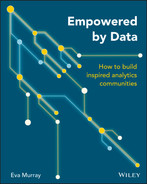
Empowered by Data
Learn to build an analytics community in your organization from scratch How to Build a Data Community shows readers how to create analytics and data communities within their organizations. Celebrated author Eva Murray relies on intuitive and practical advice structured as step-by-step guidance to demonstrate the creation of new data communities. How to Build a Data Community uses concrete insights gleaned from real-world case studies to describe, in full detail, all the critical components of a data community. Readers will discover: What analytics communities are and what they look like Why data-driven organizations need analytics communities How selected businesses and nonprofits have applied these concepts successfully and what their journey to a data-driven culture looked like. How they can establish their own communities and what they can do to ensure their community grows and flourishes Perfect for analytics professionals who are responsible for making policy-level decisions about data in their firms, the book is also a must-have for data practitioners and consultants who wish to make positive changes in the organizations with which they work.
eBook

Web Analytics and Online Retail: Ethical Perspective
Currently, all major e-retailers and even the start-ups have incorporated web analytics services on their websites to monitor customer behaviour while extracting personal data. However, the web analytics data collection methods and the applications of such collected data have raised a lot of concerns regarding the ethical use of this data. The present work identifies some important ethical challenges and unethical practices that have cropped up with the usage of these techniques. The research also suggests the measures to reduce the volume and type of personal data that can be monitored by the websites/applications at the user level. It also elaborates on measures and requirements that need to be undertaken by the online retailers at the policy level to meet the country and industry standards, while keeping their practices ethical.
Journal Article
The Interaction Between Microblog Sentiment and Stock Returns: An Empirical Examination
Opinion mining of microblog messages has become a popular application of business analytics in recent times. Opinions reflected in microblogs have provided businesses with great opportunities to acquire insights into their operating environments in real time. In particular, the relationship between microblog sentiment and stock returns is of great interest to investment professionals and academic researchers across multiple disciplines. We empirically test this complex relationship in a comprehensive study. We perform vector autoregression on a data set containing close to 18 million microblog messages spanning 4 years at the market and the individual stock levels, and at the daily and the hourly frequencies. The results show that the influence of microblog sentiment on stock returns is both statistically and economically significant at the hour level. Microblog sentiment is also largely driven by movements in the market. Moreover, stock returns have a stronger influence on negative sentiment than on positive sentiment. These findings have important implications for both research and practice.
Journal Article

Data Analytics, Innovation, and Firm Productivity
We examine the relationship between data analytics capabilities and innovation using detailed firm-level data. To measure innovation, we first utilize a survey to capture two types of firm practices, process improvement and new technology development for 331 firms. We then use patent data to further analyze new technology development for a broader sample of more than 2,000 publicly traded firms. We find that data analytics capabilities are more likely to be present and are more valuable in firms that are oriented around process improvement and that create new technologies by combining a diverse set of existing technologies than they are in firms that are focused on generating entirely new technologies. These results are consistent with the theory that data analytics are complementary to certain types of innovation because they enable firms to expand the search space of existing knowledge to combine into new technologies, as well as the theoretical arguments that data analytics support incremental process improvements. Data analytics appears less effective for developing entirely new technologies or creating combinations involving a few areas of knowledge, innovative approaches where there is either limited data or limited value in integrating diverse knowledge. Overall, our results suggest that firms that have historically focused on specific types of innovation—process innovation and innovation by diverse recombination—may receive the most benefits from using data analytics.
This paper was accepted by Chris Forman, information systems.
Journal Article

Using MicrobiomeAnalyst for comprehensive statistical, functional, and meta-analysis of microbiome data
MicrobiomeAnalyst is an easy-to-use, web-based platform for comprehensive analysis of common data outputs generated from current microbiome studies. It enables researchers and clinicians with little or no bioinformatics training to explore a wide variety of well-established methods for microbiome data processing, statistical analysis, functional profiling and comparison with public datasets or known microbial signatures. MicrobiomeAnalyst currently contains four modules: Marker-gene Data Profiling (MDP), Shotgun Data Profiling (SDP), Projection with Public Data (PPD), and Taxon Set Enrichment Analysis (TSEA). This protocol will first introduce the MDP module by providing a step-wise description of how to prepare, process and normalize data; perform community profiling; identify important features; and conduct correlation and classification analysis. We will then demonstrate how to perform predictive functional profiling and introduce several unique features of the SDP module for functional analysis. The last two sections will describe the key steps involved in using the PPD and TSEA modules for meta-analysis and visual exploration of the results. In summary, MicrobiomeAnalyst offers a one-stop shop that enables microbiome researchers to thoroughly explore their preprocessed microbiome data via intuitive web interfaces. The complete protocol can be executed in ~70 min.
This protocol details MicrobiomeAnalyst, a user-friendly, web-based platform for comprehensive statistical, functional, and meta-analysis of microbiome data.
Journal Article