
Catalogue Search | MBRL


Are you sure you want to remove the book from the shelf?

{{itemTitle}}
31,446
result(s) for
"Week."
Sort by:

It's Monday, Mrs. Jolly Bones
Mrs. Jolly Bones goes through the week, doing chores in her unique way.
Book

Adalimumab for the treatment of fistulas in patients with Crohn’s disease
Objective:To evaluate the efficacy of adalimumab in the healing of draining fistulas in patients with active Crohn’s disease (CD).Design:A phase III, multicentre, randomised, double-blind, placebo controlled study with an open-label extension was conducted in 92 sites.Patients:A subgroup of adults with moderate to severely active CD (CD activity index 220–450) for ⩾4 months who had draining fistulas at baseline.Interventions:All patients received initial open-label adalimumab induction therapy (80 mg/40 mg at weeks 0/2). At week 4, all patients were randomly assigned to receive double-blind placebo or adalimumab 40 mg every other week or weekly to week 56 (irrespective of fistula status). Patients completing week 56 of therapy were then eligible to enroll in an open-label extension.Main Outcome Measures:Complete fistula healing/closure (assessed at every visit) was defined as no drainage, either spontaneous or with gentle compression.Results:Of 854 patients enrolled, 117 had draining fistulas at both screening and baseline (70 randomly assigned to adalimumab and 47 to placebo). The mean number of draining fistulas per day was significantly decreased in adalimumab-treated patients compared with placebo-treated patients during the double-blind treatment period. Of all patients with healed fistulas at week 56 (both adalimumab and placebo groups), 90% (28/31) maintained healing following 1 year of open-label adalimumab therapy (observed analysis).Conclusions:In patients with active CD, adalimumab therapy was more effective than placebo for inducing fistula healing. Complete fistula healing was sustained for up to 2 years by most patients in an open-label extension trial.ClinicalTrials.gov Identifier: NCT00077779 and NCT00195715.
Journal Article
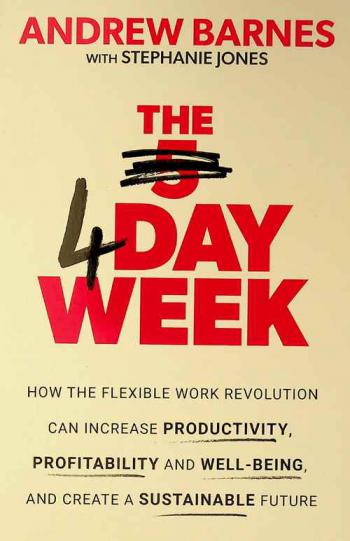
The 4 day week : how the flexible work revolution can increase productivity, profitability and well-being, and help create a sustainable future
The 4 Day Week is a practical, how-to guide for business leaders and employees alike that is applicable to nearly every industry. Using qualitative and quantitative data from research gathered through the Perpetual Guardian trial and other sources by the University of Auckland and Auckland University of Technology, the book presents a step-by-step approach to preparing businesses for productivity-focused flexibility, from the necessary cultural conditions to the often complex legislative considerations. The story of Perpetual Guardian's unprecedented work experiment has made headlines around the world and stormed social media, reaching a global audience over 4.5 billion. A mix of trenchant analysis, personal observation and actionable advice, The 4 Day Week is an essential guide for leaders and workers seeking to make a change for the better in their work world.



The week : a history of the unnatural rhythms that made us who we are
\"An investigation into the evolution of the seven-day week and how our attachment to its rhythms influences how we live. We take the seven-day week for granted, rarely asking what anchors it or what it does to us. Yet weeks are not dictated by the natural order. They are, in fact, entirely artificial -- a quintessentially modern cycle with an ancient pedigree. With meticulous archival research that draws on a wide array of sources -- including newspapers, restaurant menus, theater schedules, marriage records, school curricula, folklore, housekeeping guides, courtroom testimony, and diaries -- David Henkin reveals how our current devotion to weekly rhythms emerged in the United States during the first half of the nineteenth century. Reconstructing how weekly patterns insinuated themselves into the social practices and mental habits of Americans, Henkin argues that the week is more than just a regimen of rest days or breaks from work, but a dominant organizational principle of modern society. Ultimately, the seven-day week shapes our understanding and experience of time\"--Jacket.

Time for a nap
Bunny characters take the reader through the week, recounting the activities that each day brings, and each day always leaves time for a nap.
Book