
Catalogue Search | MBRL


Are you sure you want to remove the book from the shelf?

{{itemTitle}}
395
result(s) for
"Wehrmacht"
Sort by:
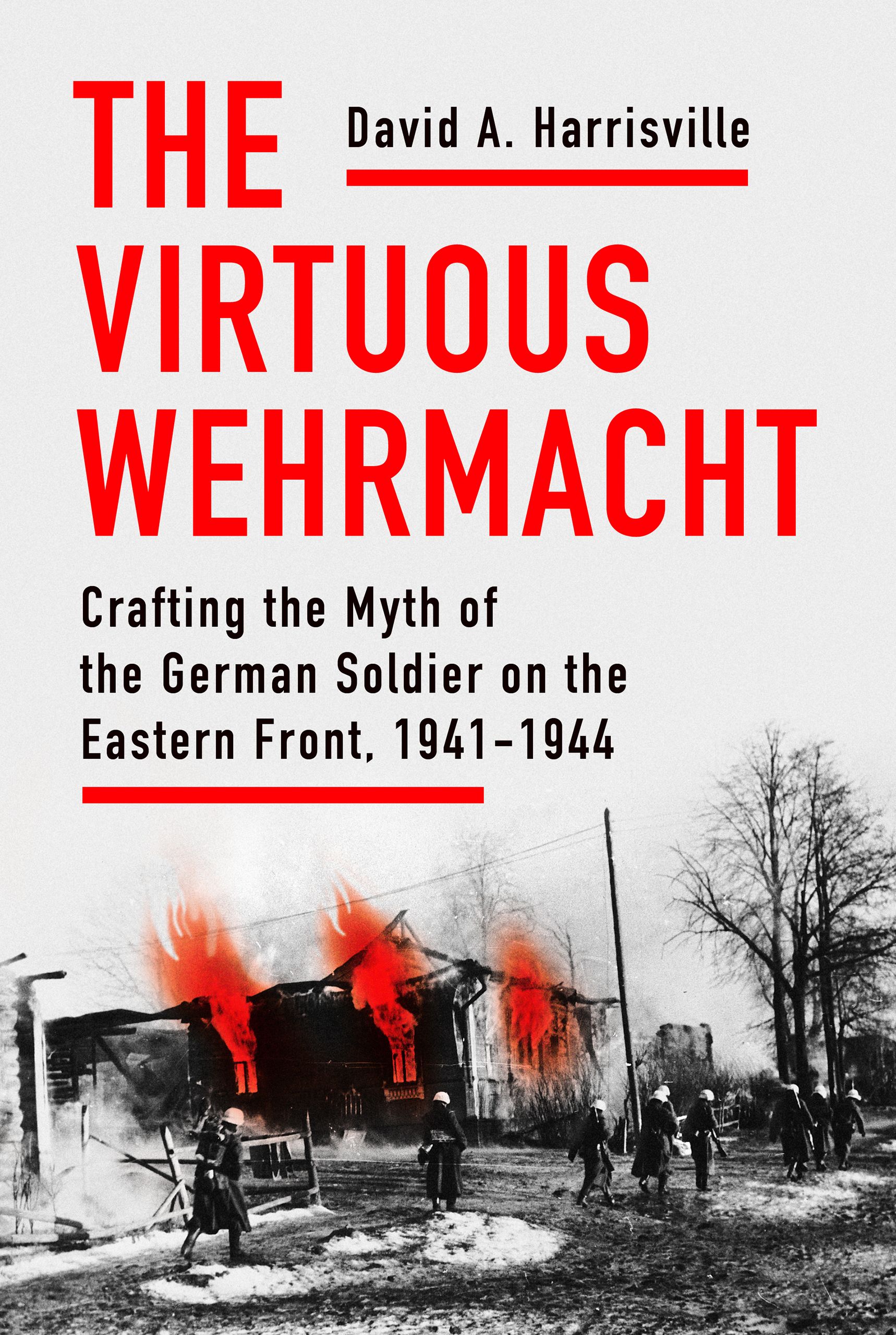
The Virtuous Wehrmacht
The Virtuous Wehrmacht
explores the myth of the German armed forces' innocence
during World War II by reconstructing the moral world of German
soldiers on the Eastern Front. How did they avoid feelings
of guilt about the many atrocities their side committed? David A.
Harrisville compellingly demonstrates that this myth of innocence
was created during the course of the war itself-and did not arise
as a postwar whitewashing of events. In 1941 three million
Wehrmacht troops overran the border between German- and
Soviet-occupied Poland, racing toward the USSR in the largest
military operation in modern history. Over the next four years,
they embarked on a campaign of wanton brutality, murdering
countless civilians, systemically starving millions of Soviet
prisoners of war, and actively participating in the genocide of
Eastern European Jews. After the war, however, German servicemen
insisted that they had fought honorably and that their institution
had never involved itself in Nazi crimes.
Drawing on more than two thousand letters from German soldiers,
contextualized by operational and home front documents, Harrisville
shows that this myth was the culmination of long-running efforts by
the army to preserve an illusion of respectability in the midst of
a criminal operation. The primary authors of this fabrication were
ordinary soldiers cultivating a decent self-image and developing
moral arguments to explain their behavior by drawing on a
constellation of values that long preceded Nazism.
The Virtuous Wehrmacht explains how the army encouraged
troops to view themselves as honorable representatives of a
civilized nation, not only racially but morally superior to
others.
eBook

The order of terror
During the twelve years from 1933 until 1945, the concentration camp operated as a terror society. In this pioneering book, the renowned German sociologist Wolfgang Sofsky looks at the concentration camp from the inside as a laboratory of cruelty and a system of absolute power built on extreme violence, starvation, \"terror labor,\" and the business-like extermination of human beings.
Based on historical documents and the reports of survivors, the book details how the resistance of prisoners was broken down. Arbitrary terror and routine violence destroyed personal identity and social solidarity, disrupted the very ideas of time and space, perverted human work into torture, and unleashed innumerable atrocities. As a result, daily life was reduced to a permanent struggle for survival, even as the meaning of self-preservation was extinguished. Sofsky takes us from the searing, unforgettable image of the Muselmann--Auschwitz jargon for the \"walking dead\"--to chronicles of epidemics, terror punishments, selections, and torture.
The society of the camp was dominated by the S.S. and a system of graduated and forced collaboration which turned selected victims into accomplices of terror. Sofsky shows that the S.S. was not a rigid bureaucracy, but a system with ample room for autonomy. The S.S. demanded individual initiative of its members. Consequently, although they were not required to torment or murder prisoners, officers and guards often exploited their freedom to do so--in passing or on a whim, with cause, or without.
The order of terror described by Sofsky culminated in the organized murder of millions of European Jews and Gypsies in the death-factories of Auschwitz and Treblinka. By the end of this book, Sofsky shows that the German concentration camp system cannot be seen as a temporary lapse into barbarism. Instead, it must be conceived as a product of modern civilization, where institutionalized, state-run human cruelty became possible with or without the mobilizing feelings of hatred.
eBook

Germany and the Ottoman Empire, 1914-1918
Questioning whether the Germans were actually as influential or dominant in the Ottoman empire as most standard works suggest, the author attacks the myths surrounding Turkey's role in the war.
Originally published in 1968.
The Princeton Legacy Library uses the latest print-on-demand technology to again make available previously out-of-print books from the distinguished backlist of Princeton University Press. These editions preserve the original texts of these important books while presenting them in durable paperback and hardcover editions. The goal of the Princeton Legacy Library is to vastly increase access to the rich scholarly heritage found in the thousands of books published by Princeton University Press since its founding in 1905.
eBook

The Germans and Air Power at Dieppe
Despite the vast academic and popular interest in the Dieppe raid of 19 August 1942, there remains a curious oversight of the German side of the story. This contribution interrogates German sources in order to explore the Dieppe air battle and its consequences from the perspective of the German armed forces. The paper ultimately demonstrates that the Germans learnt much about the role of air power in coastal defence from their experiences at Dieppe, but that the implementation of those lessons was lacking.
Journal Article

Desert Zone: History of Warfare and Crimes Committed by the Nazis in 1941 on the Territory of the Present-Day Lipetsk Oblast
Introduction. This research focuses on the previously unexplored Nazi crimes on the territory of the modern Lipetsk Oblast in the fall and winter of 1941. It is conducted as part of the nationwide project “Bez sroka davnosti” (No statute of limitation). Newly declassified information from the archives as well as historical evidence from both sides of the conflict allowed us to present a detailed description of those events. Methods and Materials. We used the principles of historicism and objectivity in order to explain the concept of Hitler’s Blitzkrieg against the USSR. We also employed the quantitative method to analyze the structure and equipment of German troops, their readiness for the upcoming battle. Analysis. The leadership of Nazi Germany initially considered the territory of the Soviet Union as their future possessions. Based on this, a policy of treatment of the local population and state property was built, which fits the definition of genocide. The Plans and legal basis for future crimes were developed prior to the outbreak of hostilities. Army corps 45, 134, 95, 262 and 293 Wehrmacht Infantry Divisions, which fought against the 34th and 35th army corps (Red Army), committed various atrocities against the civilian population, as evidenced in detail by archival materials and interrogations of German prisoners of war. Results. The system of the occupation regime was planned in such a way that it was possible to squeeze the maximum out of the occupied lands in favor of Nazi Germany. The behavior of the Wehrmacht soldiers in the occupied territory was destructive in relation to the Soviet population, cultural values and the economy. Technically and morally, the German troops were unable to recover from the defeat received in November-December 1941, while the Red Army was building up its forces and gaining the necessary experience in the fight against the enemy.
Journal Article

Bodies and Spaces: Citizenship as Claims-Making in Germany, 1942–1949
In 1935, the Nazi Party promulgated the Reich citizenship law, which, to protect the purity of the Volksgemeinschaft, denaturalized numerous people who perceived themselves as German. Despite this perceived threat to the national body, the Third Reich drafted some mixed-race men to serve in the Wehrmacht during World War II. Traditionally, scholars have focused their studies of mixed-race veterans on the so-called Jewish Mischlinge who served in the Wehrmacht. This article expands the aperture by examining the oral history testimony of Hans Hauck, a Black German Wehrmacht veteran whose wartime experiences present a complex story of a man who claimed to be German despite legal structures and normative ideals about Germanness that excluded him. Drawing on Hauck's oral history testimonies regarding two periods of his military service, I argue that Hauck used his body, symbols, and physical spaces to seek recognition as a legitimate claimant of Germanness.
Journal Article

Democracies at War
Why do democracies win wars? This is a critical question in the study of international relations, as a traditional view--expressed most famously by Alexis de Tocqueville--has been that democracies are inferior in crafting foreign policy and fighting wars. In Democracies at War, the first major study of its kind, Dan Reiter and Allan Stam come to a very different conclusion. Democracies tend to win the wars they fight--specifically, about eighty percent of the time.
eBook

Ambush at Thorame-Haute: archaeological traces of a fifteen minute Ambush by the French resistance
On 18 July 1944, a convoy of German trucks was ambushed by the French Resistance near the village of Thorame-Haute in SE France. According to reports by French witnesses, the first German truck exploded. After a brief firefight, the Resistance pulled out without casualties, claiming that 58 Germans had been killed in the attack, including a high-ranking officer. The current project used witness interviews, archives materials, and metal detecting to validate the descriptions of the ambush. The project confirmed that at least nine German soldiers had been killed in the attack. The metal detecting survey recovered numerous small artefacts whose condition and dispersal indicated that a violent explosion had indeed occurred and had probably been preceded or followed by a fire. A grouping of fired cartridge casings was found in the former Resistance positions. The project was able to confirm the French accounts apart from the casualty figures.
Journal Article
Evacuation of the German Population from Transnistria in March–July 1944
Introduction. During autumn 1943 – spring 1944 the systematic phased evacuation of the German population was carried out from the occupied Soviet regions. Its final phase was the operation of relocating more than 130 000 ethnic Germans from the Transnistria Governorate controlled by Romanian authorities to the territory of Warthegau. Materials and methods. The presented research is based on the historicism and objectivity principles. In the course of the work, the author uses special methods such as historical-systematic, chronological, historicaldescriptive, and historical-genetic. The Source base of the research consists of documents of archival funds of Germany, memoirs and partly materials from the German press. Analysis. The decision of the SS leadership to execute the evacuation of ethnic Germans from Transnistria was due to the further advance of Soviet troops in the southern direction. However, even at the planning stage, the German side was faced with serious problems that could disrupt the entire operation. Due to the fact that control over many transport communications was lost, evacuation routes could only run through the territory of Romania, Bulgaria, occupied Serbia and Hungary. Therefore, the German leadership had to initiate urgent negotiations with the authorities of some of these states. Especially difficult was the negotiation process with the Romanian side which did not want to provide any assistance in the evacuation of the Germans from Transnistria. The High Command of the Wehrmacht was also in no hurry to provide assistance (for example, in transport support). Results. Despite the above-mentioned problems, the SS leadership was still able to carry out this resettlement action for several months. Most Germans decided to leave their homes not under the administrative pressure from the occupying authorities, but voluntarily, guided exclusively by the instinct of their survival.
Journal Article
