
Catalogue Search | MBRL


Are you sure you want to remove the book from the shelf?

{{itemTitle}}
39
result(s) for
"Welles, Orson, 1915-1985 Criticism and interpretation."
Sort by:


Discovering Orson Welles
Of the dozens of books written about Orson Welles, most focus on the central enigma of Welles's career: why did someone so extravagantly talented neglect to finish so many projects? Film critic Jonathan Rosenbaum has long believed that to dwell on this aspect of the Welles canon is to overlook the wealth of information available by studying the unrealized works.Discovering Orson Wellescollects Rosenbaum's writings to date on Welles-some thirty-five years of them-and makes an irrefutable case for the seriousness of his work, illuminating both Welles the artist and Welles the man. The book is also a chronicle of Rosenbaum's highly personal writer's journey and his efforts to arrive at the truth. The essays, interviews, and reviews are arranged chronologically and are accompanied by commentary that updates the scholarship. Highlights include Rosenbaum's 1972 interview with Welles about his first Hollywood project,Heart of Darkness;Rosenbaum's rebuttal to Pauline Kael's famous essay \"Raising Kane\"; detailed essays and comprehensive discussions of Welles's major unfinished work, including two unrealized projects,The Big Brass RingandThe Cradle Will Rock;and an account of Rosenbaum's work as consultant on the 1998 re-editing ofTouch of Evil,based on a studio memo by Welles.
eBook

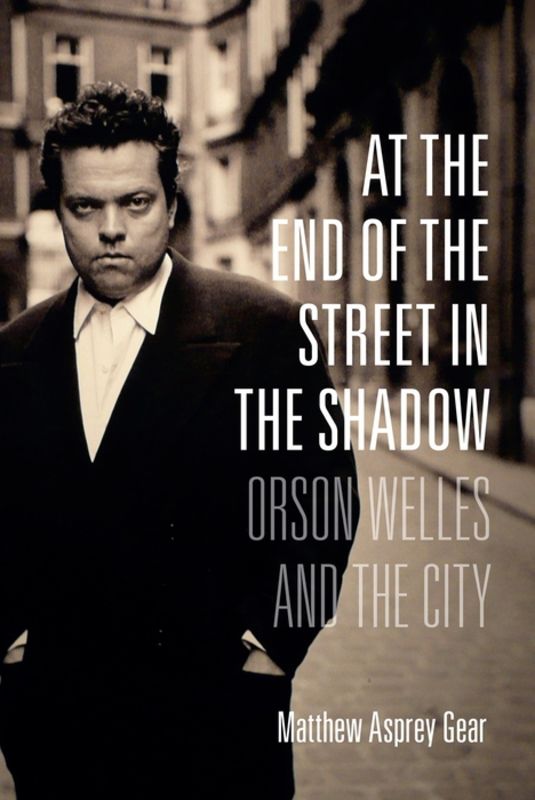
At the end of the street in the shadow
The films of Orson Welles inhabit the spaces of cities-from America's industrializing midland to its noirish borderlands, from Europe's medieval fortresses to its Kafkaesque labyrinths and postwar rubblescapes. His movies take us through dark streets to confront nightmarish struggles for power, the carnivalesque and bizarre, and the shadows and light of human character.
This ambitious new study explores Welles's vision of cities by following recurring themes across his work, including urban transformation, race relations and fascism, the utopian promise of cosmopolitanism, and romantic nostalgia for archaic forms of urban culture. It focuses on the personal and political foundation of Welles's cinematic cities-the way he invents urban spaces on film to serve his dramatic, thematic, and ideological purposes.
The book's critical scope draws on extensive research in international archives and builds on the work of previous scholars. Viewing Welles as a radical filmmaker whose innovative methods were only occasionally compatible with the commercial film industry, this volume examines the filmmaker's original vision for butchered films, such asThe Magnificent Ambersons(1942) andMr. Arkadin(1955), and considers many projects the filmmaker never completed-an immense \"shadow oeuvre\" ranging from unfinished and unreleased films to unrealized treatments and screenplays.
eBook

At the end of the street in the shadow : Orson Welles and the city
The films of Orson Welles inhabit the spaces of cities--from America's industrializing midlandto its noirish borderlands, from Europe's medieval fortresses to its Kafkaesque labyrinths and postwar rubblescapes. His movies take us through dark streets to confront nightmarish struggles for power, the carnivalesque and bizarre, and the shadows and light of human character. This ambitious new study explores Welles's vision of cities by following recurring themes across his work, including urban transformation, race relations and fascism, the utopian promise of cosmopolitanism, and romantic nostalgia for archaic forms of urban culture. It focuses on the personal and political foundation of Welles's cinematic cities--the way he invents urban spaces on film to serve his dramatic, thematic, and ideological purposes. The book's critical scope draws on extensive research in international archives and builds on the work of previous scholars.
BOOK

Orson Welles and the unfinished RKO projects : a postmodern perspective
Postmodern traces Welles's impact on contemporary media narratives, focusing on four emerging narrative modes found in the unfinished RKO films: deconstruction of the first-person singular, adaptation of classic texts for mass media, exploration of the self via primitivism, and examination of the line between reality and fiction. Ultimately, these four narrative styles would enormously impact the development of mass media entertainment, and they still resonate today in popular modes like the “mock”umentary and reality television
eBook

Spooked! : how a radio broadcast and The war of the worlds sparked the 1938 invasion of America
Author Jarrow explores in detail the famous \"War of the Worlds\" radio broadcast from 1938, highlighting the artists behind the broadcast, the broadcast itself, the aftermath, and the repercussions of \"fake news\" today.
BOOK

Vampirism in the Ether: Radio’s Horrific Potential in Orson Welles’s “Dracula”
KEYWORDS: Orson Welles. Dracula, twentieth century, modernism, radio, adaptation, sound studies The Mercury Theatre on the Air adaptation of Dracula updated the novel's protomodernist fears of technology, subsuming and enthralling its subjects through the new medium of radio. Retaining the novel's moments of travel, Orson Welles would bleed diegetic layers of the epistolary form together and rework the narrative's relationships to reflect the asymmetric dynamics of broadcaster and listener. I argue that Welles evokes debates around radio to highlight the medium's potential to both empower and subjugate.
Journal Article

Orson Welles: Director, Magician, and Pedagogue
When George Orson Welles died of a heart attack in Los Angeles in 1985, he was found with his typewriter in his lap, a position he often assumed, working until the very end. Although his health had not been good, he was quite bust Jonathan Rosenbaum has estimated conservatively that during the first half of the 1980s alone, Welles was working on at least a dozen films or scripts for films. This prodigious quantity of work was unusual for him. In celebration of Welles centennial, Naremore takes a closer look at Welles' prolific output and discusses some of his memorable works.
Journal Article

Reading Race and \Rita\ in \The Lady from Shanghai\: Decrypting the Mogul, the Star, and the Auteur
This essay explicates the desire to be independent that derives, I argue, from the moguls who invented Hollywood, resistant actors (James Cagney) and \"rogue\" producers (David O. Selznick). My historical analysis of this desire as it circulates among these figures will be supplemented by script variations of The Lady from Shanghai.
Journal Article