
Catalogue Search | MBRL


Are you sure you want to remove the book from the shelf?

{{itemTitle}}
10
result(s) for
"Weltraumforschung"
Sort by:

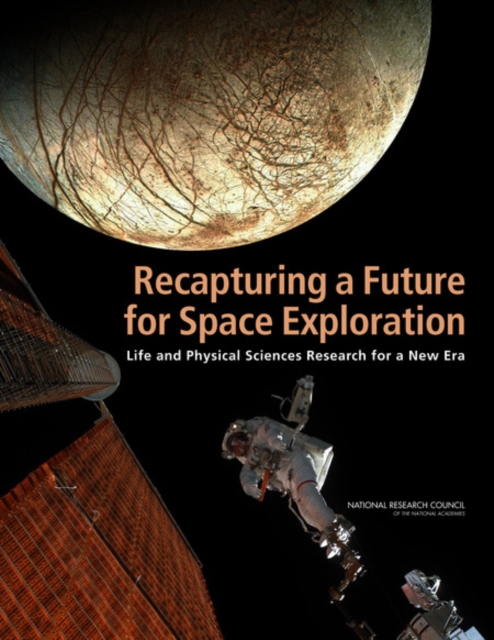
Recapturing a Future for Space Exploration
More than four decades have passed since a human first set foot on the Moon. Great strides have been made in our understanding of what is required to support an enduring human presence in space, as evidenced by progressively more advanced orbiting human outposts, culminating in the current International Space Station (ISS). However, of the more than 500 humans who have so far ventured into space, most have gone only as far as near-Earth orbit, and none have traveled beyond the orbit of the Moon. Achieving humans' further progress into the solar system had proved far more difficult than imagined in the heady days of the Apollo missions, but the potential rewards remain substantial.
During its more than 50-year history, NASA's success in human space exploration has depended on the agency's ability to effectively address a wide range of biomedical, engineering, physical science, and related obstacles-an achievement made possible by NASA's strong and productive commitments to life and physical sciences research for human space exploration, and by its use of human space exploration infrastructures for scientific discovery. The Committee for the Decadal Survey of Biological and Physical Sciences acknowledges the many achievements of NASA, which are all the more remarkable given budgetary challenges and changing directions within the agency. In the past decade, however, a consequence of those challenges has been a life and physical sciences research program that was dramatically reduced in both scale and scope, with the result that the agency is poorly positioned to take full advantage of the scientific opportunities offered by the now fully equipped and staffed ISS laboratory, or to effectively pursue the scientific research needed to support the development of advanced human exploration capabilities.
Although its review has left it deeply concerned about the current state of NASA's life and physical sciences research, the Committee for the Decadal Survey on Biological and Physical Sciences in Space is nevertheless convinced that a focused science and engineering program can achieve successes that will bring the space community, the U.S. public, and policymakers to an understanding that we are ready for the next significant phase of human space exploration. The goal of this report is to lay out steps and develop a forward-looking portfolio of research that will provide the basis for recapturing the excitement and value of human spaceflight-thereby enabling the U.S. space program to deliver on new exploration initiatives that serve the nation, excite the public, and place the United States again at the forefront of space exploration for the global good.
eBook

Shattered Dreams
Shattered Dreamsdelves into the personal stories and recollections of several men and women who were in line to fly a specific or future space mission but lost that opportunity due to personal reasons, mission cancellations, or even tragedies. While some of the subjects are familiar names in spaceflight history, the accounts of others are told here for the first time. Colin Burgess features spaceflight candidates from the United States, Russia, Indonesia, Australia, and Great Britain.Shattered Dreamsbrings to new life such episodes and upheavals in spaceflight history as the saga of the three Apollo missions that were cancelled due to budgetary constraints and never flew; NASA astronaut Patricia Hilliard Robertson, who died of burn injuries after her airplane crashed before she had a chance to fly into space; and a female cosmonaut who might have become the first journalist to fly in space. Another NASA astronaut was preparing to fly an Apollo mission before he was diagnosed with a disqualifying illness. There is also the amazing story of the pilot who could have bailed out of his damaged aircraft but held off while heroically avoiding a populated area and later applied to NASA to fulfill his cherished dream of becoming an astronaut despite having lost both legs in the accident. These are the incredibly human stories of competitive realists fired with an unquenchable passion. Their accounts reveal in their own words-and those of others close to them-how their shared ambition would go awry through personal accidents, illness, theChallengerdisaster, death, or other circumstances.
eBook

Asteroids IV
Over the past decade, asteroids have come to the forefront of planetary science. Scientists across broad disciplines are increasingly recognizing that understanding asteroids is essential to discerning the basic processes of planetary formation, including how their current distribution bespeaks our solar system's cataclysmic past. For explorers, the nearest asteroids beckon as the most accessible milestones in interplanetary space, offering spaceflight destinations easier to reach than the lunar surface. For futurists, the prospects of asteroids as commercial resources tantalize as a twenty-first-century gold rush, albeit with far greater challenges than faced by nineteenth-century pioneers. For humanity, it is the realization that asteroids matter. It is not a question of if - but when - the next major impact will occur. While the disaster probabilities are thankfully small, fully cataloging and characterizing the potentially hazardous asteroid population remains unfinished business.Asteroids IV sets the latest scientific foundation upon which all these topics and more will be built upon for the future. Nearly 150 international authorities through more than 40 chapters convey the definitive state of the field by detailing our current astronomical, compositional, geological, and geophysical knowledge of asteroids, as well as their unique physical processes and interrelationships with comets and meteorites. Most importantly, this volume outlines the outstanding questions that will focus and drive researchers and students of all ages toward new advances in the coming decade and beyond.
eBook

Defence and discovery : Canada's military space program, 1945-74
A revealing investigation into the origins, development, and impact of Canada's space program from 1945 to 1974.
eBook

Launching Europe
In this first ethnographic study of the European Space Agency, Stacia Zabusky explores the complex processes involved in cooperation on space science missions in the contemporary context of European integration. Zabusky argues that the practice of cooperation does not depend on a homogenizing of interests in a bland unity. Instead, it consists of ongoing negotiation of and conflict over often irreconcilable differences. In this case, those differences are put into play by both technical and political divisions of labor (in particular, those of big science and of European integration).
Zabusky shows how participants on space science missions make use of these differences, particularly those manifest in identities of work and of nationality, as they struggle together not only to produce space satellites but also to create European integration. She argues that the dialectical processes of production include and depend on conflict and contradiction to maintain energy and excitement and thus to be successful. Participants in these processes are not, however, working only to produce tangible success. In her epilogue, Zabusky argues that European space science missions can be interpreted as sacred journeys undertaken collectively, and that these journeys are part of a fundamental cultural project of modernity: the legitimation of and aspiration for purity. She suggests, finally, that this project characterizes not only the institution of technoscience but those of bureaucracy and nationalism as well.
eBook
Dying Planet
For more than a century, Mars has been at the center of debates about humanity’s place in the cosmos. Focusing on perceptions of the red planet in scientific works and science fiction, Dying Planet analyzes the ways Mars has served as a screen onto which humankind has projected both its hopes for the future and its fears of ecological devastation on Earth. Robert Markley draws on planetary astronomy, the history and cultural study of science, science fiction, literary and cultural criticism, ecology, and astrobiology to offer a cross-disciplinary investigation of the cultural and scientific dynamics that have kept Mars on front pages since the 1800s.Markley interweaves chapters on science and science fiction, enabling him to illuminate each arena and to explore the ways their concerns overlap and influence one another. He tracks all the major scientific developments, from observations through primitive telescopes in the seventeenth century to data returned by the rovers that landed on Mars in 2004. Markley describes how major science fiction writers—H. G. Wells, Kim Stanley Robinson, Philip K. Dick, Edgar Rice Burroughs, Ray Bradbury, Robert Heinlein, and Judith Merril—responded to new theories and new controversies. He also considers representations of Mars in film, on the radio, and in the popular press. In its comprehensive study of both science and science fiction, Dying Planet reveals how changing conceptions of Mars have had crucial consequences for understanding ecology on Earth.
eBook

Recapturing a future for space exploration : life and physical sciences research for a new era / Committee for the Decadal Survey on Biological and Physical Sciences in Space ; Space Studies Board ; Aeronautics and Space Engineering Board, Division on Engineering and Physical Sciences, National Research Council of the National Academies
'More than four decades have passed since a human first set foot on the Moon. Great strides have been made in our understanding of what is required to support an enduring human presence in space, as evidenced by progressively more advanced orbiting human outposts, culminating in the current International Space Station (ISS). However, of the more than 500 humans who have so far ventured into space, most have gone only as far as near-Earth orbit, and none have traveled beyond the orbit of the Moon. Achieving humans' further progress into the solar system had proved far more difficult than imagined in the heady days of the Apollo missions, but the potential rewards remain substantial. During its more than 50-year history, NASA's success in human space exploration has depended on the agency's ability to effectively address a wide range of biomedical, engineering, physical science, and related obstacles--an achievement made possible by NASA's strong and productive commitments to life and physical sciences research for human space exploration, and by its use of human space exploration infrastructures for scientific discovery. The Committee for the Decadal Survey of Biological and Physical Sciences acknowledges the many achievements of NASA, which are all the more remarkable given budgetary challenges and changing directions within the agency. In the past decade, however, a consequence of those challenges has been a life and physical sciences research program that was dramatically reduced in both scale and scope, with the result that the agency is poorly positioned to take full advantage of the scientific opportunities offered by the now fully equipped and staffed ISS laboratory, or to effectively pursue the scientific research needed to support the development of advanced human exploration capabilities. Although its review has left it deeply concerned about the current state of NASA's life and physical sciences research, the Committee for the Decadal Survey on Biological and Physical Sciences in Space is nevertheless convinced that a focused science and engineering program can achieve successes that will bring the space community, the U.S. public, and policymakers to an understanding that we are ready for the next significant phase of human space exploration. The goal of this report is to lay out steps and develop a forward-looking portfolio of research that will provide the basis for recapturing the excitement and value of human spaceflight--thereby enabling the U.S. space program to deliver on new exploration initiatives that serve the nation, excite the public, and place the United States again at the forefront of space exploration for the global good\"--Publisher's description.
eBook

Dying planet : Mars in science and the imagination
For more than a century, Mars has been at the center of debates about humanity's place in the cosmos. Focusing on perceptions of the red planet in scientific works and science fiction, Dying Planet analyzes the ways Mars has served as a screen onto which humankind has projected both its hopes for the future and its fears of ecological devastation on Earth. Robert Markley draws on planetary astronomy, the history and cultural study of science, science fiction, literary and cultural criticism, ecology, and astrobiology to offer a cross-disciplinary investigation of the cultural and scientific dynamics that have kept Mars on front pages since the 1800s.
Markley interweaves chapters on science and science fiction, enabling him to illuminate each arena and to explore the ways their concerns overlap and influence one another. He tracks all the major scientific developments, from observations through primitive telescopes in the seventeenth century to data returned by the rovers that landed on Mars in 2004. Markley describes how major science fiction writers—H. G. Wells, Kim Stanley Robinson, Philip K. Dick, Edgar Rice Burroughs, Ray Bradbury, Robert Heinlein, and Judith Merril—responded to new theories and new controversies. He also considers representations of Mars in film, on the radio, and in the popular press. In its comprehensive study of both science and science fiction, Dying Planet reveals how changing conceptions of Mars have had crucial consequences for understanding ecology on Earth.
eBook
