
Catalogue Search | MBRL


Are you sure you want to remove the book from the shelf?

{{itemTitle}}
6,664
result(s) for
"Western World"
Sort by:

Uses of the West : security and the politics of order
The notion of \"the West\" is commonly used in politics, the media, and in the academic world. To date, our idea of 'the West' has been largely assumed and effective, but has not been examined in detail from a theoretical perspective. 'Uses of \"the West\"' combines a range of original and topical approaches to evaluate what 'the West' really does, and how the idea is being used in everyday political practice. This book examines a range of uses of \"the West\", and traces how \"the West\" works in a broad array of conceptual and empirical contexts, ranging from the return of geopolitics - via a critical review of the debates surrounding Samuel Huntington's Clash of Civilization thesis - to the question of the future of \"the West\". Analysis extends further to the repercussions of the war on terror on Western democracy and the processes of delineating the Western from the non-Western, as well as observations of the institutional transformations of Western order.
Book

Border Conditions
Border Conditions combines
history and memory studies with literary and cultural studies to
examine lives at the limits of contemporary Europe: Russian
speakers living in Latvia. Since the fall of the USSR in
1991, Latvia's Russian speakers have balanced between Russia and
Europe as well as a socialist past, a capitalist and liberal
present, and an illiberal regime rising in the Russian Federation.
Kevin M. F. Platt describes how members of this population have
defined themselves through art, literature, cultural institutions,
film, and music-and how others have sought to define them.
At the end of the Cold War, many anticipated that societies
globally could agree on the meaning of past history and a just
politics in the present. The view from the borders of Europe
demonstrates the contradictions pertaining to terms like
empire, state socialism, liberalism , and nation
that have made it impossible to achieve a consensus. In refocusing
the examination of state socialism's aftermath around questions of
empire and postcolonialism, Border Conditions helps us
understand the distinctions between Russian and Western worldviews
driving military confrontation to this day.
eBook


Dying to Learn
In Dying to Learn
, Michael Hunzeker develops a novel theory to explain how
wartime militaries learn. He focuses on the Western Front,
which witnessed three great-power armies struggle to cope with
deadlock throughout the First World War, as the British, French,
and German armies all pursued the same solutions-assault tactics,
combined arms, and elastic defense in depth. By the end of the war,
only the German army managed to develop and implement a set of
revolutionary offensive, defensive, and combined arms doctrines
that in hindsight represented the best way to fight.
Hunzeker identifies three organizational variables that
determine how fighting militaries generate new ideas, distinguish
good ones from bad ones, and implement the best of them across the
entire organization. These factors are: the degree to which
leadership delegates authority on the battlefield; how effectively
the organization retains control over soldier and officer training;
and whether or not the military possesses an independent doctrinal
assessment mechanism.
Through careful study of the British, French, and German
experiences in the First World War, Dying to Learn
provides a model that shows how a resolute focus on analysis,
command, and training can help prepare modern militaries for
adapting amidst high-intensity warfare in an age of revolutionary
technological change.
eBook


Showcasing the Great Experiment
This book is a history of the Soviet tours of European and American intellectuals, writers, bohemians, professionals, and political tourists who saw the “Soviet experiment” in the 1920s and 1930s. It provides a new framework for understanding the relationship between intellectuals and communism and the Soviet reception of foreign visitors, including the leading fellow-travelers who praised Stalin and Stalinism in the interwar period. The work is based on a far-reaching analysis of the declassified archives of agencies charged with crafting the international image of the first socialist society, including VOKS (the All-Union Society for Cultural Ties Abroad). The book brings this story into new focus as one of the great transnational encounters of the twentieth century. As many visitors were profoundly influenced by their Soviet tours, so too was the Soviet system itself: the experiences of building showcases and tutoring outsiders to perceive the future-in-the-making comprise a neglected international dimension to the emergence of Stalinism. Probing entanglements between far-left and far-right ideological extremes, the work pays special attention to the covert interaction between communism and fascism, including Soviet attempts to recruit German “National Bolsheviks” and fascist intellectuals. The unprecedented scope of Soviet efforts to mold foreign, particularly Western public opinion created a new chapter in the history of modern cultural diplomacy. Setting the revolutionary regime's innovations in the context of the entire history of foreign visitors in Russia, the book argues that Soviet mobilization for the international ideological contest directly paved the way for the cultural Cold War.
eBook

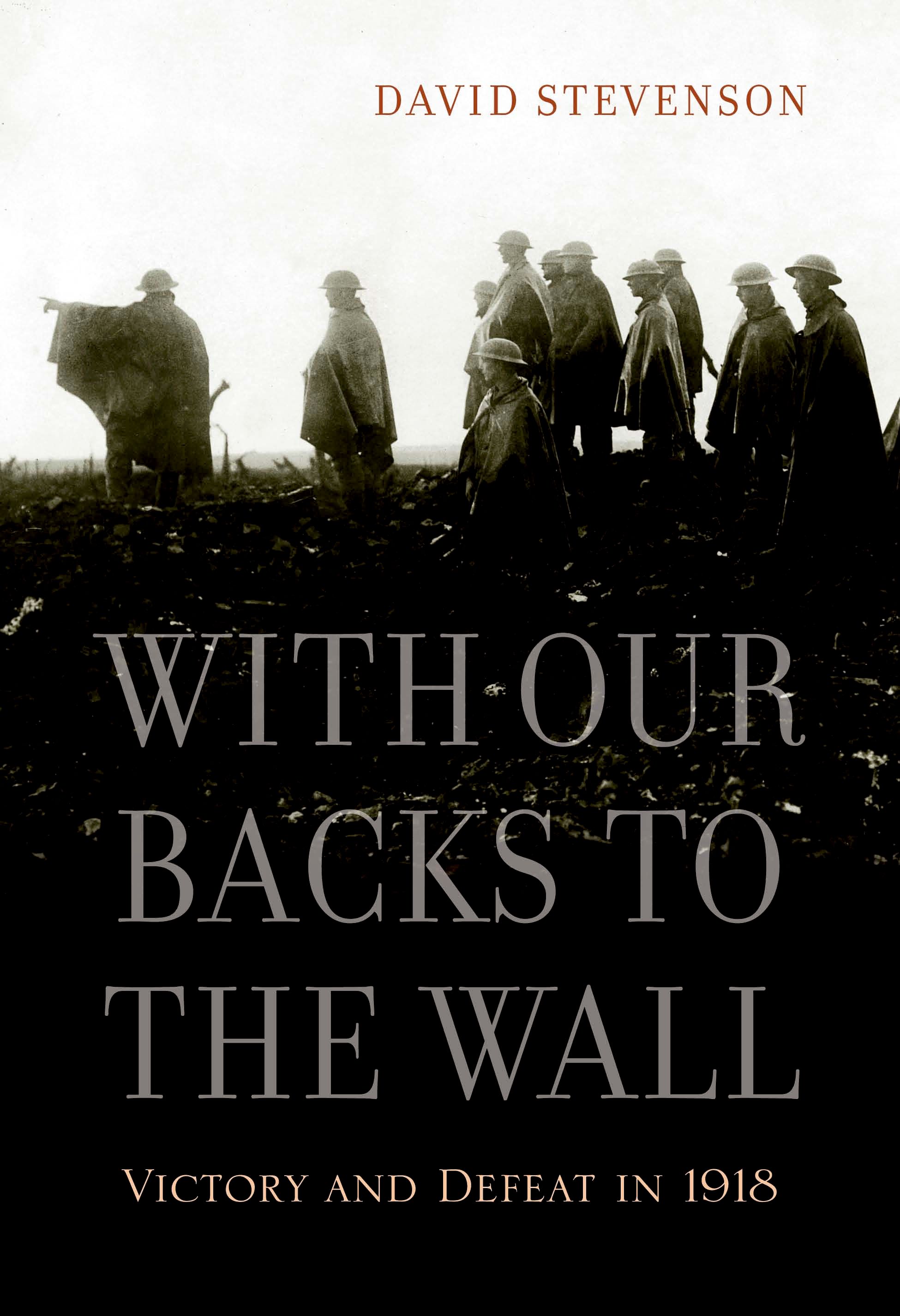
With our backs to the wall : victory and defeat in 1918
With so much at stake and so much already lost, why did World War I end with a whimper-an arrangement between two weary opponents to suspend hostilities? After more than four years of desperate fighting, with victories sometimes measured in feet and inches, why did the Allies reject the option of advancing into Germany in 1918 and taking Berlin? Most histories of the Great War focus on the avoidability of its beginning. This book brings a laser-like focus to its ominous end-the Allies' incomplete victory, and the tragic ramifications for world peace just two decades later. In the most comprehensive account to date of the conflict's endgame, David Stevenson approaches the events of 1918 from a truly international perspective, examining the positions and perspectives of combatants on both sides, as well as the impact of the Russian Revolution. Stevenson pays close attention to America's effort in its first twentieth-century war, including its naval and military contribution, army recruitment, industrial mobilization, and home-front politics. Alongside military and political developments, he adds new information about the crucial role of economics and logistics. The Allies' eventual success, Stevenson shows, was due to new organizational methods of managing men and materiel and to increased combat effectiveness resulting partly from technological innovation. These factors, combined with Germany's disastrous military offensive in spring 1918, ensured an Allied victory-but not a conclusive German defeat.
eBook