
Catalogue Search | MBRL


Are you sure you want to remove the book from the shelf?

{{itemTitle}}
98
result(s) for
"Western countries -- Foreign relations -- Middle East"
Sort by:


From resilience to revolution
Based on comparative historical analyses of Iran, Jordan, and Kuwait, Sean L. Yom examines the foreign interventions, coalitional choices, and state outcomes that made the political regimes of the modern Middle East. A key text for foreign policy scholars,From Resilience to Revolutionshows how outside interference can corrupt the most basic choices of governance: who to reward, who to punish, who to compensate, and who to manipulate.
As colonial rule dissolved in the 1930s and 1950s, Middle Eastern autocrats constructed new political states to solidify their reigns, with varying results. Why did equally ambitious authoritarians meet such unequal fates? Yom ties the durability of Middle Eastern regimes to their geopolitical origins. At the dawn of the postcolonial era, many autocratic states had little support from their people and struggled to overcome widespread opposition. When foreign powers intervened to bolster these regimes, they unwittingly sabotaged the prospects for long-term stability by discouraging leaders from reaching out to their people and bargaining for mass support-early coalitional decisions that created repressive institutions and planted the seeds for future unrest. Only when they were secluded from larger geopolitical machinations did Middle Eastern regimes come to grips with their weaknesses and build broader coalitions.
eBook

Away from chaos : the Middle East and the challenge to the West
\"Away from Chaos is a sweeping political history of the global ramifications of Middle East politics. Starting with Arab nationalism in the postwar era and tracing the international ripple effects of local conflicts in the region up to the present, Kepel has written a clever and easily digestible narrative of long-term chaotic events throughout the Middle East while seamlessly incorporating on-the-ground observations and personal experiences from the politicians and civilians who lived through them. From the Yom Kippur/Ramadan war of 1973 to the aftermath of the various Arab Springs of 2011 to the return of Russian power in the Levant, Away from Chaos seeks to make sense of and weave together the various political threads that run through Middle East politics and ties them to their implications on the larger global stage. With his signature persuasive and lively style, Kepel uses his forty years of experience in the region to create a straightforward chronology of events that traces the causes of tension in the Middle East and the fault lines to emerge as a result of our current actions\"-- Provided by publisher.
Book


The politics of persecution : Middle Eastern Christians in an age of empire
\"Persecution of Christians in the Middle East has been a recurring theme since the middle of the nineteenth century. The topic has experienced a resurgence in the last few years, especially during the Trump era. Middle Eastern Christians are often portrayed as a homogeneous, helpless group ever at the mercy of their Muslim enemies, a situation that only Western powers can remedy. The Politics of Persecution revisits this narrative with a critical eye. Mitri Raheb charts the plight of Christians in the Middle East from the invasion of Napoleon Bonaparte in 1799 to the so-called Arab Spring. The book analyzes the diverse socioeconomic and political factors that led to the diminishing role and numbers of Christians in Palestine, Egypt, Syria, Lebanon, and Jordan during the eras of Ottoman, French, and British Empires, through the eras of independence, Pan-Arabism, and Pan-Islamism, and into the current era of American empire. With an incisive exposé of the politics that lie behind alleged concerns for these persecuted Christians - and how the concept of persecution has been a tool of public diplomacy and international politics - Raheb reveals that Middle Eastern Christians have been repeatedly sacrificed on the altar of Western national interests. The West has been part of the problem for Middle Eastern Christianity and not part of the solution, from the massacre on Mount Lebanon to the rise of ISIS. The Politics of Persecution, written by a well-known Palestinian Christian theologian, provides an insider perspective on this contested region. Middle Eastern Christians survived successive empires by developing great elasticity in adjusting to changing contexts; they learned how to survive atrocities and how to resist creatively while maintaining a dynamic identity. In this light, Raheb casts the history of Middle Eastern Christians not so much as one of persecution but as one of resilience.\"--Jacket flaps.
Book
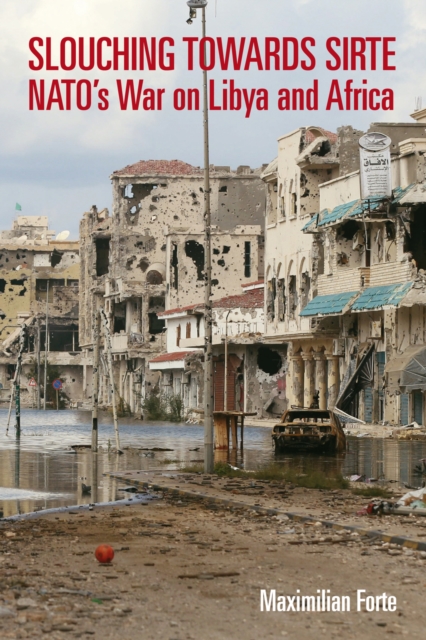
Slouching towards Sirte : NATO's war on Libya and Africa
A comprehensive analysis, this book examines all the justifications and myths about the war on Libya and methodically dismantles them. It delineates the documentary history of events, processes, and decisions that led up to the war while underscoring its resulting consequences. Arguing that NATO's war is part of a larger process of militarizing U.S. relations with Africa—which sees the development of the Pentagon's AFRICOM as being in competition with Pan-African initiative—this account shows that Western relations with a \"rehabilitated\" Libya were shaky at best, mired in distrust, and exhibiting a preference for regime change.
eBook


Night of power : the betrayal of the Middle East
This title is a blend of history and up-to-date journalism. Telling the stories of the victims of the vast, corrupt system of 'honour' crimes that plague the Middle East, which take the lives of perhaps 20,000 women a year, this volume is an essential read for anyone seeking to understand the current situation in the Middle East.
BOOK

The European Union and the Arab Spring
The European Union and the Arab Spring: Promoting Democracy and Human Rights in the Middle East, edited by Joel Peters, analyzes the response of the European Union to recent uprisings in the Middle East. The past year has witnessed a wave of popular uprisings across North Africa and the Middle East which the Western media dubbed “the Arab Spring.” Demanding greater freedoms, political reform, and human rights, the protesters swept away many of the region’s authoritarian autocratic regimes. The events of the Arab Spring have been truly historic. They led to profound changes in the domestic order of Middle Eastern states and societies and impacted the international politics of the region. Additionally, these events necessitate a comprehensive reappraisal by the United States and most notably by the EU in their relations with the states and peoples of the region. This timely collection brings together nine leading authorities on European foreign policy and the Middle East, and investigates three central questions: What role did the European Union play in promoting democracy and human rights in the countries of North Africa and the Middle East? How did the EU respond to the uprisings of the Arab street? What challenges is Europe now facing in its relations with the region? Peters’ The European Union and the Arab Spring is at the forefront of scholarship on this historic socio-political shift in the Middle East and its wider implications for the West.
eBook