
Catalogue Search | MBRL


Are you sure you want to remove the book from the shelf?

{{itemTitle}}
19
result(s) for
"Western countries Politics and government 19th century."
Sort by:

Perfecting parliament : constitutional reform, liberalism, and the rise of Western democracy
\"This book explains why contemporary liberal democracies are based on historical templates rather than revolutionary reforms; why the transition in Europe occurred during a relatively short period in the nineteenth century; why politically and economically powerful men and women voluntarily supported such reforms; how interests, ideas, and pre-existing institutions affected the reforms adopted; and why the countries that liberalized their political systems also produced the Industrial Revolution. The analysis is organized in three parts. The first part develops new rational choice models of (1) governance, (2) the balance of authority between parliaments and kings, (3) constitutional exchange, and (4) suffrage reform. The second part provides historical overviews and detailed constitutional histories of six important countries. The third part provides additional evidence in support of the theory, summarizes the results, contrasts the approach taken in this book with that of other scholars, and discusses methodological issues\"-- Provided by publisher.
Book

Routledge Handbook of Citizenship in the Middle East and North Africa
This comprehensive Handbook gives an overview of the political, social, economic and legal dimensions of citizenship in the Middle East and North Africa from the nineteenth century to the present.
The terms citizen and citizenship are mostly used by researchers in an off-hand, self-evident manner. A citizen is assumed to have standard rights and duties that everyone enjoys. However, citizenship is a complex legal, social, economic, cultural, ethical and religious concept and practice. Since the rise of the modern bureaucratic state, in each country of the Middle East and North Africa, citizenship has developed differently. In addition, rights are highly differentiated within one country, ranging from privileged, underprivileged and discriminated citizens to non-citizens. Through its dual nature as instrument of state control, as well as a source of citizen rights and entitlements, citizenship provides crucial insights into state-citizen relations and the services the state provides, as well as the way citizens respond to these actions.
This volume focuses on five themes that cover the crucial dimensions of citizenship in the region:
Historical trajectory of citizenship since the nineteenth century until independence
Creation of citizenship from above by the state
Different discourses of rights and forms of contestation developed by social movements and society
Mechanisms of inclusion and exclusion
Politics of citizenship, nationality and migration
Covering the main dimensions of citizenship, this multidisciplinary book is a key resource for students and scholars interested in citizenship, politics, economics, history, migration and refugees in the Middle East and North Africa.
eBook

The Vienna School of Art History
Matthew Rampley’s The Vienna School of Art History is the first book in over seventy-five years to study in depth and in context the practices of art history from 1847, the year the first teaching position in the discipline was created, to 1918, the collapse of Austria-Hungary. It traces the emergence of art history as a discipline, the establishment of norms of scholarly enquiry, and the involvement of art historians in wider debates about the cultural and political identity of the monarchy. While Rampley also examines the formation of art history elsewhere in Austria-Hungary, the so-called Vienna School plays the central role in the study. Located in the Habsburg imperial capital, Vienna art historians frequently became entangled in debates that were of importance to art historians elsewhere in the Empire, and the book pays particular attention to these areas of overlapping interest. The Vienna School was well known for its methodological innovations and this book analyzes its contributions in this area. Rampley focuses most fully, however, on the larger political and ideological context of the practice of art history, in particular the way in which art historical debates served as proxies for wider arguments over the political, social, and cultural life of the Habsburg Empire.
eBook

Russia and the West from Alexander to Putin
Since Russia has re-emerged as a global power, its foreign policies have come under close scrutiny. In Russia and the West from Alexander to Putin, Andrei P. Tsygankov identifies honor as the key concept by which Russia's international relations are determined. He argues that Russia's interests in acquiring power, security and welfare are filtered through this cultural belief and that different conceptions of honor provide an organizing framework that produces policies of cooperation, defensiveness and assertiveness in relation to the West. Using ten case studies spanning a period from the early nineteenth century to the present day - including the Holy Alliance, the Triple Entente and the Russia-Georgia war - Tsygankov's theory suggests that when it perceives its sense of honor to be recognized, Russia cooperates with the Western nations; without such a recognition it pursues independent policies either defensively or assertively.
eBook

The Monument of Tomorrow
Rupture, iconoclasm, and tabula rasa are concepts commonly used to describe the approach to cultural heritage associated with the avant-garde and revolutionary politics during the early twentieth century. Highlighting artists and radical intellectuals who worked to protect public monuments in 1910–1950s Spain, The Monument of Tomorrow challenges the persistent narrative, imposed by Francoism, of an iconoclastic Second Republic in Spain.
Author Miguel Caballero draws on a wide range of sources to examine how artists, architects, writers, and activists transformed monument and heritage conservation into a progressive, experimental cause in their fight against fascism. During the Spanish War, with its devastating air raids, these individuals were motivated by the “defense of culture” to become determined conservationists. Caballero’s research incorporates surviving monuments, architectural plans, propaganda posters, and literary works, including novels, plays, and poetry. The war became a laboratory for experiments in conserving and redefining monuments and national heritage. Modernist-style protective structures, for example, were built atop Madrid’s historic monuments, including statues of Cybele, Neptune, and Phillip III in Plaza Mayor. Such innovations later influenced strategies for safeguarding monuments during the Second World War. This history, Caballero argues, makes the Spanish War pivotal to development of the concept of World Heritage.
Ultimately, The Monument of Tomorrow demonstrates that heritage conservation does not have to be politically conservative. Those interested in anti-fascism, art history, modern architecture, modernism, cultural heritage, conservation and preservation, Iberian studies, and war studies should find valuable insights in this innovative, original work.
eBook
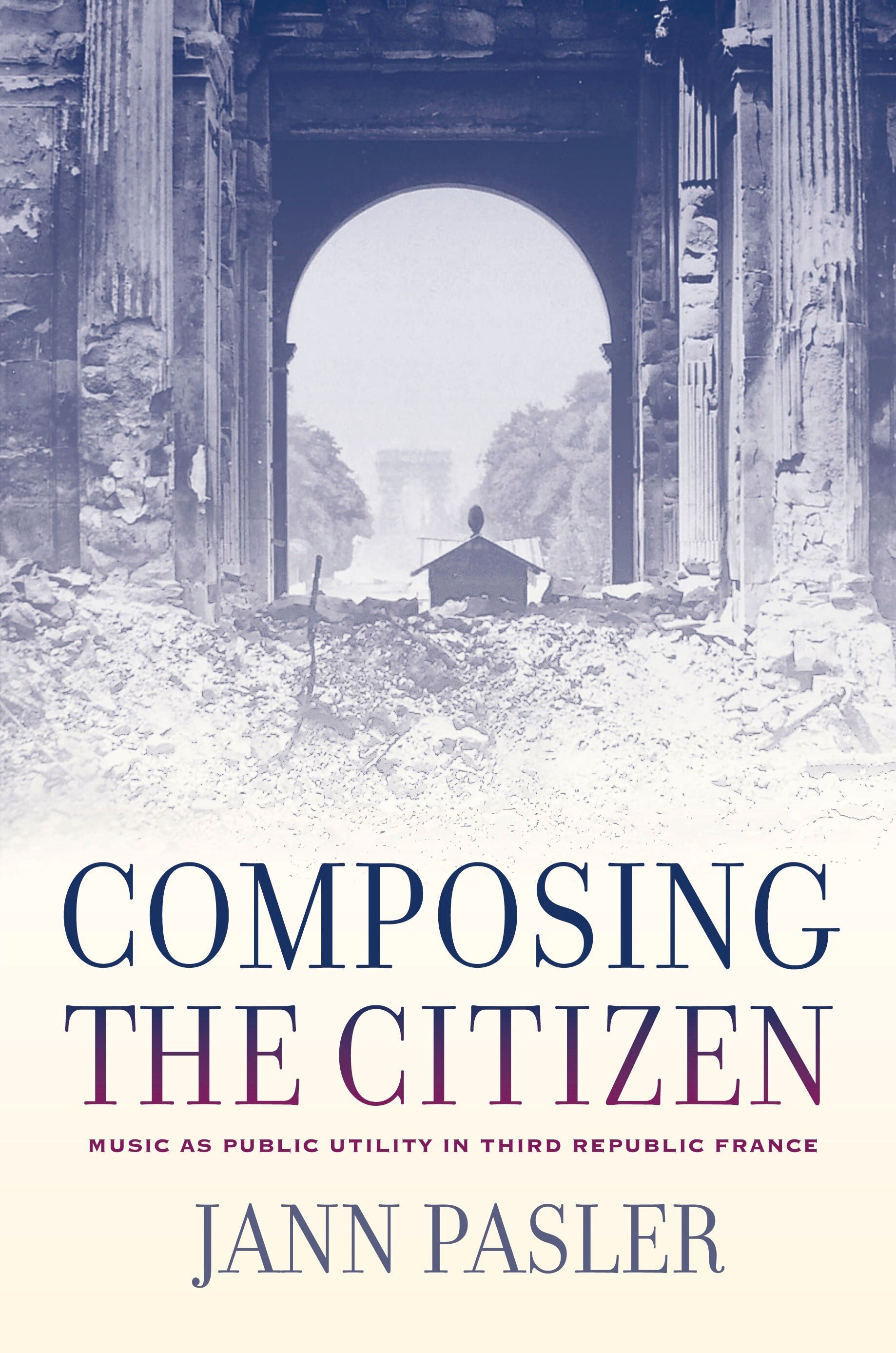
Composing the Citizen
In a book that challenges modernist ideas about the value and role of music in Western society, Composing the Citizen demonstrates how music can help forge a nation. Deftly exploring the history of Third Republic France, Jann Pasler shows how French people from all classes and political persuasions looked to music to revitalize the country after the turbulent crises of 1871. Embraced not as a luxury but for its \"public utility,\" music became an object of public policy as integral to modern life as power and water, a way to teach critical judgment and inspire national pride. It helped people to forget the past, voice conflicting aspirations, and imagine a shared future. Based on a dazzling survey of archival material, Pasler's rich interdisciplinary work looks beyond elites and the histories their agendas have dominated to open new windows onto the musical tastes and practices of amateurs as well as professionals. A fascinating history of the period emerges, one rooted in political realities and the productive tensions between the political and the aesthetic. Highly evocative and deeply humanistic, Composing the Citizen ignites broad debates about music's role in democracy and its meaning in our lives.
eBook

The State and Business in the Major Powers
In the 19th and early 20th centuries, the state emerged as a major player in the economies of the Western World.
This important new volume provides an economic history for the period 1815-1939 of state/business relations in the major powers: France, Germany, Japan, Russia, UK and the USA. The book challenges the traditional story that the scale of state intervention reflected the degree to which each country was ideologically committed to laissez-faire, and which also tended to assume that governments were interested in economic growth and raising average living standards. Robert Millward gives a rather different perspective, arguing that the scale of state intervention and the differences across countries were motivated more by considerations of external defence and internal unification than by any notions of promoting economic growth or adherence to laissez-faire.
This book provides, for the first time, an integrated economic history of these state /business relations in the major powers in the period 1815-1939, and offers a completely new perspective on the links between tariff policies, state enterprise in manufacturing, the treatment of the peasantry, regulation of railways, taxation of the business sector, policies on cartels, trusts and competition.
eBook

Europe's utopias of peace : 1815, 1919, 1951
Europe's Utopias of Peace explores attempts to create a lasting European peace in the aftermath of the Napoleonic wars and the two world wars.The book charts the 250 year cycle of violent European conflicts followed by new utopian formulations for peace.
eBook

Gifts of Mars: Warfare and Europe's Early Rise to Riches
Western Europe surged ahead of the rest of the world long before technological growth became rapid. Europe in 1500 already had incomes twice as high on a per capita basis as Africa, and one-third greater than most of Asia. In this essay, we explain how Europe's tumultuous politics and deadly penchant for warfare translated into a sustained advantage in per capita incomes. We argue that Europe's rise to riches was driven by the nature of its politics after 1350—it was a highly fragmented continent characterized by constant warfare and major religious strife. No other continent in recorded history fought so frequently, for such long periods, killing such a high proportion of its population. When it comes to destroying human life, the atomic bomb and machine guns may be highly efficient, but nothing rivaled the impact of early modern Europe's armies spreading hunger and disease. War therefore helped Europe's precocious rise to riches because the survivors had more land per head available for cultivation. Our interpretation involves a feedback loop from higher incomes to more war and higher land-labor ratios, a loop set in motion by the Black Death in the middle of the 14th century.
Journal Article

Transformation at the margins: Imperial expansion and systemic change in world politics
Taking the phenomenon of empire as its starting point, this article seeks to provide a framework for addressing the question of how and why international systems change over time. Synthesising elements from network-relational analysis and practice theory, I argue that international systems are best thought of as being composed of multiple partially overlapping and interrelated hierarchical networks. These networks are made up of social ties – as in classic network analysis – but also of specific repertoires of practice. Systemic transformations happen through the reconfiguration of networks, both through shifts in social ties and through changes in their practices. Empire provides a particularly illuminating window into the topic of systemic change, in part because a major driver of historical transformations has been the expansion of empires and their encounters with other heterogeneous polities across the globe, and in part because a focus on imperial interactions highlights the limitations of existing unit-centric perspectives. Drawing on examples from the nineteenth century, I illustrate the usefulness of the framework by showing how different regionally anchored systems came into contact with the expanding spheres of Western empires and how such points of interaction contributed to the development of an increasingly global international system.
Journal Article