
Catalogue Search | MBRL


Are you sure you want to remove the book from the shelf?

{{itemTitle}}
383
result(s) for
"Westliche Welt"
Sort by:

Useful enemies : Islam and the Ottoman Empire in Western political thought, 1450-1750
From the fall of Constantinople in 1453 until the eighteenth century, many Western European writers viewed the Ottoman Empire with almost obsessive interest. Typically they reacted to it with fear and distrust; and such feelings were reinforced by the deep hostility of Western Christendom towards Islam. Yet there was also much curiosity about the social and political system on which the huge power of the sultans was based. In the sixteenth century, especially, when Ottoman territorial expansion was rapid and Ottoman institutions seemed particularly robust, there was even open admiration. In this path-breaking book Noel Malcolm ranges through these vital centuries of East-West interaction, studying all the ways in which thinkers in the West interpreted the Ottoman Empire as a political phenomenon - and Islam as a political religion. Useful Enemies shows how the concept of 'oriental despotism' began as an attempt to turn the tables on a very positive analysis of Ottoman state power, and how, as it developed, it interacted with Western debates about monarchy and government. Noel Malcolm also shows how a negative portrayal of Islam as a religion devised for political purposes was assimilated by radical writers, who extended the criticism to all religions, including Christianity itself. Examining the works of many famous thinkers (including Machiavelli, Bodin, and Montesquieu) and many less well-known ones, Useful Enemies illuminates the long-term development of Western ideas about the Ottomans, and about Islam. Noel Malcolm shows how these ideas became intertwined with internal Western debates about power, religion, society, and war. Discussions of Islam and the Ottoman Empire were thus bound up with mainstream thinking in the West on a wide range of important topics. These Eastern enemies were not just there to be denounced. They were there to be made use of, in arguments which contributed significantly to the development of Western political thought. -- Provided by publisher.
Book

Western capitalism in transition
Since its emergence at the end of the seventeenth century, industrial capitalism as a specific form of social organisation has set recurrent challenges to its own persistence, and until today, it has proved to be successful to develop new ways of accumulation based on its capacity of adaptation. Is this process of transition now accelerating or reaching an end point? This book is a critical exploration of capitalism in transition, bringing together cutting edge, world renowned scholars who reflect from different disciplinary points of view. This collection engages with the primarily Western themes of welfare capitalism and social fragmentation. Structured over three parts, the book analyses; the transformations of welfare societies and capitalism with a focus on South European welfare states and their (in)capacity to tackle poverty; the transformation of work and migration with a special attention to informality and the question of social rights; and the transformation of cities.
eBook

The new politics of Russia : interpreting change
From the conflict in Syria to the crisis in Ukraine, Russia continues to dominate the headlines. Yet the political realities of contemporary Russia are poorly understood by Western observers and policy-makers. In this highly engaging book, Andrew Monaghan explains why we tend to misunderstand Russia - and the importance of 'getting Russia right'. Exploring in detail the relationship between the West and Russia, he charts the development of relations and investigates the causes of the increasingly obvious sense of strategic dissonance. He also considers the evolution in Russian domestic politics, introducing influential current figures and those who are forming the leadership and opposition of the future. By delving into the depths of difficult questions such as the causes of the Ukraine crisis or the political protests surrounding the 2011-12 elections, the book offers a dynamic model for understanding this most fascinating and elusive of countries. -- Publisher website.
Book

Who Dislikes Whom? Affective Polarization between Pairs of Parties in Western Democracies
While dislike of opposing parties, that is, affective polarization, is a defining feature of contemporary politics, research on this topic largely centers on the United States. We introduce an approach that analyzes affective polarization between pairs of parties, bridging the US two-party system and multiparty systems in other democracies. Analyzing survey data from twenty Western democracies since the mid-1990s, first, we show that partisans' dislike of out-parties is linked to elite policy disagreements on economic issues and, increasingly over time, also to cultural issues. Secondly, we argue and empirically demonstrate that governing coalition partners in parliamentary democracies display much warmer feelings toward each other than we would expect based on elite policy (dis)agreements. Third, we show that radical right parties are disliked much more intensely than we would expect based on policy disputes and coalition arrangements. These findings highlight the policy-based and institutional underpinnings of affective polarization.
Journal Article


Theoterrorism v. Freedom of Speech
The Rushdie Affair, the Danish Cartoon Affair, the assault on Charlie Hebdo, and the earlier Carrell Affair, are examples of religious fanaticsș extreme reactions to religious satire and criticism. Perpetrators of these actions consider themselves as true believers. This book aims to understand their motives by means of the concept of theoterrorism: terrorism grounded in religious zealotry.
eBook

Capital wars : the new east-west challenge for entrepreneurial leadership and economic success
\"Just a few years is all it took for the debt crisis to bring down the mighty forces of American and European capitalism and undo two centuries of Western dominance on the world's economic and political stage. In Capital Wars, Daniel Pinto offers a unique insight into how the East is winning the battle for economic supremacy, thereby shaping the new world order and leaving America and Europe with no choice but to reinvent themselves. Drawing on his own experience at the highest levels of business and finance, Pinto dismisses the common notion that globalization is to blame for anemic growth, massive unemployment and over-indebtedness. Instead, he argues that by killing our own entrepreneurial spirit, we have set the stage for the demise of the West and the rise of emerging powers. Capital Wars is a road map designed to re-energize large corporations, better control financial markets and reposition the entrepreneur at the center of the Western capitalist model in order to regain economic dominance.\" -- Publisher's website.
Book
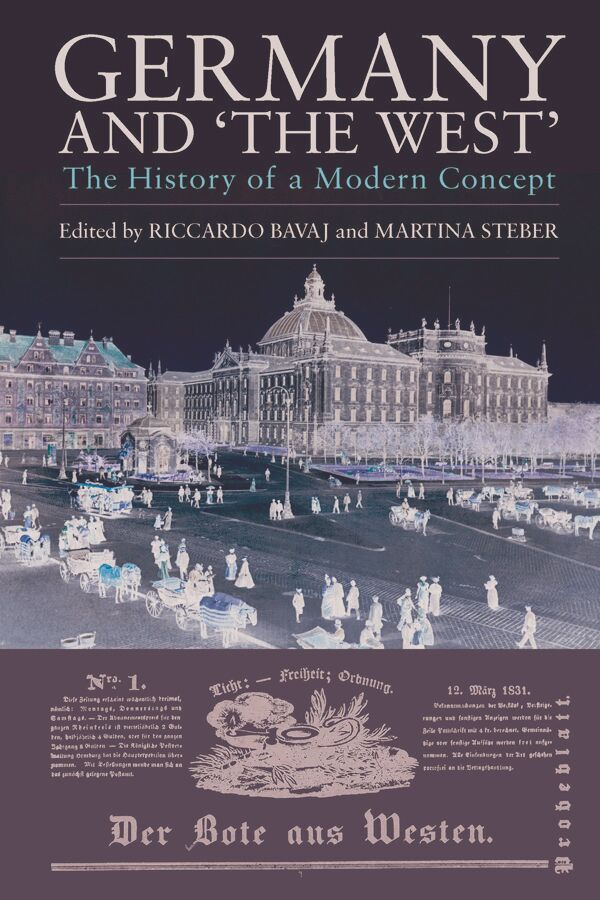
Germany and 'The West'
“The West” is a central idea in German public discourse, yet historians know surprisingly little about the evolution of the concept. Contrary to common assumptions, this volume argues that the German concept of the West was not born in the twentieth century, but can be traced from a much earlier time. In the nineteenth century, “the West” became associated with notions of progress, liberty, civilization, and modernity. It signified the future through the opposition to antonyms such as “Russia” and “the East,” and was deployed as a tool for forging German identities. Examining the shifting meanings, political uses, and transnational circulations of the idea of “the West” sheds new light on German intellectual history from the post-Napoleonic era to the Cold War.
eBook


Machines as the Measure of Men
Over the past five centuries, advances in Western understanding of and control over the material world have strongly influenced European responses to non-Western peoples and cultures. InMachines as the Measure of Men, Michael Adas explores the ways in which European perceptions of their scientific and technological superiority shaped their interactions with people overseas. Adopting a broad, comparative perspective, he analyzes European responses to the cultures of sub-Saharan Africa, India, and China, cultures that they judged to represent lower levels of material mastery and social organization.
Beginning with the early decades of overseas expansion in the sixteenth century, Adas traces the impact of scientific and technological advances on European attitudes toward Asians and Africans and on their policies for dealing with colonized societies. He concentrates on British and French thinking in the nineteenth century, when, he maintains, scientific and technological measures of human worth played a critical role in shaping arguments for the notion of racial supremacy and the \"civilizing mission\" ideology which were used to justify Europe's domination of the globe. Finally, he examines the reasons why many Europeans grew dissatisfied with and even rejected this gauge of human worth after World War I, and explains why it has remained important to Americans.
Showing how the scientific and industrial revolutions contributed to the development of European imperialist ideologies,Machines as the Measure of Menhighlights the cultural factors that have nurtured disdain for non-Western accomplishments and value systems. It also indicates how these attitudes, in shaping policies that restricted the diffusion of scientific knowledge, have perpetuated themselves, and contributed significantly to chronic underdevelopment throughout the developing world. Adas's far-reaching and provocative book will be compelling reading for all who are concerned about the history of Western imperialism and its legacies.
First published to wide acclaim in 1989,Machines as the Measure of Menis now available in a new edition that features a preface by the author that discusses how subsequent developments in gender and race studies, as well as global technology and politics, enter into conversation with his original arguments.
eBook