
Catalogue Search | MBRL


Are you sure you want to remove the book from the shelf?

{{itemTitle}}
832
result(s) for
"Wideman, John Edgar"
Sort by:


All Stories Are True
In All Stories Are True, Tracie Church Guzzio provides the first full-length study of John Edgar Wideman's entire oeuvre to date. Specifically, Guzzio examines the ways in which Wideman (b. 1941) engages with three crucial themes-history, myth, and trauma-throughout his career, showing how they intertwine. Guzzio argues that, for four decades, the influential African American writer has endeavored to create a version of the African American experience that runs counter to mainstream interpretations, using history and myth to confront and then heal the trauma caused by slavery and racism.
Wideman's work intentionally blurs boundaries between fiction and autobiography, myth and history, particularly as that history relates to African American experience in his hometown of Pittsburgh, Pennsylvania. The fusion of fiction, national history, and Wideman's personal life is characteristic of his style, which-due to its complexity and smudging of genre distinctions-has presented analytic difficulties for literary scholars. Despite winning the PEN/Faulkner award twice, for Sent for You Yesterday (1984) and Philadelphia Fire (1990), Wideman remains under-studied.
Of particular value is Guzzio's analysis of the many ways in which Wideman alludes to his previous works. This intertextuality allows Wideman to engage his books in direct, intentional dialogue with each other through repeated characters, images, folktales, and songs. In Wideman's challenging of a monolithic view of history and presenting alternative perspectives to it, and his allowing past, present, and future time to remain fluid in the narratives, Guzzio finds an author firm in his notion that all stories and all perspectives have merit.
eBook

The Empty Noose: The Trouble With Removing Spectacle From Lynching Iconography
Although graphic lynching photographs have become a popular topic of academic study, today's lynching iconography does not rely on spectacle. This essay explores how the shift to figurative representations of lynching affected anti-racist strategies. In particular, it examines how one organization and two authors of the Black Power/Black Arts Movement era—the Black Panther Party, playwright Ed Bullins, and novelist John Edgar Wideman—responded to this change. The Black Panthers and Bullins employed empty and cartoon noose imagery to retaliate against White power. They put the noose into the hands of a Black mob and made it into a tool of revenge. However, this strategy backfired, replacing one vision of mob violence with another, glossing over the costs of revolutionary violence, and allowing White culture to deny the racist meaning of the empty noose. John Edgar Wideman's 1973 novel The Lynchers illustrates this, demonstrating that the empty noose image, even reclaimed for anti-racist purposes, has not been useful for African American liberation. Early anti-lynching activists like Ida B. Wells-Barnett were right in their insistence on gruesome spectacle in the fight against lynching, and their strategy remains necessary even in the 21st century, long after the era of frequent lynchings.
Journal Article


Writing to Save a Life : The Louis Till file
Emmett Till took a train from his home in Chicago to visit family in Money, Mississippi; a few weeks later he returned home dead. Murdered because he was a colored boy and had, allegedly, whistled at a white woman. His mother, Mamie Till, chose to display her son's brutalized face in a glass-topped casket, \"so the world can see what they did to my baby.\" Emmett Till's murder and his mother\\'s refusal to allow his story to be forgotten have become American legends. But one darkly significant twist in the Till legend is rarely mentioned: Louis Till, Emmett's father, Mamie's husband, a soldier during World War II, was executed in Italy for committing rape and murder. In 1955, when he and Emmett were each only fourteen years old, Wideman saw a horrific photograph of dead Emmett's battered face. Decades later, upon discovering that Louis Till had been court-martialed and hanged, he was impelled to investigate the tragically intertwined fates of father and son. Writing to Save a Life is \"part exploration and part meditation, a searching account of [Wideman's] attempt to learn more about the short life of Louis Till\" (The New York Times Book Review) and shine light on the truths that have remained in darkness. Wideman, the author of the award-winning Brothers and Keepers, \"is a master of quiet meditation - and his book is remarkable for its insight and power\" (SFGate). An amalgam of research, memoir, and imagination, Writing to Save a Life is essential and \"impressive\" (Pittsburgh Post-Gazette) reading-an engaging, enlightening conversation between generations, the living and the dead, fathers and sons.
BOOK

Confessional Performance: Remorse and the Affective Economy of Parole
Taking the popular podcast series Violation as its point of departure, this article examines the dramaturgy within the parole system, its affective politics, and its performative speech acts to consider its role in the perpetuation of mass incarceration in the United States. By training an eye on the affective economy of parole hearings, this article explores the retributive turn in the criminal legal process in the wake of neoliberal economic reforms. It focuses on the anxious performance of remorse within parole hearings as a key form of affective currency that could potentially secure release from incarceration. In the process, the article examines the significant role that remorse plays in parole hearings in entrenching a dispositional conception of personal responsibility in the criminal legal system.
Journal Article

“Frankstown Was the World with a Big W”: Pittsburgh and Beyond, an Interview with John Edgar Wideman
On Friday, October 18, 2019, I conducted an interview with John Edgar Wideman at his home in New York City. The conversation was incredibly rich, John being very generous indeed with his memories and his profound insights. Our first focus was Pittsburgh itself—what a joy to hear him speak about the Homewood of his childhood, about something like a lost world. We discussed basketball, the languages of his childhood, and origin stories; as the conversation progressed, John reflected poignantly on what he sees as the cost of his success, that he is pushed ahead as a token while very little of his privilege is afforded to his own community. He also had much to say about a driving quality of shame that he has experienced on a number of occasions in his life—in being shamed by a white classmate for not knowing more about Black music, and the related shame of not knowing much Black literature, and how that motivated him to establish the African American Studies program at the University of Pennsylvania. We discussed the expansion of his intellectual and cultural horizons that came with the experience of being a Rhodes Scholar at Oxford. The interview concluded with a sense of the awe with which the author regards his brother as well as his son, who have retained their humanity in spite of the greatest odds, and a reflection on the role of creativity in accomplishing such a feat.
Journal Article
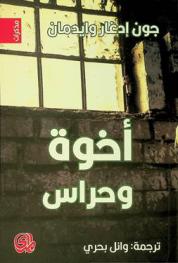
My Brother’s Words
Robert “Faruq” Wideman is the formerly incarcerated younger brother of the African American author John Edgar Wideman. The first published in-depth interview since Faruq’s release in 2019 after forty-four years in prison, this piece speaks to Kalfou’s interest in the theme of “insubordinate space.” John and Faruq’s relationship itself, the subject of one of John’s best-known books, Brothers and Keepers (1984), is the very definition of the journal’s intent to “connect the specialized knowledge produced in academe to the situated knowledge generated in aggrieved communities.” Beyond that, Wideman’s writing is unthinkable without his connection with Faruq; the radical contrast between their fates is arguably the underpinning interest of his work. The interview connects Faruq’s life experience, at the hardest end of the U.S. justice system, to some of the key themes from his brother’s work. The discussion offers a window onto what rehabilitation can look like during a lifetime spent in the prison system, and the interpersonal processes that can assist a person’s reform. Considered here are the complexities of the role of Faruq’s voice in Brothers and Keepers, and the intense pressures on him of growing up young, gifted, and Black but in the shadow of his older siblings. We gain important insights into Faruq’s work as a mathematician, a teacher, and a mentor, and he also offers some new perspectives on his brother’s writing and its representation of their family relationships and especially their father. Faruq offers insights into his experiences of the Black Power movement, literary celebrity, and the abuse of his human rights while in jail; he speaks about his meditation practice and the power of learning stillness for creating a change in his life. The interview concludes with Faruq’s electrifying story of the commutation of his sentence.
Journal Article