
Catalogue Search | MBRL


Are you sure you want to remove the book from the shelf?

{{itemTitle}}
12,636
result(s) for
"Widows"
Sort by:


Of Little Comfort
During and especially after World War I, the millions of black-clad widows on the streets of Europe’s cities were a constant reminder that war caused carnage on a vast scale. But widows were far more than just a reminder of the war’s fallen soldiers; they were literal and figurative actresses in how nations crafted their identities in the interwar era. In this extremely original study, Erika Kuhlman compares the ways in which German and American widows experienced their postwar status, and how that played into the cultures of mourning in their two nations: one defeated, the other victorious. Each nation used widows and war dead as symbols to either uphold their victory or disengage from their defeat, but Kuhlman, parsing both German and U.S. primary sources, compares widows’ lived experiences to public memory. For some widows, government compensation in the form of military-style awards sufficed. For others, their own deprivations, combined with those suffered by widows living in other nations, became the touchstone of a transnational awareness of the absurdity of war and the need to prevent it.
eBook

Secrets of Hallstead House
\"Macy Stoddard had hoped to ease the grief of losing her parents in a fiery car crash by accepting a job as a private nurse to the wealthy and widowed Alexandria Hallstead. But her first sight of Hallstead House is of a dark and forbidding home. Shey quickly finds its winding halls and shadowy rooms filled with secrets and suspicions. Alex seems happy to have Macy's help, but others on the island, including Alex's sinister servants and hostile relatives, are far less welcoming. Watching eyes, veiled threats ... slowly, surely, the menacing spirit of Hallstead Island closes in around Macy. And she can only wonder if her story will become just one of the many secrets of Hallstead House...\" p. [4] of cover.
Book

Wife to Widow
The diversity of women's lives as wives then as widows negotiating the law, patriarchy, family relationships, and the economy in 19th-century Montreal come alive in this first major study of widows in Canada.
eBook

Cocoa Beach
Burdened by a dark family secret, Virginia Fortescue flees her oppressive home in New York City for the battlefields of World War I France. Driving an ambulance for the Red Cross, she meets a charismatic British army surgeon whose persistent charm opens her heart to the possibility of love. As the war rages, Virginia falls into a passionate affair with the dashing Captain Simon Fitzwilliam, only to discover that his past has its own dark secrets--secrets that will damage their eventual marriage and propel her back across the Atlantic to the sister and father she'd left behind. Five years later, in the early days of Prohibition, the newly widowed Virginia Fitzwilliam arrives in the tropical boomtown of Cocoa Beach, Florida, to settle her husband's estate. Simon's brother and sister welcome her with open arms and introduce her to a dazzling new world of citrus groves, white beaches, bootleggers, and Prohibition agents. But Virginia senses a predatory presence lurking beneath the irresistible, hedonistic surface of this coastal oasis. The more she learns about Simon and his mysterious business interests, the more she fears that the dangers surrounding Simon now threaten her and their daughter's life as well.
Book

Widowhood in Early Modern Spain
This study of Castilian widows, based on extensive analysis of literary and archival sources, provides insight into the complex mechanisms lying behind the formulation of gender boundaries and the pragmatic politics of everyday life in the early modern world.
eBook

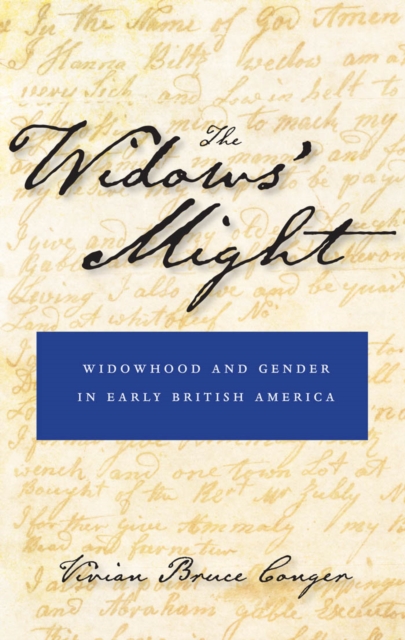
The Widows' Might
In early American society, one's identity was determined in large part by gender. The ways in which men and women engaged with their communities were generally not equal: married women fell under the legal control of their husbands, who handled all negotiations with the outside world, as well as many domestic interactions. The death of a husband enabled women to transcend this strict gender divide. Yet, as a widow, a woman occupied a third, liminal gender in early America, performing an unusual mix of male and female roles in both public and private life.With shrewd analysis of widows' wills as well as prescriptive literature, court appearances, newspaper advertisements, and letters, The Widows' Might explores how widows were portrayed in early American culture, and how widows themselves responded to their unique role. Using a comparative approach, Vivian Bruce Conger deftly analyzes how widows in colonial Massachusetts, South Carolina, and Maryland navigated their domestic, legal, economic, and community roles in early American society.
eBook

Here's to us : a novel
Laurel Thorpe, Belinda Rowe, and Scarlett Oliver share only two things: a love for the man they all married, Deacon Thorpe -- a celebrity chef with an insatiable appetite for life, and a passionate dislike of one another. All three are remarkable, spirited women, but they couldn't be more different. Laurel: Deacon's high school sweetheart and an effortlessly beautiful social worker; Belinda: a high-maintenance Hollywood diva; and Scarlett: a sexy southern belle floating by on her family money and her fabulous looks. They've established a delicate understanding over the years, avoiding each other at all costs. But their fragile detente threatens to come crashing down after Deacon's tragic death on his favorite place on earth: a ramshackle Nantucket summer cottage. Deacon's final wish was for his makeshift family to assemble on his beloved Nantucket to say good-bye. Begrudgingly, Laurel, Belinda, and Scarlett gather on the island as once again, as in each of their marriages, they're left to pick up Deacon's mess. Now they're trapped in the crowded cottage where they all made their own memories -- a house that they now share in more ways than one -- along with the children they raised with Deacon, and his best friend. Laurel, Belinda, and Scarlett each had an unbreakable bond with Deacon and they all have secrets to hide. Before the weekend is over, there are enough accusations, lies, tears, and drama to turn even the best of friends, let alone three women who married the same man, into adversaries. As his unlikely family says good-bye to the man who brought them together -- for better or worse -- will they be able to put aside their differences long enough to raise a glass in Deacon's honor?
Book
