
Catalogue Search | MBRL


Are you sure you want to remove the book from the shelf?

{{itemTitle}}
46
result(s) for
"Wikinger."
Sort by:

The Vikings and their age
\"The Vikings and Their Age offers a quick overview of the chronology and major themes of the Viking period. Written in an accessible manner, it also provides a great introduction to some of the most interesting and significant figures in Viking lore, such as Harald Bluetooth, Eirik the Red, Leif Eiriksson, and Gudrid Thorbjarnardottir, a female Viking traveller. Insights and evidence from such diverse disciplines as archaeology, philology, linguistics, and genetics are provided.
Book
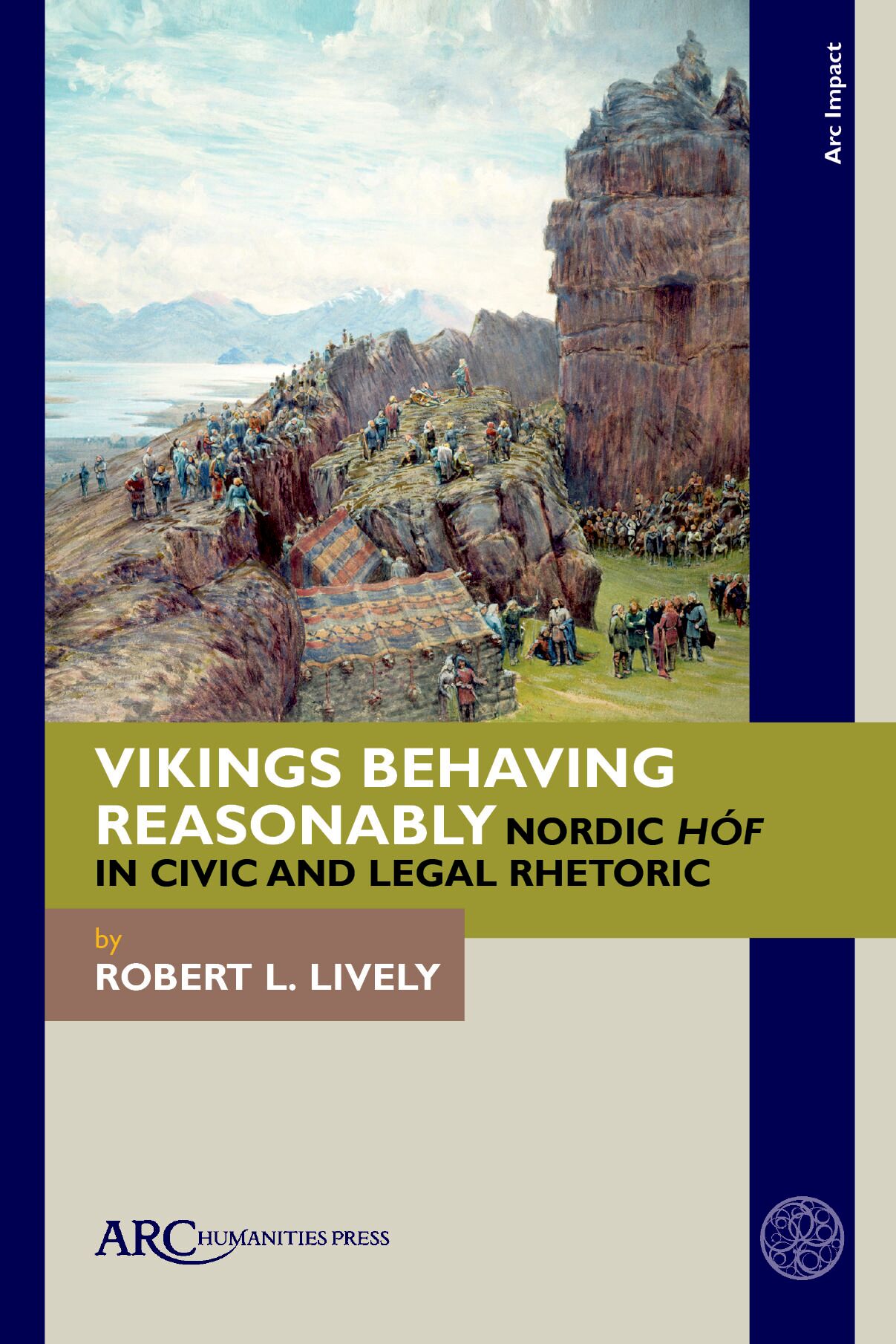
Vikings Behaving Reasonably
Rather than being the lawless barbarian society that history and popular culture have painted it, medieval Scandinavian culture was complex and nuanced. This book fundamentally challenges our stereotypes of the Vikings, and interrogates the use of a \"rhetoric of reasonableness\" (hóf) in medieval Nordic society to give voice to this hitherto silenced tradition. Civic rhetoric relied heavily on hóf to keep community customs manageable. In small towns and villages without central bureaucracies, reasonableness became important to the peaceful functioning of civil society. Legal rhetoric was also based on hóf. If civic actions became potentially violent, then the courts needed means of redress, and a way to maintain the peace in the locality. The Scandinavian tradition of court cases appears both in the early laws and in several sagas, allowing a picture of the rhetorical stance of hóf to emerge through Nordic legal processes.
eBook


Thorvald's Cross
The 'Manx Crosses', Scandinavian-style gravestones from the Isle of Man, are a unique collection of stone monuments unequalled in the medieval Viking World. Focussing on one particular example, 'Thorvald's cross', this book collates all the available information and presents a new interpretation as to how to understand this remarkable monument.
eBook

The Valkyries’ Loom
In The Valkyries' Loom , Michèle Hayeur Smith examines
Viking textiles as evidence of the little-known work of women in
the Norse colonies that expanded from Scandinavia across the North
Atlantic in the ninth century AD. While previous researchers have
overlooked textiles as insignificant artifacts, Hayeur Smith is the
first to use them to understand gender and economy in Norse
societies of the North Atlantic.
This groundbreaking study is based on the author's systematic
comparative analysis of the vast textile collections in Iceland,
Greenland, Denmark, Scotland, and the Faroe Islands, materials that
are largely unknown even to archaeologists and span 1,000 years.
Through these garments and fragments, Hayeur Smith provides new
insights into how the women of these island nations influenced
international trade by producing cloth ( vaðmál ); how they
shaped the development of national identities by creating clothing;
and how they helped their communities survive climate change by
reengineering clothes during the Little Ice Age. She supplements
her analysis by revealing societal attitudes about weaving through
the poem \"Darraðarljoð\" from Njál's Saga , in which the
Valkyries-Óðin's female warrior spirits-produce the cloth of
history and decide the fates of men and nations.
Bringing Norse women and their labor to the forefront of
research, Hayeur Smith establishes the foundation for a gendered
archaeology of the North Atlantic that has never been attempted
before. This monumental and innovative work contributes to global
discussions about the hidden roles of women in past societies in
preserving tradition and guiding change.
eBook

Crafts and Social Networks in Viking Towns
Crafting Communities explores the interface between craft, communication networks, and urbanization in Viking-age Northern Europe. Viking-period towns were the hubs of cross-cultural communication of their age, and innovations in specialized crafts provide archaeologists with some of the best evidence for studying this communication. The integrated results presented in these papers have been made possible through the sustained collaboration of a group of experts with complementary insights into individual crafts. Results emerge from recent scholarly advances in the study of artifacts and production: first, the application of new analytical techniques in artifact studies (e.g. metallographic, isotopic, and biomolecular techniques) and second, the shifted in interpretative focus of medieval artifact studies from a concern with object function to considerations of processes of production, and of the social agency of technology. Furthermore, the introduction of social network theory and actor-network theory has redirected attention toward the process of communication, and highlighted the significance of material culture in the learning and transmission of cultural knowledge, including technology. The volume brings together leading UK and Scandinavian archaeological specialists to explore crafted products and workshop-assemblages from these towns, in order to clarify how such long-range communication worked in pre-modern Northern Europe. Contributors assess the implications for our understanding of early towns and the long-term societal change catalysed by them, including the initial steps towards commercial economies. Results are analyzed in relation to social network theory, social and economic history, and models of communication, setting an agenda for further research. Crafting Communities provides a landmark statement on our knowledge of Viking-Age craft and communication
eBook

The Viking Age
The majority of literature about the Viking period, based on artifacts or written sources, covers battles, kings, chiefs and mercenaries, long distance travel and colonization, trade, and settlement. Less is said about the life of those that stayed at home or those that immigrated into Scandinavia, whether voluntarily or by force. This book uses results from the examination of a substantial corpus of Swedish osteological material to discuss aspects of demography and health in the Viking period – those which would have been visible and recognizable in the faces or physical appearances of the individuals concerned. It explores the effects of migration, from the spread of new diseases such as leprosy to patterns of movement and integration of immigrants into society. The skeletal material also allows the study of levels of violence, attitudes towards disablement, and the care provided by Viking communities. An overview of the worldwide phenomenon of modified teeth also gives insight into the practice of deliberate physical embellishment and body modification. The interdisciplinary approach to questions regarding ordinary life presented here will broaden the knowledge about society during the Viking Age. The synthesis of the Swedish unburnt human skeletal remains dated to the Viking age will be a valuable resource for future research and provides an in-depth view on Viking age society.
eBook

In Austrvegr: The Role of the Eastern Baltic in Viking Age Communication across the Baltic Sea
Winner of the Early Slavic Studies Association 2018 Book Prize Marika Mägi's book considers the cultural, mercantile and political interaction of the Viking Age (9th-11th century), focusing on the eastern coasts of the Baltic Sea. The majority of research on Viking activity in the East has so far concentrated on the modern-day lands of Russia, while the archaeology and Viking Age history of today's small nation states along the eastern coasts of the Baltic Sea is little known to a global audience.This study looks at the area from a trans-regional perspective, combining archaeological evidence with written sources, and offering reflections on the many different factors of climate, topography, logistics, technology, politics and trade that shaped travel in this period. The work offers a nuanced vision of Eastern Viking expansion, in which the Eastern Baltic frequently acted as buffer zone between eastern and western powers. Winner of the Early Slavic Studies Association 2018 Book Prize for most outstanding recent scholarly monograph on pre-modern Slavdom. The work was described by the prize committee in the following terms: \"The scope of this book is far broader than the title might suggest. It amounts to a substantial rethinking of the history of the eastern Baltic from the tenth to the thirteenth century, based on both archaelogical and written evidence. The author is by training an archaeologist, and she mounts a powerful criticism of historians who prioritise the written sources and then pick and choose from the archaeological evidence to suit their theories. This book foregrounds the archaeology, which is used to question and consider the written evidence. The author is also highly and rightly critical of the archaeological scholarship, for projecting back into the past the narrow concerns of the numerous nation states that now exist across the eastern and northern Baltic, or the Great Russian nationalist-materialist-imperialist interpretations of the Soviet period. The result is a detailed and fascinating account of the interactions of the worlds of Scandinavia and Rus with the various peoples of the Baltic region, both Finno-Ugric and Baltic. The resulting picture of commercial, political, and cultural interaction across several cultures, and based on reading in a wide range of languages, is a tour-de-force.\".
eBook

Danes in Wessex: the Scandinavian impact on southern England, c.800-c.1100
There have been many studies of the Scandinavians in Britain, but this is the first collection of essays to be devoted solely to their engagement with Wessex. New work on the early Middle Ages, not least the excavations of mass graves associated with the Viking Age in Dorset and Oxford, drew attention to the gaps in our understanding of the wider impact of Scandinavians in areas of Britain not traditionally associated with them. Here, a multi-disciplinary and inter-disciplinary approach to the problems of their study is presented. While there may not have been the same degree of impact, discernable particularly in place-names and archaeology, as in those areas of Britain which had substantial influxes of Scandinavian settlers, Wessex was a major theatre of the Viking wars in the reigns of Alfred and Æthelred Unræd. Two major topics, the Viking wars and the Danish landowning elite, figure strongly in this collection but are shown not to be the sole reasons for the presence of Danes, or items associated with them, in Wessex. Multi-disciplinary approaches evoke Vikings and Danes not just through the written record, but through their impact on real and imaginary landscapes and via the objects they owned or produced. The papers raise wider questions too, such as when did aggressive Vikings morph into more acceptable Danes, and what issues of identity were there for natives and incomers in a province whose founders were believed to have also come from North Sea areas, if not from parts of Denmark itself? Readers can continue for themselves aspects of these broader debates that will be stimulated by this fascinating and significant series of studies by both established scholars and new researchers.
eBook

Identity Formation and Diversity in the Early Medieval Baltic and Beyond
In Identity Formation and Diversity in the Early Medieval Baltic and Beyond, contacts between Early Medieval Baltic Finns, Sami, Scandinavians, Slavs and Balts are discussed and exemplified. Communication expressed through material culture is analysed in order to understand the culturally diverse regions in the Baltic and beyond.
eBook