
Catalogue Search | MBRL


Are you sure you want to remove the book from the shelf?

{{itemTitle}}
63,988
result(s) for
"Wildfires."
Sort by:

Wildfire!
Describes different kinds of wildfires, including forest fires, grass fires, and bush fires, explains how these fires are started, what conditions create a crisis, and steps taken to put fires out. Includes information on safety and prevention.
Book

Adapting western North American forests to climate change and wildfires
We review science-based adaptation strategies for western North American (wNA) forests that include restoring active fire regimes and fostering resilient structure and composition of forested landscapes. As part of the review, we address common questions associated with climate adaptation and realignment treatments that run counter to a broad consensus in the literature. These include the following: (1) Are the effects of fire exclusion overstated? If so, are treatments unwarranted and even counterproductive? (2) Is forest thinning alone sufficient to mitigate wildfire hazard? (3) Can forest thinning and prescribed burning solve the problem? (4) Should active forest management, including forest thinning, be concentrated in the wildland urban interface (WUI)? (5) Can wildfires on their own do the work of fuel treatments? (6) Is the primary objective of fuel reduction treatments to assist in future firefighting response and containment? (7) Do fuel treatments work under extreme fire weather? (8) Is the scale of the problem too great? Can we ever catch up? (9) Will planting more trees mitigate climate change in wNA forests? And (10) is post-fire management needed or even ecologically justified? Based on our review of the scientific evidence, a range of proactive management actions are justified and necessary to keep pace with changing climatic and wildfire regimes and declining forest heterogeneity after severe wildfires. Science-based adaptation options include the use of managed wildfire, prescribed burning, and coupled mechanical thinning and prescribed burning as is consistent with land management allocations and forest conditions. Although some current models of fire management in wNA are averse to short-term risks and uncertainties, the long-term environmental, social, and cultural consequences of wildfire management primarily grounded in fire suppression are well documented, highlighting an urgency to invest in intentional forest management and restoration of active fire regimes.
Journal Article

Wildfire readiness
\"As people expand settlement into wilder areas, the impact of wildfires, both naturally occurring and human-set, becomes more destructive. This timely book examines what scientists know about wildfires, whether we can predict them, and how we learn from each event. By studying the destruction they cause, scientists and engineers continue to come up with new and improved technologies to predict and control wildfires and better protect cities, buildings, and people. Case studies and brief bios of key scientists and organizations highlight the information\"-- Provided by publisher.
Book

A Comparison between FARSITE and FOREFIRE
Accurate fire spread modeling is essential for understanding and mitigating the impacts of wildfires. This study compares two fire spread models, FARSITE and FOREFIRE, by reconstructing the 2022 wildfire in El Pont de Vilomara, Spain. Both models use the Rothermel rate of spread (ROS) equation to model fire behavior, however, FOREFIRE employs a simplified fuel classification system, which may impact the accuracy of its predictions. Our analysis evaluates fire spread predictions in 0D (ROS), 2D (fire perimeter), and 3D (plume dynamics) simulations. Results show that FARSITE underestimates fire propagation, while FOREFIRE overestimates it, both requiring ROS adjustments to match observation. The coupled FOREFIRE-MesoNH require also ROS adjustment but better incorporates fire behavior representation.
Journal Article


The changing risk and burden of wildfire in the United States
Recent dramatic and deadly increases in global wildfire activity have increased attention on the causes of wildfires, their consequences, and how risk from wildfire might be mitigated. Here we bring together data on the changing risk and societal burden of wildfire in the United States. We estimate that nearly 50 million homes are currently in the wildland–urban interface in the United States, a number increasing by 1 million houses every 3 y. To illustrate how changes in wildfire activity might affect air pollution and related health outcomes, and how these linkages might guide future science and policy, we develop a statistical model that relates satellite-based fire and smoke data to information from pollution monitoring stations. Using the model, we estimate that wildfires have accounted for up to 25% of PM
2.5 (particulate matter with diameter <2.5 μm) in recent years across the United States, and up to half in some Western regions, with spatial patterns in ambient smoke exposure that do not follow traditional socioeconomic pollution exposure gradients. We combine the model with stylized scenarios to show that fuel management interventions could have large health benefits and that future health impacts from climate-change–induced wildfire smoke could approach projected overall increases in temperature-related mortality from climate change—but that both estimates remain uncertain. We use model results to highlight important areas for future research and to draw lessons for policy.
Journal Article
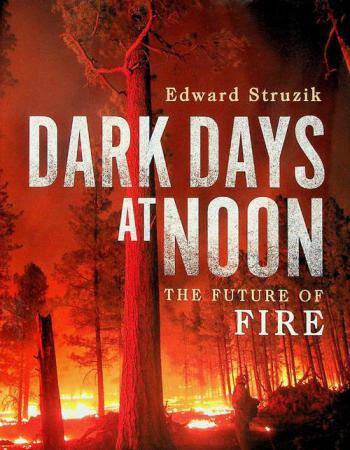
Dark days at noon : the future of fire
\"The catastrophic runaway wildfires advancing through North America and other parts of the world are not unprecedented. Fires loomed large once human activity began to warm the climate in the 1820s, leading to an aggressive firefighting strategy that has left many of the continent's forests too old and vulnerable to the fires that many tree species need to regenerate. Dark Days at Noon provides a broad history of wildfire in North America, from pre-European contact to the present, in the hopes that we may learn from how we managed fire in the past, and apply those lessons in the future. As people continue to move into forested landscapes to work, play, live, and ignite fires--intentionally or unintentionally--fire has begun to take its toll, burning entire towns, knocking out utilities, closing roads, and forcing the evacuation of hundreds of thousands of people. Fire management in North America requires attention and cooperation from both sides of the border, and many of the most significant fires have taken place at the boundary line. Despite a clear lack of political urgency among political leaders, Edward Struzik argues that wildfire science needs to guide the future of fire management, and that those same leaders need to shape public perception accordingly. By explaining how society's misguided response to fire has led to our current situation, Dark Days at Noon warns of what may happen in the future if we do not learn to live with fire as the continent's Indigenous Peoples once did.\"-- Provided by publisher.
Human-started wildfires expand the fire niche across the United States
The economic and ecological costs of wildfire in the United States have risen substantially in recent decades. Although climate change has likely enabled a portion of the increase in wildfire activity, the direct role of people in increasing wildfire activity has been largely overlooked. We evaluate over 1.5 million government records of wildfires that had to be extinguished or managed by state or federal agencies from 1992 to 2012, and examined geographic and seasonal extents of human-ignited wildfires relative to lightning-ignited wildfires. Humans have vastly expanded the spatial and seasonal “fire niche” in the coterminous United States, accounting for 84% of all wildfires and 44% of total area burned. During the 21-y time period, the human-caused fire season was three times longer than the lightning-caused fire season and added an average of 40,000 wildfires per year across the United States. Human-started wildfires disproportionally occurred where fuel moisture was higher than lightning-started fires, thereby helping expand the geographic and seasonal niche of wildfire. Human-started wildfires were dominant (>80% of ignitions) in over 5.1 million km², the vast majority of the United States, whereas lightning-started fires were dominant in only 0.7 million km², primarily in sparsely populated areas of the mountainous western United States. Ignitions caused by human activities are a substantial driver of overall fire risk to ecosystems and economies. Actions to raise awareness and increase management in regions prone to human-started wildfires should be a focus of United States policy to reduce fire risk and associated hazards.
Journal Article


Rescue Brazil’s burning Pantanal wetlands
Climate extremes, poor management and lax laws are making this World Heritage Site prone to fierce fires. Researchers and governments must develop a plan to manage these risks together.
Climate extremes, poor management and lax laws are making this World Heritage Site prone to fierce fires. Researchers and governments must develop a plan to manage these risks together.
Journal Article