
Catalogue Search | MBRL


Are you sure you want to remove the book from the shelf?

{{itemTitle}}
57,133
result(s) for
"William Shakespeare"
Sort by:


Shakespeare's cinema of love
This engaging and stimulating book argues that Shakespeare's plays
significantly influenced movie genres in the twentieth century,
particularly in films concerning love in the classic Hollywood
period. Shakespeare's 'green world' has a close functional
equivalent in 'tinseltown' and on 'the silver screen', as well as
in hybrid genres in Bollywood cinema. Meanwhile, Romeo and
Juliet continues to be an enduring source for romantic tragedy
on screen. The nature of generic indebtedness has not gained
recognition because it is elusive and not always easy to recognise.
The book traces generic links between Shakespeare's comedies of
love and screen genres such as romantic comedy, 'screwball' comedy
and musicals, as well as clarifying the use of common conventions
defining the genres, such as mistaken identity, 'errors', disguise
and 'shrew-taming'. Speculative, challenging and entertaining, the
book will appeal to those interested in Shakespeare, movies and the
representation of love in narratives.
eBook


Speaking of the Moor
Selected byChoicemagazine as an Outstanding Academic Title \"Speak of me as I am,\" Othello, the Moor of Venice, bids in the play that bears his name. Yet many have found it impossible to speak of his ethnicity with any certainty. What did it mean to be a Moor in the early modern period? In the late sixteenth and early seventeenth centuries, when England was expanding its reach across the globe, the Moor became a central character on the English stage. InThe Battle of Alcazar,Titus Andronicus,Lust's Dominion, andOthello, the figure of the Moor took definition from multiple geographies, histories, religions, and skin colors. Rather than casting these variables as obstacles to our-and England's-understanding of the Moor's racial and cultural identity, Emily C. Bartels argues that they are what make the Moor so interesting and important in the face of growing globalization, both in the early modern period and in our own. InSpeaking of the Moor, Bartels sets the early modern Moor plays beside contemporaneous texts that embed Moorish figures within England's historical record-Richard Hakluyt'sPrincipal Navigations, Queen Elizabeth's letters proposing the deportation of England's \"blackamoors,\" and John Pory's translation ofThe History and Description of Africa. Her book uncovers the surprising complexity of England's negotiation and accommodation of difference at the end of the Elizabethan era.
eBook

Ideas of order : a close reading of Shakespeare's sonnets
Shakespeare's sonnets constitute the greatest single work of lyric poetry in English, as passionate and daring as any love poems we may ever encounter, and yet they are often misunderstood. [This book] reveals an underlying structure encompassing the 154 poems that illuminates the entire work, and provides a guide for first-time readers and connoisseurs alike [that inspires a new understanding of this complex masterpiece.] --Page 4 of cover.
Book

Shakespeare and the Force of Modern Performance
Shakespeare and the Force of Modern Performance asks a central theoretical question in the study of drama: what is the relationship between the dramatic text and the meanings of performance? Developing the notion of 'performativity' explored by J. L. Austin, Judith Butler, and others, Worthen argues that the text cannot govern the force of its performance. Instead the text becomes significant only as embodied in the changing conventions of its performance. Worthen explores this understanding of dramatic performativity by interrogating several contemporary sites of Shakespeare production. He analyses how Shakespeare is recreated in historical performance, exemplified by the Globe Theatre on Bankside; by international and intercultural performance; by film; and by the appearance of Shakespeare on the Internet. The book includes detailed discussions of recent film and stage productions, and sets Shakespeare performance alongside other works of contemporary drama and theatre.
eBook

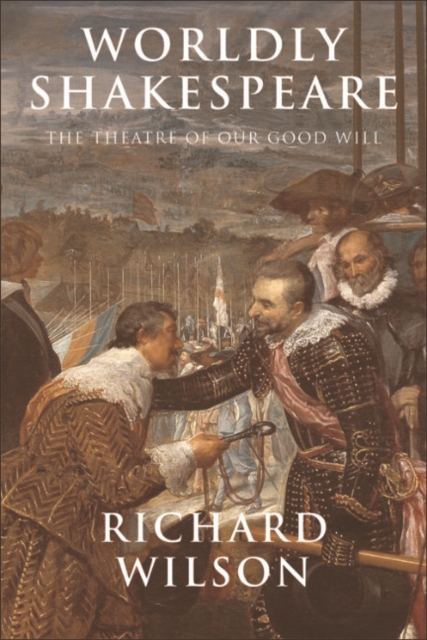
Worldly Shakespeare : the theatre of our good will
A comprehensive rereading of Shakespeare's plays in light of current debates about free speech and toleration.
eBook

The Shakespeare timeline wallbook : the wonderful plays of William Shakespeare, at the Original Globe Theatre
Unfold the complete plays of Shakespeare--one theater, thirty-eight dramas! Developed in partnership with the Shakespeare Birthplace Trust.
Book

Othello in European Culture
This volume argues that a focus on the European reception of Othello represents an important contribution to critical work on the play. The chapters examine non-anglophone translations and performances, alternative ways of distinguishing between texts, adaptations and versions, as well as differing perspectives on questions of gender and race.
eBook