
Catalogue Search | MBRL


Are you sure you want to remove the book from the shelf?

{{itemTitle}}
627,334
result(s) for
"Wilson"
Sort by:

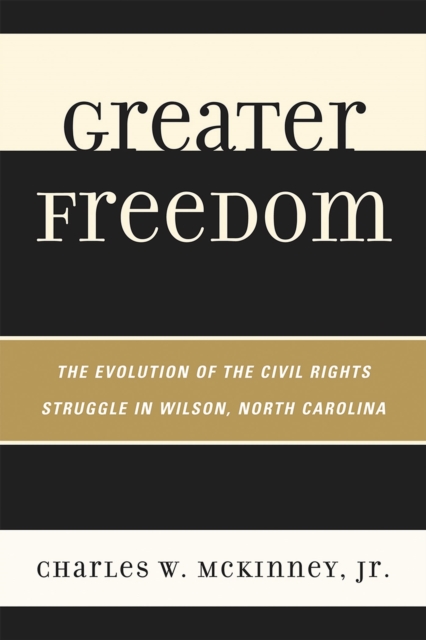
Greater freedom
Greater Freedom offers a groundbreaking long-term community study of Wilson County, North Carolina. Charting the evolution of Wilson's civil rights movement, Charles McKinney argues that African Americans in Wilson created an expansive notion of freedom that influenced every aspect of life in the region and directly confronted the state's reputation for moderation. Through exhaustive research and a compelling narrative, McKinney chronicles the approaches and perspectives that blacks in this eastern North Carolina county utilized to confront white supremacy. In the face of violence, intimidation, and marginalization, voting rights activists, educational reformers, the collaboration of union members, students, and working class black women activists in Wilson built a grassroots movement that helped shape the course of the national civil rights movement in America.
eBook

Lanford Wilson : early stories, sketches, and poems
Before Lanford Wilson became a Pulitzer Prize-winning playwright, with such celebrated productions as The Hot 1 Baltimore, Fifth of July, Talley's Folly, and Burn This, he wrote dozens of short stories and poems, many of which take place in the 1950s small-town Missouri where he grew up. This selection of Wilson's early work, written between 1955 and 1964 when he was between the ages of 18 and 27, provides a rare look at a young writer developing his style. The stories explore many of the themes Wilson later took up in the theatre, such as sexual identity and the rupture of societies and families. These never-before-published works - part of the manuscript collection donated by Wilson to the University of Missouri - shed light on the roots of some of America's best-loved plays and are accomplished and evocative works in their own right. -- from dust jacket.
Book

Study of gapped phases of 4d gauge theories using temporal gauging of the ℤN 1-form symmetry
A
bstract
To study gapped phases of 4d gauge theories, we introduce the temporal gauging of ℤ
N
1-form symmetry in 4d quantum field theories (QFTs), thereby defining effective 3d QFTs with
ℤ
~
N
× ℤ
N
1-form symmetry. In this way, spatial fundamental Wilson and ’t Hooft loops are simultaneously genuine line operators. Assuming a mass gap and Lorentz invariant vacuum of the 4d QFT, the
ℤ
~
N
× ℤ
N
symmetry must be spontaneously broken to an order-
N
subgroup
H
, and we can classify the 4d gapped phases by specifying
H
. This establishes the 1-to-1 correspondence between the two classification schemes for gapped phases of 4d gauge theories: one is the conventional Wilson-’t Hooft classification, and the other is the modern classification using the spontaneous breaking of 4d 1-form symmetry enriched with symmetry-protected topological states.
Journal Article

Semi-Abelian gauge theories, non-invertible symmetries, and string tensions beyond N-ality
A
bstract
We study a 3d lattice gauge theory with gauge group U(1)
N−
1
⋊ S
N
, which is obtained by gauging the S
N
global symmetry of a pure U(1)
N−
1
gauge theory, and we call it the semi-Abelian gauge theory. We compute mass gaps and string tensions for both theories using the monopole-gas description. We find that the effective potential receives equal contributions at leading order from monopoles associated with the entire SU(
N
) root system. Even though the center symmetry of the semi-Abelian gauge theory is given by ℤ
N
, we observe that the string tensions do not obey the
N
-ality rule and carry more detailed information on the representations of the gauge group. We find that this refinement is due to the presence of non-invertible topological lines as a remnant of U(1)
N−
1
one-form symmetry in the original Abelian lattice theory. Upon adding charged particles corresponding to
W
-bosons, such non-invertible symmetries are explicitly broken so that the
N
-ality rule should emerge in the deep infrared regime.
Journal Article


