
Catalogue Search | MBRL


Are you sure you want to remove the book from the shelf?

{{itemTitle}}
3,388
result(s) for
"Wing design"
Sort by:

Application of 3D printing technology for designing light-weight unmanned aerial vehicle wing structures
Unmanned Aerial Vehicles (UAVs) have been developed to perform various military and civilian applications, such as reconnaissance, attack missions, surveillance of pipelines, and interplanetary exploration. The present research is motivated by the need to develop a fast adaptable UAV design technologies for agile, fuel efficient, and flexible structures that are capable of adapting and operating in any environments. The objective of this research is to develop adaptive design technologies by investigating current design methods and knowledge of deployable technologies in the area of engineering design and manufacturing. More specifically, this research seeks to identify one truss lattice with the optimal elastic performance for deployable UAV wing design according to the Hashin & Shtrikman theoretical bounds. We propose three lattice designs — 3D Kagome structure, 3D pyramidal structure and the hexagonal diamond structure. The proposed lattice structure designs are fabricated using an Objet 350 3D printer while the material chosen is a polypropylene-like photopolymer called Objet DurusWhite RGD430. Based on compression testing, the proposed inflatable wing design will combine the advantages of compliant mechanisms and deployable structures to maximize flexibilities of movement in UAV design and development.
Journal Article

Aquatic unmanned aerial vehicles (AquaUAV): Bionic prototypes, key technologies, analysis methods, and potential solutions
Some research on aircraft is largely inspired by birds. Among them, aerial-aquatic amphibians with trans-media locomotion capabilities have greatly promoted the development of aquatic unmanned aerial vehicles (AquaUAV). In this article, the studies of AquaUAV are sorted out by their biological counterpart and summarized in chronological order from 2005 to 2021. To further understand the key technologies of AquaUAV, we focus on the structural compatibility design of wing and aerial-aquatic propulsion methods by analyzing their advantages and disadvantages. In addition, the analysis methods of kinematics and dynamics performance of AquaUAV for simulation and experiment are involved in the process of studying the kinematics, lift/drag, and propulsion of prototypes. Finally, we present several challenges and propose some potential solutions to improve the ability of AquaUAV in the future.
Journal Article

DLR transonic inverse design code, extensions and modifications to increase versatility and robustness
The DLR inverse design code computes the wing geometry for a prescribed target pressure distribution. It is based on the numerical solution of the integral inverse transonic small perturbation (TSP) equations. In this work, several extensions and modifications of the inverse design code are described. Results are validated with corresponding redesign test cases. The first modification concerns applications for high transonic Mach numbers or cases with strong shocks. The introduced modifications enable converged design solutions for cases where the original method failed. The second modification is the extension of the code to general non-planar wings. Previously, the design code was restricted to non-planar wing designs with small dihedral or to nacelle design. A third modification concerns aerofoil/wings designed for wind-tunnel design. In order to design a swept wing between two wind-tunnel walls, the solution method was extended to two symmetry planes. The introduced extensions and modifications have increased the robustness and range of applicability of the inverse design code.
Journal Article

Towards the Design of a Multispar Composite Wing
In the pursuit of a lighter composite wing design, fast and effective methodologies for sizing and validating the wing members (e.g., spar, ribs, skins, etc.) are required. In the present paper, the preliminary design methodology of an airliner main composite wing, which has an innovative multispar configuration instead of the conventional two-spar design, is investigated. The investigated aircraft wing is a large-scale composite component, requiring an efficient analysis methodology; for this purpose, the initial wing sizing is mostly based on simplified Finite Element (FE) stress analysis combined to analytically formulated design criteria. The proposed methodology comprises three basic modules, namely, computational stress analysis of the wing structure, comparison of the stress–strain results to specific design allowable and a suitable resizing procedure, until all design requirements are satisfied. The design constraints include strain allowable for the entire wing structure, stability constraints for the upper skin and spar webs, as well as bearing bypass analysis of the riveted/bolted joints of the spar flanges/skins connection. A comparison between a conventional (2-spar) and an innovative 4-spar wing configuration is presented. It arises from the comparison between the conventional and the 4-spar wing arrangement, that under certain conditions the multispar configuration has significant advantages over the conventional design.
Journal Article
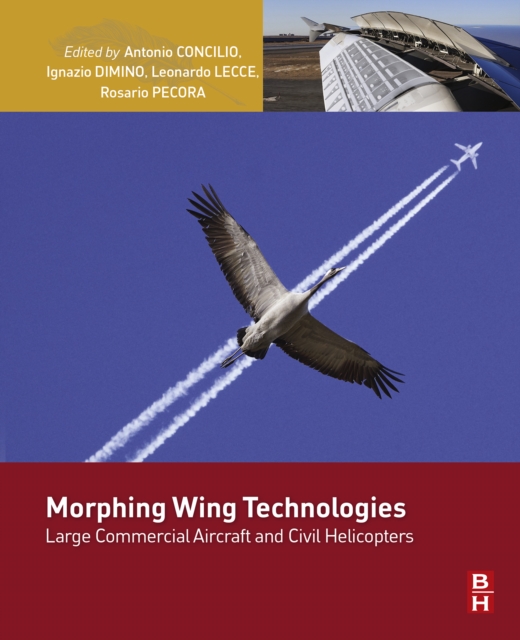
Morphing Wing Technologies - Large Commercial Aircraft and Civil Helicopters
This book offers a fresh look at current research on morphing aircraft, including industry design, real manufactured prototypes and certification. This is an invaluable reference for students in the aeronautics and aerospace fields who need an introduction to the morphing discipline, as well as senior professionals seeking exposure to morphing potentialities. Practical applications of morphing devices are presented-from the challenge of conceptual design incorporating both structural and aerodynamic studies, to the most promising and potentially flyable solutions aimed at improving the performance of commercial aircraft and UAVs.Morphing aircraft are multi-role aircraft that change their external shape substantially to adapt to a changing mission environment during flight. The book consists of eight sections as well as an appendix which contains both updates on main systems evolution (skin, structure, actuator, sensor, and control systems) and a survey on the most significant achievements of integrated systems for large commercial aircraft.
eBook

OpenMDAO: an open-source framework for multidisciplinary design, analysis, and optimization
Multidisciplinary design optimization (MDO) is concerned with solving design problems involving coupled numerical models of complex engineering systems. While various MDO software frameworks exist, none of them take full advantage of state-of-the-art algorithms to solve coupled models efficiently. Furthermore, there is a need to facilitate the computation of the derivatives of these coupled models for use with gradient-based optimization algorithms to enable design with respect to large numbers of variables. In this paper, we present the theory and architecture of OpenMDAO, an open-source MDO framework that uses Newton-type algorithms to solve coupled systems and exploits problem structure through new hierarchical strategies to achieve high computational efficiency. OpenMDAO also provides a framework for computing coupled derivatives efficiently and in a way that exploits problem sparsity. We demonstrate the framework’s efficiency by benchmarking scalable test problems. We also summarize a number of OpenMDAO applications previously reported in the literature, which include trajectory optimization, wing design, and structural topology optimization, demonstrating that the framework is effective in both coupling existing models and developing new multidisciplinary models from the ground up. Given the potential of the OpenMDAO framework, we expect the number of users and developers to continue growing, enabling even more diverse applications in engineering analysis and design.
Journal Article

Giga-voxel computational morphogenesis for structural design
Giga-voxel-resolution computational morphogenesis is used to optimize the internal structure of a full-scale aeroplane wing, yielding light-weight designs with more similarities to animal bone structures than to current aeroplane wing designs.
Computing structure design
Computational morphogenesis is used to design the best possible shapes and material distributions for the desired structural properties, such as high strength at minimal weight. In plants and animals, morphogenesis occurs naturally through slow genetic evolution. In engineering, a much faster iterative approach for optimum material distribution has been adopted, called topology optimization. So far, it has been used to calculate only small or simple structures owing to limited resolution. Niels Aage
et al
. have developed a morphogenesis tool that can be run on a supercomputer and can calculate two orders of magnitude more voxels (the three-dimensional equivalents of pixels) than was previously attainable. This makes it possible to design structures with unprecedented detail, yielding new insights into optimal material distribution. The authors calculate an optimized full aircraft wing structure with remarkable structural detail at several length scales, which displays similarities to naturally occurring bone structures such as those seen in bird beaks. The new tool could inspire surprising design approaches for a range of structures, including wind turbine blades, tower masts and bridges.
In the design of industrial products ranging from hearing aids to automobiles and aeroplanes, material is distributed so as to maximize the performance and minimize the cost. Historically, human intuition and insight have driven the evolution of mechanical design, recently assisted by computer-aided design approaches. The computer-aided approach known as topology optimization enables unrestricted design freedom and shows great promise with regard to weight savings, but its applicability has so far been limited to the design of single components or simple structures, owing to the resolution limits of current optimization methods
1
,
2
. Here we report a computational morphogenesis tool, implemented on a supercomputer, that produces designs with giga-voxel resolution—more than two orders of magnitude higher than previously reported. Such resolution provides insights into the optimal distribution of material within a structure that were hitherto unachievable owing to the challenges of scaling up existing modelling and optimization frameworks. As an example, we apply the tool to the design of the internal structure of a full-scale aeroplane wing. The optimized full-wing design has unprecedented structural detail at length scales ranging from tens of metres to millimetres and, intriguingly, shows remarkable similarity to naturally occurring bone structures in, for example, bird beaks. We estimate that our optimized design corresponds to a reduction in mass of 2–5 per cent compared to currently used aeroplane wing designs, which translates into a reduction in fuel consumption of about 40–200 tonnes per year per aeroplane. Our morphogenesis process is generally applicable, not only to mechanical design, but also to flow systems
3
, antennas
4
, nano-optics
5
and micro-systems
6
,
7
.
Journal Article

Investigation into Reynolds number effects on a biomimetic flapping wing
This research investigated the behavior of a Manduca sexta inspired biomimetic wing as a function of Reynolds number by measuring the aerodynamic forces produced by varying the characteristic wing length and testing at air densities from atmospheric to near vacuum. A six degree of freedom balance was used to measure forces and moments, while high speed cameras were used to measure wing stroke angle. An in-house created graphical user interface was used to vary the voltage of the drive signal sent to the piezoelectric actuator which determined the wing stroke angle. The Air Force Institute of Technology baseline 50 mm wing was compared to wings manufactured with 55, 60, 65, and 70 mm spans, while maintaining a constant aspect ratio. Tests were conducted in a vacuum chamber at air densities between 0.5% and 100% of atmospheric pressure. Increasing the wingspan increased the wing’s weight, which reduced the first natural frequency; and did not result in an increase in vertical force over the baseline 50 mm wing. However, if the decrease in natural frequency corresponding to the increased wing span was counteracted by increasing the thickness of the joint material in the linkage mechanism, vertical force production increased over the baseline wing planform. Of the wings built with the more robust flapping mechanism, the 55 mm wing span produced 95% more vertical force at a 26% higher flapping frequency, while the 70 mm wing span produced 165% more vertical force at a 10% lower frequency than the Air Force Institute of Technology baseline wing. Negligible forces and moments were measured at vacuum, where the wing exhibited predominantly inertial motion, revealing flight forces measured in atmosphere are almost wholly limited to interaction with the surrounding air. Lastly, there was a rough correlation between Reynolds number and vertical force, indicating Reynolds number is a useful modelling parameter to predict lift and corresponding aerodynamic coefficients for a specific wing design.
Journal Article
Robust optimization design of a flying wing using adjoint and uncertainty-based aerodynamic optimization approach
Robust optimization design is significant and urgently required for the fly wings, owing to its unique characteristics. However, there is a lack of efficient tools for performing shape optimization which considers multiple uncertainties. This is in part because implementing robust design in the widely used and very efficient adjoint-based optimization method is challenging. This paper addresses this need by developing an uncertainty-based optimization design framework where the gradient-enhanced polynomial chaos expansion and discrete, adjoint-based optimization framework are coupled to perform shape optimization under multiple uncertainties. The gradient information from adjoint equation is applied to improve the computation efficiency. The objective function is the statistic moment, consisting of mean and standard deviation. The gradients of the statistic moment are computed using the adjoint-based system and reconstructing a regression algorithm. A flying wing configuration with deterministic and two uncertainty-based optimizations is performed. The first uncertainty-based optimization considers flight conditions, Mach and angle of attack, and the second one added the planform uncertainty parameters, i.e., inner and outer wing sweep angle. The uncertainty-based optimizations gain reductions of statistic moments by 8.58% and 5.3%, respectively. Compared with the deterministic optimization, the uncertainty-based optimizations behave much better in robustness but sacrifice a small aerodynamic performance. The successful uncertainty-based optimization enables acceptable risks of fly wing design in the development process and indicates that our established framework can be applied for future aircraft robust optimization design.
Journal Article

Aerodynamic wing shape optimization based on the computational design framework CEASIOM
Purpose
A collaborative design environment is needed for multidisciplinary design optimization (MDO) process, based on all the modules those for different design/analysis disciplines, and a systematic coupling should be made to carry out aerodynamic shape optimization (ASO), which is an important part of MDO.
Design/methodology/approach
Computerized environment for aircraft synthesis and integrated optimization methods (CEASIOM)-ASO is developed based on loosely coupling all the existing modules of CEASIOM by MATLAB scripts. The optimization problem is broken down into small sub-problems, which is called “sequential design approach”, allowing the engineer in the loop.
Findings
CEASIOM-ASO shows excellent design abilities on the test case of designing a blended wing body flying in transonic speed, with around 45 per cent drag reduction and all the constraints fulfilled.
Practical implications
Authors built a complete and systematic technique for aerodynamic wing shape optimization based on the existing computational design framework CEASIOM, from geometry parametrization, meshing to optimization.
Originality/value
CEASIOM-ASO provides an optimization technique with loosely coupled modules in CEASIOM design framework, allowing engineer in the loop to follow the “sequential approach” of the design, which is less “myopic” than sticking to gradient-based optimization for the whole process. Meanwhile, it is easily to be parallelized.
Journal Article