
Catalogue Search | MBRL


Are you sure you want to remove the book from the shelf?

{{itemTitle}}
256
result(s) for
"Wire (Television program)"
Sort by:


Connecting The Wire
Critically acclaimed as one of the best television shows ever produced, the HBO series The Wire (2002–2008) is a landmark event in television history, offering a raw and dramatically compelling vision of the teeming drug trade and the vitality of life in the abandoned spaces of the postindustrial United States. With a sprawling narrative that dramatizes the intersections of race, urban history, and the neoliberal moment, The Wire offers an intricate critique of a society riven by racism and inequality. In Connecting The Wire, Stanley Corkin presents the first comprehensive, season-by-season analysis of the entire series. Focusing on the show’s depictions of the built environment of the city of Baltimore and the geographic dimensions of race and class, he analyzes how The Wire’s creator and showrunner, David Simon, uses the show to develop a social vision of its historical moment, as well as a device for critiquing many social “givens.\" In The Wire’s gritty portrayals of drug dealers, cops, longshoremen, school officials and students, and members of the judicial system, Corkin maps a web of relationships and forces that define urban social life, and the lives of the urban underclass in particular, in the early twenty-first century. He makes a compelling case that, with its embedded history of race and race relations in the United States, The Wire is perhaps the most sustained and articulate exploration of urban life in contemporary popular culture.
eBook

All the pieces matter : the inside story of The wire
\"The definitive oral history of the iconic and beloved TV show The Wire, as told by the actors, writers, directors, and others involved in its creation.\"--Provided by publisher.
Book

Comprehensive assessment of the thermal aging effects on fire risks of PVC cable
There is still a disagreement on how aging affects the risk of cable fire. In order to comprehensively assess the aging effects on cable fire risks, a series of cone calorimeter tests and flame spread experiments on accelerated thermal aging PVC cables were carried out with various thermal aging time. A large amount of fire characteristics was measured, including the ignition time (TTI), heat release rate, critical heat flux, fire performance index (FPI) and fire growth index (FGI) by cone calorimeter tests, as well as flame spread and dripping behaviors by flame spread experiments. Results showed that the values of TTI, FPI and the dripping frequency are increased with thermal aging time, but the maximum heat release rate, flame spread rate, FGI are decreased. It is evidenced that the thermal aging PVC cables have lower ignition risk, heat release risk, fire growth risk, but have a higher risk of dripping and igniting surrounding combustibles. This work may provide an in-depth understanding of fire risk of thermal aging cables.
Journal Article


The Wire as Social Science—fiction?
This article examines the HBO television series TheWire as an example of a popular cultural form that stimulates the sociological imagination. It provides some examples of how it functions to do this. A brief case study of one character—'Snoop'—is examined to illustrate a set of more general observations. It is suggested that The Wire, although still containing strong narrative elements, provides an intriguing popular cultural example of what Andrew Abbott has recently called a 'lyrical sociology'.
Journal Article
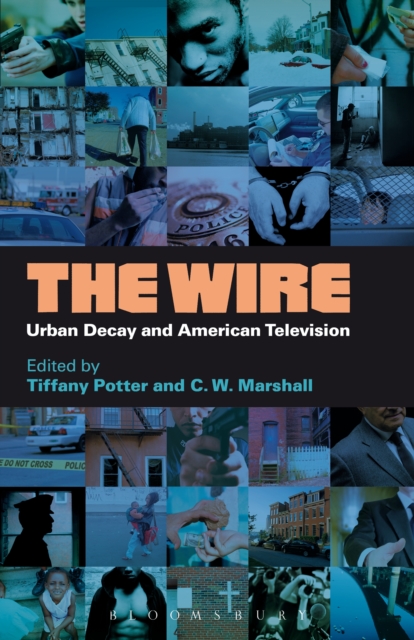
The Wire : urban decay and American television
The first collection of critical essays on HBO's The Wire - the most brilliant and socially relevant television series in years The Wire is about survival, about the strategies adopted by those living and working in the inner cities of America.
eBook

Revisiting the Dickensian echo of the HBO TV series The Wire
This article analyzes the alleged Dickensian echo of the highly-acclaimed HBO TV series The Wire. Charles Dickens is probably the literary author to whom the series has most frequently been likened. This correspondence is scrutinized here, as it seems to have been built upon impressionistic references, rather than on methodical intertextual analyses of both the series and the Victorian author. The analysis is intended to throw new light on the Dickensian ambience of The Wire, which seems to be different than previous critical appreciations of the series have suggested.
Journal Article

The Wire and Urban Health Education
As urban health has emerged as a distinct field, experts have collaborated to develop models for interdisciplinary education to train health professionals. Interdisciplinary learning is an important yet challenging imperative for urban health education. This paper explores lessons learned from a 2010 speaker series at the Johns Hopkins Bloomberg School of Public Health. The television show,
The Wire,
was used as a teaching tool to illustrate the context of health disparities in American cities and to explore the complex factors perpetuating urban health outcomes. We suggest that individuals interested in developing interdisciplinary teaching models can learn from both the form and the content of
The Wire
. As a popular televised serial narrative, The Wire prompts an investigation into the forms and circulation of academic research in a fractured and specialized media landscape. The formal narrative structure of the show provides mental scaffolding from which epidemiological, historical, geographical, anthropological, and other relevant disciplinary learning can build.
The Wire
encourages critical reflection among public health professionals about the forces that shape public health training, research, and practice and offers creative expansions to existing urban health educational efforts.
Journal Article
Visible Fictions
This revised edition of a standard textbook combines an examination of the cinema and television industries with a detailed analysis of their aesthetic and semiotic characteristics. John Ellis draws on his experience as an independent television producer to provide a comprehensive and challenging overview of the place of film, television and video in our daily lives and their future prospects in a changing media landscape.
eBook