
Catalogue Search | MBRL


Are you sure you want to remove the book from the shelf?

{{itemTitle}}
5,058
result(s) for
"Wireless communication systems -- Computer simulation"
Sort by:

Nonlinear Distortion in Wireless Systems
This book covers the principles of modeling and simulation of nonlinear distortion in wireless communication systems with MATLAB simulations and techniques In this book, the author describes the principles of modeling and simulation of nonlinear distortion in single and multichannel wireless communication systems using both deterministic and.
eBook
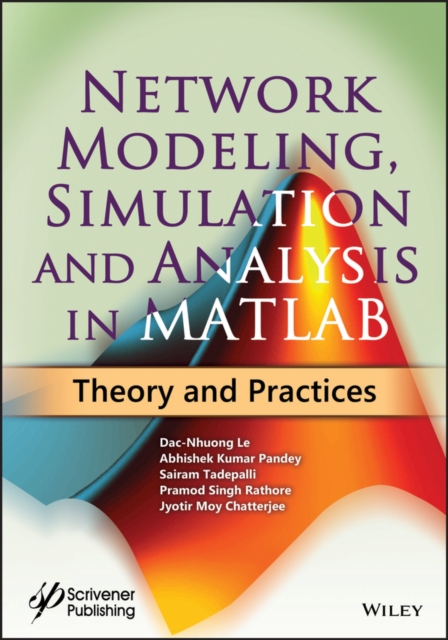
Network Modeling, Simulation and Analysis in MATLAB
The purpose of this book is first to study MATLAB programming concepts, then the basic concepts of modeling and simulation analysis, particularly focus on digital communication simulation. The book will cover the topics practically to describe network routing simulation using MATLAB tool. It will cover the dimensions' like Wireless network and WSN simulation using MATLAB, then depict the modeling and simulation of vehicles power network in detail along with considering different case studies.
Key features of the book include:
* Discusses different basics and advanced methodology with their fundamental concepts of exploration and exploitation in NETWORK SIMULATION.
* Elaborates practice questions and simulations in MATLAB
* Student-friendly and Concise
* Useful for UG and PG level research scholar
* Aimed at Practical approach for network simulation with more programs with step by step comments.
* Based on the Latest technologies, coverage of wireless simulation and WSN concepts and implementations
eBook

Webrtc Blueprints
This book is a step-by-step project-based guide that aims to teach you how to develop your own web applications and services with WebRTC in a concise, practical manner.If you are a WebRTC developer and want to build complex WebRTC applications and projects, or if you want to gain practical experience in developing web applications, advanced WebRTC media handling, Server and client signalling, call flows, third party integration, then this book is perfect for you. It is essential to have prior knowledge about building simple applications using WebRTC.
eBook
WebRTC blueprints
This book introduces you to WebRTC and how you can utilize its open API. Each chapter covers a new concept of the technology with thoroughly explained code examples of completed applications to help you learn quickly and efficiently. You will learn about the client and server sides of a WebRTC application in a practical manner, as well as how to implement data exchange between peers using the WebRTC Data API. The book also guides you through how to develop applications for desktop sharing and prerecorded video streaming. The book also teaches you how to use HTTPS with a WebRTC application and why it can be useful. You will also learn how to implement authentication in an application and integrate it with your own TURN server.
eBook

SGHRP: Secure Greedy Highway Routing Protocol with authentication and increased privacy in vehicular ad hoc networks
VANETs are networks of connected intelligent vehicles that can communicate with each other, as well as with infrastructure and fixed roadside equipment. As a result of the lack of fixed infrastructure and open-access environment, security is crucial when sending packets. Secure routing protocols have been proposed for VANETs, but most are focused on authenticating nodes and creating a secure route, without considering confidentiality after the route is created. Using a chain of source keys validated by a one-way function, we have proposed a secure routing protocol called Secure Greedy Highway Routing Protocol (GHRP), which provides increased confidentiality over other protocols. As part of the proposed protocol, the source, destination, and intermediate nodes are authenticated using a hashing chain in the first stage, and in the second stage, one-way hashing has been used to increase data security. In order to resist routing attacks such as black hole attacks, the proposed protocol is based on the GHRP routing protocol. The proposed protocol is simulated using the NS2 simulator, and its performance is compared with that of the SAODV protocol. Based on the simulation results, the proposed protocol performs better than the mentioned protocol in terms of packet delivery rate, overhead, and average end-to-end delay.
Journal Article

Outage Performance for IDF Relaying Mobile Cooperative Networks
Cooperative communication is a key technique in fifth generation (5G) mobile wireless networks. In this paper, we study the transmit antenna selection (TAS) in mobile cooperative networks. We derive the exact closed-form outage probability (OP) expressions for two TAS schemes. Based on the derived OP expressions, the impact of power allocation on OP performance is evaluated. Then we obtain that the Monte-Carlo simulation results and the analysis results match very well. The OP performance is affected by the power-allocation parameter.
Journal Article

Versatile mobile communications simulation: the Vienna 5G Link Level Simulator
Research and development of mobile communications systems require a detailed analysis and evaluation of novel technologies to further enhance spectral efficiency, connectivity and reliability. Due to the exponentially increasing demand of mobile broadband data rates and challenging requirements for latency and reliability, mobile communications specifications become increasingly complex. For this reason, analytic analysis as well as measurement-based investigations of link-level methods soon encounter feasibility limitations. Therefore, computer-aided numeric simulation is an important tool for investigation of wireless communications standards and is indispensable for analysis and development of future technologies. In this contribution, we introduce the Vienna 5G Link Level Simulator, a Matlab-based link-level simulation tool that facilitates research and development in mobile communications. Our simulator enables standard compliant setups according to 4G LTE, 5G NR and even beyond, making it a very flexible simulation tool. Offered under an academic use license free of charge to fellow researchers, it considerably enhances reproducibility in wireless communications research.
Journal Article
Deep Learning Based Cooperative Resource Allocation in 5G Wireless Networks
Wireless personal communication has become popular with the rapid development of 5G communication systems. Critical demands on transmission speed and QoS make it difficult to upgrade current wireless personal communication systems. In this paper, we develop a novel resource allocation method using deep learning to squeeze the benefits of resource utilization. By generating the convolutional neural network using channel information, resource allocation is to be optimized. The deep learning method could help make full use of the small scale channel information instead of traditional resource optimization, especially when the channel environment is changing fast. Simulation results indicate the fact that the performance of our proposed method is close to MMSE method and better than ZF method, and the time consumption of computation is smaller than traditional method.
Journal Article
Flexible multi-node simulation of cellular mobile communications: the Vienna 5G System Level Simulator
The investigation and prediction of new trends and technologies for mobile cellular networks is of utmost importance for researchers and network providers to quickly identify promising developments. With the verge of the fifth generation of mobile communications (5G), networks become more and more heterogeneous and dynamic while the amount of active users within a cell keeps ever increasing. Therefore, the search for more efficient network layouts and configurations attracts massive attention while on the other hand becomes more and more complex. In this contribution, we present the Vienna 5G system level simulator, which allows to perform numerical performance evaluation of large-scale multi-tier networks, with numerous types of network nodes. The simulator is based on Matlab and is implemented in a modular fashion, to conveniently investigate arbitrary network and parameter constellations, which can be enhanced effortlessly. We first discuss the distinguishing aspects of our simulator platform, describe its structure, and then showcase its functionality by demonstrating the key aspects in more detail.
Journal Article
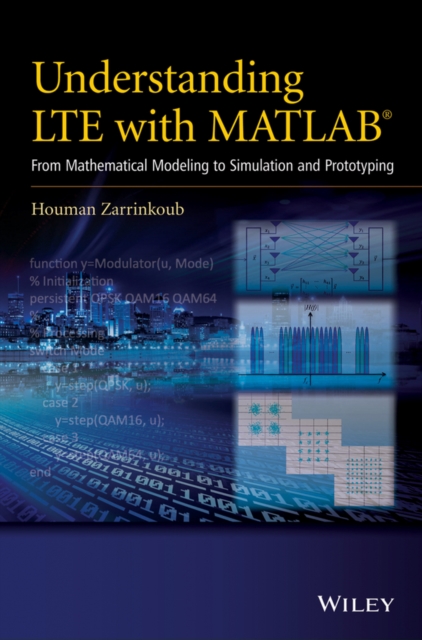
Understanding LTE with MATLAB
An introduction to technical details related to the Physical Layer of the LTE standard with MATLAB® The LTE (Long Term Evolution) and LTE-Advanced are among the latest mobile communications standards, designed to realize the dream of a truly global, fast, all-IP-based, secure broadband mobile access technology. This book examines the Physical Layer (PHY) of the LTE standards by incorporating three conceptual elements: an overview of the theory behind key enabling technologies; a concise discussion regarding standard specifications; and the MATLAB® algorithms needed to simulate the standard. The use of MATLAB®, a widely used technical computing language, is one of the distinguishing features of this book. Through a series of MATLAB® programs, the author explores each of the enabling technologies, pedagogically synthesizes an LTE PHY system model, and evaluates system performance at each stage. Following this step-by-step process, readers will achieve deeper understanding of LTE concepts and specifications through simulations. Key Features: Accessible, intuitive, and progressive; one of the few books to focus primarily on the modeling, simulation, and implementation of the LTE PHY standard Includes case studies and testbenches in MATLAB®, which build knowledge gradually and incrementally until a functional specification for the LTE PHY is attained Accompanying Web site includes all MATLAB® programs, together with PowerPoint slides and other illustrative examples
eBook