
Catalogue Search | MBRL


Are you sure you want to remove the book from the shelf?

{{itemTitle}}
270
result(s) for
"Wissenschaftsgeschichte"
Sort by:

Age of System
In the years after World War II, a new generation of scholars redefined the central concepts and practices of social science in America.
Before the Second World War, social scientists struggled to define and defend their disciplines. After the war, \"high modern\" social scientists harnessed new resources in a quest to create a unified understanding of human behavior—and to remake the world in the image of their new model man.
In Age of System, Hunter Heyck explains why social scientists—shaped by encounters with the ongoing \"organizational revolution\" and its revolutionary technologies of communication and control—embraced a new and extremely influential perspective on science and nature, one that conceived of all things in terms of system, structure, function, organization, and process. He also explores how this emerging unified theory of human behavior implied a troubling similarity between humans and machines, with freighted implications for individual liberty and self-direction.
These social scientists trained a generation of decision-makers in schools of business and public administration, wrote the basic textbooks from which millions learned how the economy, society, polity, culture, and even the mind worked, and drafted the position papers, books, and articles that helped set the terms of public discourse in a new era of mass media, think tanks, and issue networks. Drawing on close readings of key texts and a broad survey of more than 1, 800 journal articles, Heyck follows the dollars—and the dreams—of a generation of scholars that believed in \"the system.\" He maps the broad landscape of changes in the social sciences, focusing especially intently on the ideas and practices associated with modernization theory, rational choice theory, and modeling. A highly accomplished historian, Heyck relays this complicated story with unusual clarity.
eBook

Minds behind the brain : a history of the pioneers and their discoveries
This volume presents a series of vibrant profiles that trace the evolution of our knowledge about the brain. Beginning almost 5,000 years ago, with the ancient Egyptian study of “the marrow of the skull”, the book takes us on a fascinating journey from the classical world of Hippocrates, to the time of René Descartes and the era of Paul Broca and Santiago Ramón y Cajal, to modern researchers such as Roger W. Sperry. We meet Galen, a man of titanic ego and abrasive disposition, whose teachings dominated medicine for a thousand years; Andreas Vesalius, a contemporary of Nicolaus Copernicus, who pushed our understanding of human anatomy to new heights; Otto Loewi, pioneer in neurotransmitters, who gave the Nazis his Nobel prize money and fled Austria for England; and Rita Levi-Montalcini, discoverer of nerve growth factor, who in war-torn Italy was forced to do her research in her bedroom. For each individual, the philosophy, the tools, the books, and the ideas that brought new insights are examined. The book also looks at broader topics: How dependent are researchers on the work of others? What makes the time ripe for discovery? And what role does chance or serendipity play? Many fascinating background figures are also included, from Leonardo da Vinci and Emanuel Swedenborg to Karl August Weinhold—who claimed to have reanimated a dead cat by filling its skull with silver and zinc—and Mary Shelley, whose Frankenstein was inspired by such experiments.
eBook

Sleep as Movement/Sleep as Stillness. Colliding “Objects” at the Scientific Exhibition Dreamstage (1977)
This contribution analyzes the much-acclaimed exhibition Dreamstage, initially presented at the Carpenter Center for the Visual Arts in Cambridge, Massachusetts, USA, in 1977. Based on conceptual papers, private correspondences, press releases and reviews, etc., it will claim that, at the time, divergent cultures of knowledge had created divergent objects of “sleep”: On the one hand, participating scientists and artists at Dreamstage represented what shall be called “sleep as movement” – by underlining the hidden activities of the sleeping body. Yet, popular cultures regarded sleep as opposing movement – a poetics, that shall be called “sleep as stillness,” would frame, or even romanticize, sleep as an act of refusal or pacifistic resistance. In virtue of their constituent logic, both objects were found to collide. Throughout the 20th century, representations of “sleep” and “dreams” were shaped via multiple applications of objectifying/observational, time-based technologies (e.g., Electroencephalography [EEG], Magnetic resonance imaging [MRI], film, or video). This allowed for a circulation between laboratory, cinema, and television, in which knowledge appears to be consolidated again and again. “Sleep as stillness” and “sleep as movement” are thus developed from the case study to better grasp these formations since the late 20th century.
Journal Article

The effects of publishing processes on scientific thought: Typography and typology in prehistoric archaeology (1950s–1990s)
In the last decades, many changes have occurred in scientific publishing, including online publication, data repositories, file formats and standards. The role played by computers in this process rekindled the argument on forms of technical determinism. This paper addresses this old debate by exploring the case of publishing processes in prehistoric archaeology during the second part of the twentieth century, prior to the wide-scale adoption of computers. It investigates the case of a collective and international attempt to standardize the typological analysis of prehistoric lithic objects, coined typologie analytique by Georges Laplace and developed by a group of French, Italian, and Spanish researchers. The aim of this paper is to: 1) present a general bibliometric scenario of prehistoric archaeology publishing in continental Europe; 2) report on the little-known typologie analytique method in archaeology, using publications, archives, and interviews; 3) show how the publication of scientific production was shaped by social (editorial policies, support networks) and material (typography features and publication formats) constraints; and 4) highlight how actors founded resources to control and counterbalance these effects, namely by changing and improving publishing formats.
Journal Article
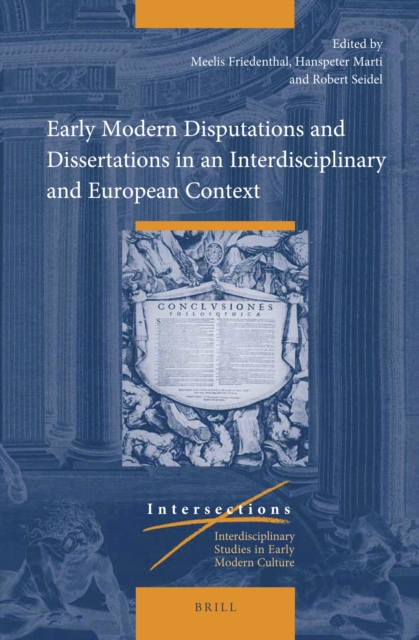
Early Modern Disputations and Dissertations in an Interdisciplinary and European Context
This volume offers a wide-ranging overview of the 16th-18th century disputation culture in various European regions. Its focus is on printed disputations as a polyvalent media form which brings together many of the elements that contributed to the cultural and scientific changes during the early modern period.
eBook

\Under water\ – Between Science and Art – The rediscovery of the first authentic underwatersketches by Eugen von Ransonnet-Villez (1838–1926)
This article presents new material on the Austrian artist-explorer Eugen von Ransonnet-Villez (1838–1926). Ransonnet gained local credit for his underwater-oil painting held in the Natural History Museum Vienna (hereafter NHM Vienna). This picture is based on sketches taken by Ransonnet sitting in a diving bell in the year 1864/65 in Ceylon (today Sri Lanka). This diving bell experiment always drew some attention to itself. But despite that little is still known about Ransonnet's life and working techniques. Ransonnet's diving bell experiment was not his only attempt to explore and picture the then unknown world underwater. Before and after this he tried different techniques to obtain more naturalistic insights into the submarine world. The rediscovery and the presentation of until date unpublished material from the Oceanographic Museum of Monaco (hereafter MOM) sheds new light on his methods in underwater-landscaping. Among this are the very first authentic underwater sketches in history.
Vorliegender Artikel präsentiert neues Material über den Maler und Entdecker Eugen Freiherr von Ransonnet-Villez (1838–1926). Ransonnet erlangte lokale Berühmtheit für sein im Naturhistorischen Museum Wien (NHM Vienna) aufbewahrtes Unterwasser-Ölgemälde. Dieses Gemälde basiert auf Skizzen, die Ransonnet in einer Taucherglocke im Jahr 1864/65 in Ceylon (heute Sri Lanka) angefertigt hat. Dieses Taucherglocken-Experiment zog stets Interesse auf sich. Doch abgesehen davon ist noch immer wenig über Ransonnet's Leben und seine Arbeitsmethoden bekannt. Ransonnet's Taucherglocken-Experiment war nicht sein einziger Versuch, die bis dahin unbekannte Welt unter Wasser zu erforschen und zu malen. Davor und danach testete er verschiedene Techniken, um einen immer naturalistischeren Einblick in die submarine Welt zu erlangen. Die Wiederentdeckung und erstmalige Publikation von bisher unveröffentlichten Materialien aus dem Ozeanographischen Museum von Monaco (MOM) wirft neues Licht auf seine Methoden in der Unterwassermalerei. Darunter befinden sich auch die ersten authentischen Unterwasser-Skizzen der Wissenschafts- und Kunstgeschichte.
Journal Article
War and the humanities : the cultural impact of the First World War
Der Erste Weltkrieg war eine entscheidende Zäsur zwischen dem \"langen\" 19. und \"kurzen\" 20. Jahrhundert. Als einer der zerstörerischsten Konflikte der Weltgeschichte hatte der Erste Weltkrieg jedoch auch einen maßgeblichen Einfluss auf die Geisteswissenschaften. Eine Verbindung, welche im vorliegenden Sammelband eingehender betrachtet wird. The First World War was, of course, the seminal catas-trophe of the 20th century, determining the future poli-tics, redefining warfare, and creating its own mythology. However, it also had a tremendous cultural impact, which is be analyzed in the present volume with a spe-cial focus on the humanities. The battles of the First World War created a fundamen-tally new impression of war. Total warfare, the use of propaganda, chemical weapons, and every possible other measure to ensure victory defined the event that should later be known as the \"Great War\", because it caused so many deaths and suffering. The catastrophe also had an impact on the humanities, which inevitably had to deal with the processing of an event that seemed to be too big to be clearly understood by the human mind. The present volume covers several interdisciplinary per-spectives by dealing with the impact of the war on the humanities during and after the conflict that deeply in-fluenced the mindset of the 20th century.
eBook

Vorreiterin für das Verständnis der Indischen Philosophie abseits eurozentristischer Deutungen? Die jüdische Indologin Betty Heimann (1888–1961) und die Anthropogeographie
Im Vordergrund dieses Artikels stehen die jüdische Indologin Betty Heimann und ihre wissenschaftliche Methode, die sie selbst als „anthropo-geographischen“ Standpunkt bezeichnete. Vorangestellt werden eine Erörterung damaliger eurozentristischer Deutungen, eine biographische Skizze und eine Rekonstruktion ihrer wissenschaftlichen Karriere. Als Quellengrundlage dienen die Publikationen Heimanns. Außerdem werden Rezensionen und Gutachten herangezogen, um ihre Rolle und ihren Einfluss im Kontext der Indologie zu beurteilen. Darüber hinaus wird die Entwicklung der Anthropogeographie vorgestellt. Die Untersuchung der Adaption der Anthropogeographie in der Indologie ist bisher nicht erforscht. Trotz ihres Geschlechtes und ihrer Religion beschritt Heimann als erste Frau mit einer Habilitation und Venia Legendi in den 1920er-Jahren eine wissenschaftliche Karriere an der Universität Halle-Wittenberg und später an den Universitäten in London und Colombo, Sri Lanka. Schlüsselwörter: Indische Philosophie, Humangeographie, Eurozentrismus, Antisemitismus, Intersektionalität, Wissenschaftsgeschichte / A pioneer on the road to understanding Indian philosophy beyond Eurocentric interpretations? Summary: The Jewish Indologist Betty Heimann (1888–1961) and anthropogeography This article focuses on the Jewish Indologist Betty Heimann and her scientific method, which she herself described as an “anthropogeographical” point of view. This is preceded by a discussion of Eurocentric interpretations at the time, a biographical sketch and a reconstruction of her academic career. I draw on Heimann‘s publications as my source. Reviews and expert opinions also provide a basis for assessing her role and influence in the context of Indology. The development of anthropogeography is also presented. The adaptation of anthropogeography in Indology has not yet been researched. Despite experiencing discrimination due to her gender and religion, she was the first woman to pursue an academic career in the 1920s at the University of Halle-Wittenberg and subsequently at the University of London and the University of Colombo, Sri Lanka.. Keywords: Indian philosophy, human geography, Eurocentrism, anti-Semitism, intersectionality, history of science
Journal Article

Economists and societies
\"Economists and Societies is the first book to systematically compare the profession of economics in the United States, Britain, and France, and to explain why economics, far from being a uniform science, differs in important ways among these three countries. Drawing on in-depth interviews with economists, institutional analysis, and a wealth of scholarly evidence, the author traces the history of economics in each country from the late nineteenth century to the present, demonstrating how each political, cultural, and institutional context gave rise to a distinct professional and disciplinary configuration. She argues that because the substance of political life varied from country to country, people's experience and understanding of the economy, and their political and intellectual battles over it, crystallized in different ways - through scientific and mercantile professionalism in the United States, public-minded elitism in Britain, and statist divisions in France. Fourcade moves past old debates about the relationship between culture and institutions in the production of expert knowledge to show that scientific and practical claims over the economy in these three societies arose from different elites with different intellectual orientations, institutional entanglements, and social purposes. Much more than a history of the economics profession, the book is a revealing exploration of American, French, and British society and culture as seen through the lens of their respective economic institutions and the distinctive character of their economic experts.\" Die Untersuchung enthält quantitative Daten. Forschungsmethode: deskriptive Studie; historisch. Die Untersuchung bezieht sich auf den Zeitraum 1890 bis 2000. (author's abstract, IAB-Doku).
eBook