
Catalogue Search | MBRL


Are you sure you want to remove the book from the shelf?

{{itemTitle}}
4,463
result(s) for
"Wittgenstein, Ludwig"
Sort by:


A Sceptical Guide to Meaning and Rules
No other recent book in Anglophone philosophy has attracted as much criticism and has found so few friends as Saul Kripke's \"Wittgenstein on Rules and Private Language\". Amongst its critics, one finds the very top of the philosophical profession. Yet, it is rightly counted amongst the books that students of philosophy, at least in the Anglo-American world, have to read at some point in their education. Enormously influential, it has given rise to debates that strike at the very heart of contemporary philosophy of mind and language. In this major new interpretation, Martin Kusch defends Kripke's account against the numerous weighty objections that have been put forward over the past twenty years and argues that none of them is decisive. He shows that many critiques are based on misunderstandings of Kripke's reasoning; that many attacks can be blocked by refining and developing Kripke's position; and that many alternative proposals turn out either to be unworkable or to be disguised variants of the view they are meant to replace. Kusch argues that the apparent simplicity of Kripke's text is deceptive and that a fresh reading gives Kripke's overall argument a new strength.
eBook


Normativity, Meaning and Philosophy
This is a collection of essays on Wittgenstein originally published between 1996 and 2019, with a new introduction. The essays defend and develop a central Wittgensteinian idea: 'grammatical rules' for the use of expressions hold the key to understanding linguistic meaning, as well as its connections to necessary propositions, conceptual thought, and the nature of philosophy.
eBook


A Beginner's Guide to the Later Philosophy of Wittgenstein
In this Beginner's Guide, Peter Hacker introduces the later philosophy of Wittgenstein in a lively and engaging combination of lectures and dialogues that presupposes no philosophical knowledge. He examines such topics as the nature of language and linguistic meaning, the analysis of necessity and its roots in convention, the relation of thought and language, the nature of the mind and its relation to behaviour, self-consciousness, and knowledge of other minds. This unique form of introduction will capture the interest of all readers with an enquiring mind.
eBook

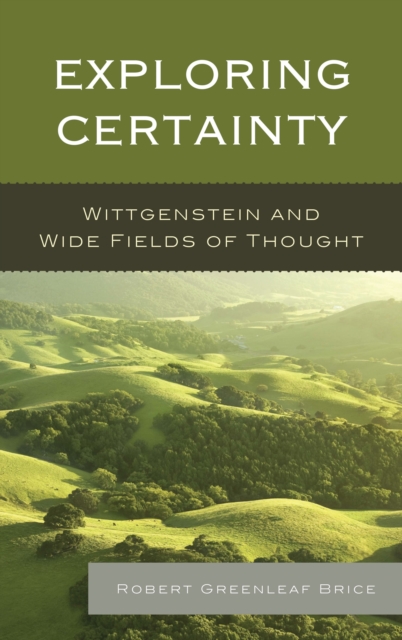
Exploring certainty
Ludwig Wittgenstein’s On Certainty explores a myriad of new and important ideas regarding our notions of belief, knowledge, skepticism, and certainty. During the course of his exploration, Wittgenstein makes a fascinating new discovery about certitude, namely, that it is categorically distinct from knowledge. As his investigation advances, he recognizes that certainty must be non-propositional and non-ratiocinated; borne out not in the things we say, but in our actions, our deeds. Many philosophers working outside of epistemology recognized Wittgenstein's insights and determined that his work's abrupt end might serve as an excellent launching point for still further philosophical expeditions. In Exploring Certainty: Wittgenstein and Wide Fields of Thought, Robert Greenleaf Brice surveys some of this rich topography. Wittgenstein's writings serve as a point of departure for Brice's own ideas about certainty. He shows how Wittgenstein's rough and unpolished notion of certitude might be smoothed out and refined in a way to benefit studies of morality, aesthetics, cognitive science, philosophy of mathematics. Brice's work opens new avenues of thought for scholars and students of the Wittgensteinian tradition, while introducing original philosophies concerning issues central to human knowledge and cognition.
eBook


Wittgenstein Rehinged
This volume brings together thirteen papers on hinge epistemology written by Annalisa Coliva and published after her influential monographs Moore and Wittgenstein: Scepticism, Certainty and Common Sense (2010), and Extended Rationality: A Hinge Epistemology (2015). By mixing together Wittgenstein scholarship and systematic philosophy, they illuminate the significance of hinge epistemology for current debates on skepticism, relativism, realism and anti-realism, as well as alethic pluralism, and envision its possible extension to the epistemology of logic. Along the way, other varieties of hinge epistemology, such as Moyal-Sharrock's, Pritchard's, Williams' and Wright's, are considered, both with respect to Wittgenstein scholarship and in their own right.
eBook