
Catalogue Search | MBRL


Are you sure you want to remove the book from the shelf?

{{itemTitle}}
72
result(s) for
"Women -- Arab countries -- Social conditions"
Sort by:


Women, Islam and resistance in the Arab world
No detailed description available for \"Women, Islam, and Resistance in the Arab World\".
eBook


The Arab State and Women's Rights
Researchers studying gender politics in Arab societies have been puzzled by a phenomenon common in many Arab states - while women are granted suffrage rights, they are often discriminated against by the state in their private lives.
This book addresses this phenomenon, maintaining that the Arab state functions according to a certain 'logic' and 'patterns' which have direct consequences on its gender policies, in both the public and private spheres. Using the features of the Arab Authoritarian state as a basis for a theoretical framework of analysis, the author draws on detailed fieldwork and first-hand interviews to study women's rights in three countries - Yemen, Syria, and Kuwait. She argues that the puzzle may be resolved once we focus on the features of the Arab state, and its stage of development.
Offering a new approach to the study of gender and politics in Arab states, this book will be of great interest to scholars and students of gender studies, international politics and Middle East studies.
eBook


Women and Gender in Islam
Are Islamic societies inherently oppressive to women? Is the trend among Islamic women to appear once again in veils and other traditional clothing a symbol of regression or an effort to return to a \"pure\" Islam that was just and fair to both sexes? In this book Leila Ahmed adds a new perspective to the current debate about women and Islam by exploring its historical roots, tracing the developments in Islamic discourses on women and gender from the ancient world to the present.
In order to distinguish what was distinctive about the earliest Islamic doctrine on women, Ahmed first describes the gender systems in place in the Middle East before the rise of Islam. She then focuses on those Arab societies that played a key role in elaborating the dominant Islamic discourses about women and gender: Arabia during the period in which Islam was founded; Iraq during the classical age, when the prescriptive core of legal and religious discourse on women was formulated; and Egypt during the nineteenth and twentieth centuries, when exposure to Western societies led to dramatic social change and to the emergence of new discourses on women. Throughout, Ahmed not only considers the Islamic texts in which central ideologies about women and gender developed or were debated but also places this discourse in its social and historical context. Her book is thus a fascinating survey of Islamic debates and ideologies about women and the historical circumstances of their position in society, the first such discussion using the analytic tools of contemporary gender studies.
eBook

Muslim women at work : religious discourses in Arab society
\"This book explores how a growing religious discourse is advocating for change in women's employment participation in Arab societies. It provides a historical and cultural overview of women in Arab societies as well as issues of homogeneity and heterogeneity in religion. An emerging group of activists, intellectuals, and religious scholars are rocking the boat of traditional Islamic understanding of the role of women and their economic and social participation, which is rooted in reinterpretations of the religious texts and history. Signs of this change are already seen in some Arab workplaces though with varying degrees of success. This book uncovers a neglected discourse on the status of Arab women that is relevant to students and academics with interest in economics, gender studies, the Middle East, and Islam. \"-- Provided by publisher.
Book

Bad Girls of the Arab World
Women’s transgressive behaviors and perspectives are challenging societal norms in the Arab world, giving rise to anxiety and public debate. Simultaneously, however, other Arab women are unwillingly finding themselves labeled “bad\" as authority figures attempt to redirect scrutiny from serious social ills such as patriarchy and economic exploitation, or as they impose new restrictions on women’s behavior in response to uncertainty and change in society. Bad Girls of the Arab World elucidates how both intentional and unintentional transgressions make manifest the social and cultural constructs that define proper and improper behavior, as well as the social and political policing of gender, racial, and class divisions. The works collected here address the experiences of women from a range of ages, classes, and educational backgrounds who live in the Arab world and beyond. They include short pieces in which the women themselves reflect on their experiences with transgression; academic articles about performance, representation, activism, history, and social conditions; an artistic intervention; and afterwords by the acclaimed novelists Laila al-Atrash and Miral al-Tahawy. The book demonstrates that women’s transgression is both an agent and a symptom of change, a site of both resistance and repression. Showing how transnational forces such as media discourses, mobility and confinement, globalization, and neoliberalism, as well as the legacy of colonialism, shape women’s badness, Bad Girls of the Arab World offers a rich portrait of women’s varied experiences at the boundaries of propriety in the twenty-first century.
eBook
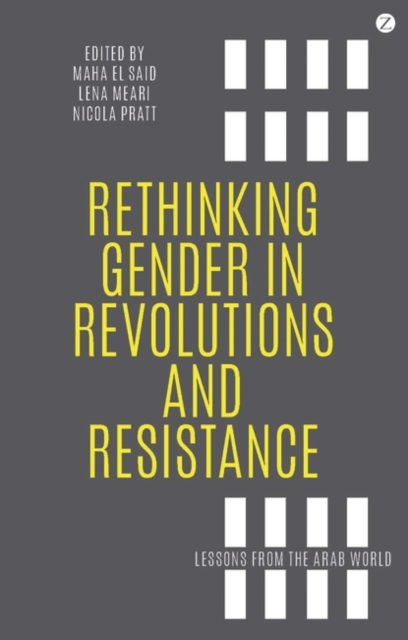
Rethinking Gender in Revolutions and Resistance
Ever since the uprisings that swept the Arab world, the role of Arab women in political transformations received unprecedented media attention. The copious commentary, however, has yet to result in any serious study of the gender dynamics of political upheaval. Rethinking Gender in Revolutions and Resistance is the first book to analyse the interplay between moments of sociopolitical transformation, emerging subjectivities and the different modes of women's agency in forging new gender norms in the Arab world. Written by scholars and activists from the countries affected, including Palestine, Egypt, Tunisia and Libya, this is an important addition to Middle Eastern gender studies.
eBook