
Catalogue Search | MBRL


Are you sure you want to remove the book from the shelf?

{{itemTitle}}
139
result(s) for
"Women -- United States -- Social conditions -- 19th century"
Sort by:

Antebellum women : private, public, partisan
The authors identify three phases in the changing relationship of women to civic and political activities. They first situate women as deferential domestics in a world of conservative gender expectations; then map out the development of an ideology that allowed women to leverage their familial roles into participation as companionate co-workers in movements of religion, reform, and social welfare; and finally trace the path of those who followed their causes into the world of politics as passionate partisans. The book includes a selection of primary documents that encompasses both well-known works and previously unpublished texts representing a variety of genres, making Antebellum Women a unique volume work that will introduce readers to the documentary record as well as to the vibrant body of historical work on gender in the early nineteenth century.
Book

A stitch in time : the needlework of aging women in antebellum America
Drawing from 167 examples of decorative needlework—primarily samplers and quilts from 114 collections across the United States—made by individual women aged forty years and over between 1820 and 1860, this exquisitely illustrated book explores how women experienced social and cultural change in antebellum America. The book is filled with individual examples, stories, and over eighty fine color photographs that illuminate the role that samplers and needlework played in the culture of the time. For example, in October 1852, Amy Fiske (1785–1859) of Sturbridge, Massachusetts, stitched a sampler. But she was not a schoolgirl making a sampler to learn her letters. Instead, as she explained, \"The above is what I have taken from my sampler that I wrought when I was nine years old. It was w[rough]t on fine cloth [and] it tattered to pieces. My age at this time is 66 years.\" Situated at the intersection of women's history, material culture study, and the history of aging, this book brings together objects, diaries, letters, portraits, and prescriptive literature to consider how middle-class American women experienced the aging process. Chapters explore the physical and mental effects of \"old age\" on antebellum women and their needlework, technological developments related to needlework during the antebellum period and the tensions that arose from the increased mechanization of textile production, and how gift needlework functioned among friends and family members. Far from being solely decorative ornaments or functional household textiles, these samplers and quilts served their own ends. They offered aging women a means of coping, of sharing and of expressing themselves. These \"threads of time\" provide a valuable and revealing source for the lives of mature antebellum women. Publication of this book was made possible in part through generous funding from the Coby Foundation, Ltd and from the Quilters Guild of Dallas, Helena Hibbs Endowment Fund.
eBook

Wayward lives, beautiful experiments : intimate histories of social upheaval
\"In wrestling with the question, \"What is a free life?\" many young black women created forms of intimacy and kinship indifferent to the dictates of respectability, and outside the bounds of law. They cleaved to and cast off lovers, exchanged sex to subsist, and revised the meaning of marriage. Longing and desire fueled their experiments in how to live. They refused to labor like slaves or to accept degrading conditions of work. Beautifully written, Wayward Lives narrates the story of this radical transformation of black intimate and social life. It re-creates the experience of young black women who desired an existence qualitatively different than the one that had been scripted for them, and, for the first time, credits them with shaping a cultural movement that transformed the urban landscape. Through a melding of history and literary imagination, Wayward Lives seeks to recover the radical aspirations and insurgent desires of these young women.\"--Provided by publisher.
Book

Mere Equals
InMere Equals, Lucia McMahon narrates a story about how a generation of young women who enjoyed access to new educational opportunities made sense of their individual and social identities in an American nation marked by stark political inequality between the sexes. McMahon's archival research into the private documents of middling and well-to-do Americans in northern states illuminates educated women's experiences with particular life stages and relationship arcs: friendship, family, courtship, marriage, and motherhood. In their personal and social relationships, educated women attempted to live as the \"mere equals\" of men. Their often frustrated efforts reveal how early national Americans grappled with the competing issues of women's intellectual equality and sexual difference.
In the new nation, a pioneering society, pushing westward and unmooring itself from established institutions, often enlisted women's labor outside the home and in areas that we would deem public. Yet, as a matter of law, women lacked most rights of citizenship and this subordination was authorized by an ideology of sexual difference. What women and men said about education, how they valued it, and how they used it to place themselves and others within social hierarchies is a highly useful way to understand the ongoing negotiation between equality and difference. In public documents, \"difference\" overwhelmed \"equality,\" because the formal exclusion of women from political activity and from economic parity required justification. McMahon tracks the ways in which this public disparity took hold in private communications. By the 1830s, separate and gendered spheres were firmly in place. This was the social and political heritage with which women's rights activists would contend for the rest of the century.
eBook

Antebellum women
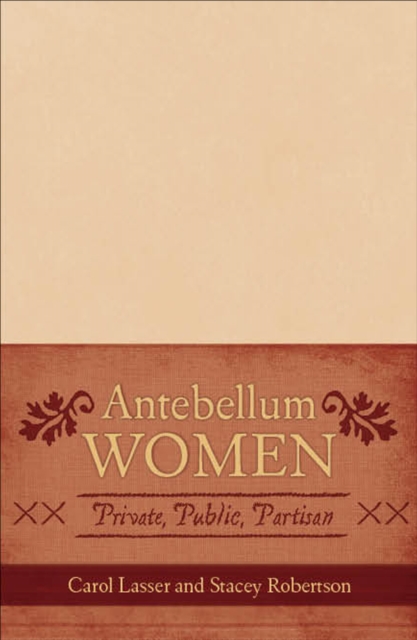
How did diverse women in America understand, explain, and act upon their varied constraints, positions, responsibilities, and worldviews in changing American society between the end of the Revolution and the beginning of the Civil War? Antebellum Women: Private, Public, Partisan answers the question by going beyond previous works in the field. The authors identify three phases in the changing relationship of women to civic and political activities. They first situate women as \"deferential domestics\" in a world of conservative gender expectations; then map out the development of an ideology that allowed women to leverage their familial responsibilities into participation as \"companionate co-workers\" in movements of religion, reform, and social welfare; and finally trace the path of those who followed their causes into the world of politics as \"passionate partisans.\" The book includes a selection of primary documents that encompasses both well-known works and previously unpublished texts from a variety of genres, making Antebellum Women a unique one-volume work that will introduce readers to the documentary record as well as to the vibrant body of historical work on gender in the early nineteenth century.
eBook


The Nineteenth-Century Woman
This collection of papers draws on insights from social anthropology to illuminate historical material, and presents a set of closely integrated studies on the inter-connections between feminism and medical, social and educational ideas in the nineteenth century.
Throughout the book evidence from both the USA and UK shows that feminists had to operate in a restricting and complex social environment in which the concept of \"the lady\" and the ideal of the saintly mother defined the nineteenth-century woman's cultural and physical world.
eBook