
Catalogue Search | MBRL


Are you sure you want to remove the book from the shelf?

{{itemTitle}}
77
result(s) for
"Women Political activity United States History 20th century."
Sort by:


Cold War Progressives
In recognizing the relation between gender, race, and class oppression, American women of the postwar Progressive Party made the claim that peace required not merely the absence of violence, but also the presence of social and political equality. For progressive women, peace was the essential thread that connected the various aspects of their activist agendas. This study maps the routes taken by postwar popular front women activists into peace and freedom movements of the 1960s and 1970s. Historian Jacqueline Castledine tells the story of their decades-long effort to keep their intertwined social and political causes from unraveling and to maintain the connections among peace, feminism, and racial equality._x000B__x000B_Postwar progressive women and their allies often saw themselves as members of a popular front promoting the rights of workers, women, and African Americans under the banner of peace. However, the Cold War indelibly shaped the contours of their activism. Following the Progressive Party's demise in the 1950s, these activists reentered social and political movements in the early 1960s and met the inescapable reality that their agenda was a casualty of the left-liberal political division of the early Cold War era. Many Americans now viewed peace as a leftist concern associated with Soviet sympathizers and civil rights as the favored cause of liberals. Faced with the dilemma of working to reunite these movements or choosing between them, some progressive women chose to lead such New Left organizations as the Jeannette Rankin Brigade while others became leaders of liberal \"second wave\" feminist movements._x000B__x000B_Whether they committed to affiliating with groups that emphasized one issue over others or attempted to found groups with broad popular-front type agendas, Progressive women brought to their later work an understanding of how race, class, and gender intersect in women's organizing. These women's stories demonstrate that the ultimate result of Cold War-era McCarthyism was not the defeat of women's activism, but rather its reconfiguration._x000B_
eBook


Battling Miss Bolsheviki
Why did the political authority of well-respected female reformers diminish after women won the vote? InBattling Miss BolshevikiKirsten Marie Delegard argues that they were undercut during the 1920s by women conservatives who spent the first decade of female suffrage linking these reformers to radical revolutions that were raging in other parts of the world. In the decades leading up to the Nineteenth Amendment, women activists had enjoyed great success as reformers, creating a political subculture with settlement houses and women's clubs as its cornerstones. Female volunteers piloted welfare programs as philanthropic ventures and used their organizations to pressure state, local, and national governments to assume responsibility for these programs.
These female activists perceived their efforts as selfless missions necessary for the protection of their homes, families, and children. In seeking to fulfill their \"maternal\" responsibilities, progressive women fundamentally altered the scope of the American state, recasting the welfare of mothers and children as an issue for public policy. At the same time, they carved out a new niche for women in the public sphere, allowing female activists to become respected authorities on questions of social welfare. Yet in the aftermath of the suffrage amendment, the influence of women reformers plummeted and the new social order once envisioned by progressives appeared only more remote.
Battling Miss Bolshevikichronicles the ways women conservatives laid siege to this world of female reform, placing once-respected reformers beyond the pale of political respectability and forcing most women's clubs to jettison advocacy for social welfare measures. Overlooked by historians, these new activists turned the Daughters of the American Revolution and the American Legion Auxiliary into vehicles for conservative political activism. Inspired by their twin desires to fulfill their new duties as voting citizens and prevent North American Bolsheviks from duplicating the success their comrades had enjoyed in Russia, they created a new political subculture for women activists. In a compelling narrative, Delegard reveals how the antiradicalism movement reshaped the terrain of women's politics, analyzing its enduring legacy for all female activists for the rest of the twentieth century and beyond.
eBook


Revolutionizing Expectations
In the 1970s the women's movement created tremendous changes in the lives of women throughout the United States. Millions of women participated in a movement that fundamentally altered the country's ideas about how women could and should contribute to American society.Revolutionizing Expectationstells the story of some of those women, many of whom took part in the movement in unexpected ways. By looking at feminist activism in Durham, Denver, and Indianapolis, Melissa Estes Blair uncovers not only the work of local NOW chapters but also the feminist activism of Leagues of Women Voters and of women's religious groups in those pivotal cities.
Through her exploration of how women's organizations that were not explicitly feminist became channels for feminism, Blair expands our understanding of who feminists were and what feminist action looked like during the high tide of the women's movement. Revolutionizing Expectations looks beyond feminism's intellectual leaders and uncovers a multifaceted women's movement of white, African American, and Hispanic women from a range of political backgrounds and ages who worked together to bring about tremendous changes in their own lives and the lives of generations of women who followed them.
eBook

Reasoning from race : feminism, law, and the civil rights revolution
Looking beneath the surface of Supreme Court opinions to the deliberations of feminist advocates, their opponents, and the legal decisionmakers who heard - or chose not to hear - their claims. This book showcases previously hidden struggles that continue to shape the scope and meaning of equality under the law.
Book

The Women's Joint Congressional Committee and the Politics of Maternalism, 1920-30
Documenting the rise and fall of a feminist reform powerhouse, The Women's Joint Congressional Committee and the Politics of Maternalism is the first comprehensive history of the umbrella organization founded in 1920 by former suffrage leaders in order to coordinate organized women's reform. Encompassing nearly every major national women's organization of its time, including the League of Women Voters, the Women's Trade Union League, and the National Consumers' League, the Women's Joint Congressional Committee (WJCC) evolved into a powerful lobbying force for the legislative agendas of more than twelve million women. As such, the WJCC was recognized by critics and supporters alike as \"the most powerful lobby in Washington.\"_x000B_ _x000B_Through a close examination of the WJCC's most consequential and contentious campaigns, Jan Doolittle Wilson demonstrates organized women's strategies, rhetoric, and initial success in generating congressional and grassroots support for their far-reaching, progressive reforms. The committee's early achievements spurred a business-led retaliation that challenged and ultimately limited the programs these women envisioned. By using the WJCC as a lens through which to analyze women's political culture during the 1920s, the book also sheds new light on the initially successful ways women lobbied for social legislation, the limitations of that process for pursuing class-based reforms, and the enormous difficulties faced by women trying to expand public responsibility for social welfare in the years following the nineteenth amendment's passage._x000B_
eBook

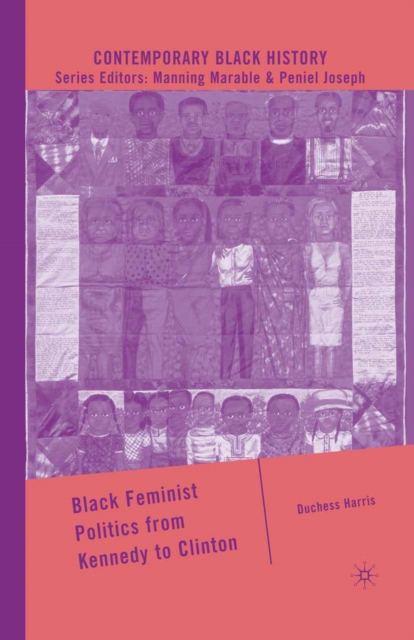
Black feminist politics from Kennedy to Clinton
Taking an interdisciplinary approach, this book analyzes Black women's involvement in American political life, focusing on what they did to gain political power between 1961 and 2001, and why, in many cases, they did not succeed.
eBook