
Catalogue Search | MBRL


Are you sure you want to remove the book from the shelf?

{{itemTitle}}
252
result(s) for
"Women alien labor"
Sort by:


Not One of the Family
A collection of original essays by researchers and workers-turned-activists, it documents how citizen and non-citizen workers are treated unequally in the Canadian system and demonstrates how workers can resist exploitation.
eBook

Laboring in the Shadow of Empire
Laboring in the Shadow of Empire: Race, Gender, and Care
Work in Portugal examines the everyday lives of an
African-descendant care service workforce that labors in an
ostensibly \"anti-racial\" Europe and against the backdrop of the
Portuguese colonial empire. While much of the literature on global
care work has focused on Asian and Latine migrant care workers,
there is comparatively less research that explicitly examines
African care workers and their migration histories to Europe.
Sociologist Celeste Vaughan Curington focuses on Portugal-a
European setting with comparatively liberal policies around family
settlement and naturalization for migrants. In this setting, rapid
urbanization in the late twentieth century, along with a national
push to reconcile work and family, has shaped the growth of paid
home care and cleaning service industries. Many researchers focus
on informal work settings, where immigrant rights are restricted
and many workers are undocumented or without permanent residence
status. Curington instead examines workers who have accessed
citizenship or permanent residence status and also explores African
women's experiences laboring in care and service industries in the
formal market, revealing how deeply colonial and intersectional
logics of a racialized and international division of reproductive
labor in Portugal render these women \"hyper-invisible\" and
\"hyper-visible\" as \"appropriate\" workers in Lisbon.
eBook
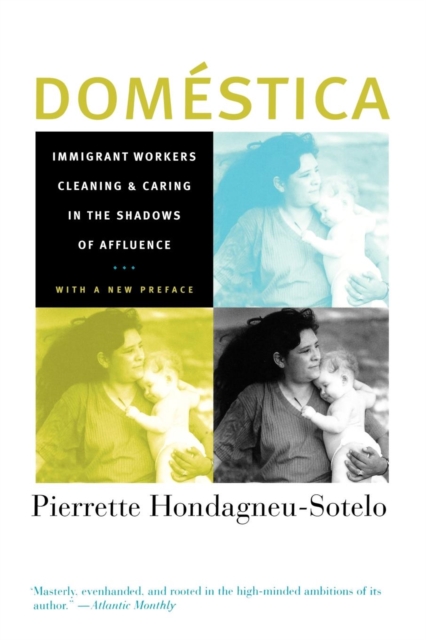
Doméstica
In this enlightening and timely work, Pierrette Hondagneu-Sotelo highlights the voices, experiences, and views of Mexican and Central American women who care for other people's children and homes, as well as the outlooks of the women who employ them in Los Angeles. The new preface looks at the current issues facing immigrant domestic workers in a global context.
eBook


Migration and New Media
How do parents and children care for each other when they are separated because of migration? The way in which transnational families maintain long-distance relationships has been revolutionised by the emergence of new media such as email, instant messaging, social networking sites, webcam and texting. A migrant mother can now call and text her left-behind children several times a day, peruse social networking sites and leave the webcam for 12 hours achieving a sense of co-presence.
Drawing on a long-term ethnographic study of prolonged separation between migrant mothers and their children who remain in the Philippines, this book develops groundbreaking theory for understanding both new media and the nature of mediated relationships. It brings together the perspectives of both the mothers and children and shows how the very nature of family relationships is changing. New media, understood as an emerging environment of polymedia, have become integral to the way family relationships are enacted and experienced. The theory of polymedia extends beyond the poignant case study and is developed as a major contribution for understanding the interconnections between digital media and interpersonal relationships.
\"[A] compelling read about the ‘connected transnational family’ … The most compelling aspect of this book, this reader would argue, is its simultaneous engagement with a broad range of entangled issues. It convincingly puts mothers/children, migration/communication, mediation/relationship, past/present/future as well as theory/research practice into close encounter throughout.\" - Nicole Shephard, LSE Review of Books
\"Mirca Madianou and Daniel Miller seem to have formed a dream team when they embarked on their mutual research project on transnational families and the role of ICTs ... In my view, the book succeeds in what many authors fruitlessly pursue: deriving convincing theory from an abundance of vast qualitative data. It is a highly engaging book that is rich in detail without drowning the reader in it. Its empirical and theoretical innovations make it a highly recommended book for any scholar working on media and migration, long-distance communication and the increasingly complex media environments that enfold us.\" - Kevin Smets, Communications
\"An exemplary and groundbreaking study, with contributions to theory and our understanding of polymedia in everyday life, this stands out as an extraordinary read on the technology of relationships.\" - Zizi Papacharissi, University of Illinois-Chicago, USA
\"This fascinating, richly detailed book investigates the role that fluency across multiple digital platforms plays in enabling mothering and caring to be sustained at a distance. A genuine breakthrough.\" - Nick Couldry , Goldmiths, University of London, UK
\"With deft weaving of interview material and theorization...Mirca Madianou and Daniel Miller have produced an important and useful theoretical intervention that advances our understanding of the social life of transnational communities.\" - Radha S. Hegde, Media, Culture, & Society
Mirca Madianou is Senior Lecturer in Media and Communication at the University of Leicester, UK. She is the author of Mediating the Nation and several articles on the social consequences of the media.
Daniel Miller is Professor of Material Culture at the Department of Anthropology, University College London, UK. His most recent books include Tales from Facebook and Digital Anthropology (edited with Heather Horst).
1. Introduction 2. Philippines at the Forefront of Globalisation 3. The Hidden Motivations of Migration 4. Crafting Love: Letters and Cassettes 5. The Cultural Contradictions of Transnational Motherhood: The Mothers’ Perspective 6. The Children’s Perspective 7. Technologies of Relationships 8. Polymedia 9. A Theory of Mediated Relationships 10. Appendix: A Note on Method
eBook

Born out of place
Hong Kong is a meeting place for migrant domestic workers, traders, refugees, asylum seekers, tourists, businessmen, and local residents. In Born Out of Place, Nicole Constable looks at the experiences of Indonesian and Filipina women in this Asian world city. Giving voice to the stories of these migrant mothers, their South Asian, African, Chinese, and Western expatriate partners, and their Hong Kong–born babies, Constable raises a serious question: Do we regard migrants as people, or just as temporary workers? This accessible ethnography provides insight into global problems of mobility, family, and citizenship and points to the consequences, creative responses, melodramas, and tragedies of labor and migration policies.
eBook

When women come first
With a subtle yet penetrating understanding of the intricate interplay of gender, race, and class, Sheba George examines an unusual immigration pattern to analyze what happens when women who migrate before men become the breadwinners in the family. Focusing on a group of female nurses who moved from India to the United States before their husbands, she shows that this story of economic mobility and professional achievement conceals underlying conditions of upheaval not only in the families and immigrant community but also in the sending community in India. This richly textured and impeccably researched study deftly illustrates the complex reconfigurations of gender and class relations concealed behind a quintessential American success story. When Women Come First explains how men who lost social status in the immigration process attempted to reclaim ground by creating new roles for themselves in their church. Ironically, they were stigmatized by other upper class immigrants as men who needed to \"play in the church\" because the \"nurses were the bosses\" in their homes. At the same time, the nurses were stigmatized as lower class, sexually loose women with too much independence. George's absorbing story of how these women and men negotiate this complicated network provides a groundbreaking perspective on the shifting interactions of two nations and two cultures.
eBook

Families Apart
In a developing nation like the Philippines, many mothers provide for their families by traveling to a foreign country to care for someone else’s. Families Apart focuses on Filipino overseas workers in Canada to reveal what such arrangements mean for families, documenting the difficulties of family separation and the problems that children have when reuniting with their mothers in Vancouver.
eBook

Intimate encounters
This groundbreaking study explores the recent dramatic changes brought about in Japan by the influx of a non-Japanese population, Filipina brides. Lieba Faier investigates how Filipina women who emigrated to rural Japan to work in hostess bars-where initially they were widely disparaged as prostitutes and foreigners-came to be identified by the local residents as \"ideal, traditional Japanese brides.\"Intimate Encounters, an ethnography of cultural encounters, unravels this paradox by examining the everyday relational dynamics that drive these interactions. Faier remaps Japan, the Philippines, and the United States into what she terms a \"zone of encounters,\" showing how the meanings of Filipino and Japanese culture and identity are transformed and how these changes are accomplished through ordinary interpersonal exchanges. Intimate Encounters provides an insightful new perspective from which to reconsider national subjectivities amid the increasing pressures of globalization, thereby broadening and deepening our understanding of the larger issues of migration and disapora.
eBook