
Catalogue Search | MBRL


Are you sure you want to remove the book from the shelf?

{{itemTitle}}
20
result(s) for
"Women and journalism -- United States -- History -- 19th century"
Sort by:

Women writers and journalists in the nineteenth-century south
\"The first study to focus on white and black women journalists and writers both before and after the Civil War, this book offers fresh insight into southern intellectual life, the fight for women's rights, and gender ideology. Based on fresh research into southern magazines and newspapers, this book seeks to shift scholarly attention away from novelists and toward the rich and diverse periodical culture of the South between 1820 and 1900. Magazines were of central importance to the literary culture of the South because the region lacked the publishing centers that could produce large numbers of books. Easily portable, newspapers and magazines could be sent through the increasingly sophisticated postal system for relatively low subscription rates. The mix of content, from poetry to short fiction and literary reviews to practical advice and political news, meant that periodicals held broad appeal. As editors, contributors, correspondents, and reporters in the nineteenth century, southern women entered traditionally male bastions when they embarked on careers in journalism. In so doing, they opened the door to calls for greater political and social equality at the turn of the twentieth century\"-- Provided by publisher.
Book

Between the Novel and the News
While American literary history has long acknowledged the profound influence of journalism on canonical male writers, Sari Edelstein argues that American women writers were also influenced by a dynamic relationship with the mainstream press. From the early republic through the turn of the twentieth century, she offers a comprehensive reassessment of writers such as Catharine Maria Sedgwick, Harriet Jacobs, and Charlotte Perkins Gilman. Drawing on slave narratives, sentimental novels, and realist fiction, Edelstein examines how advances in journalism-including the emergence of the penny press, the rise of the story-paper, and the birth of eyewitness reportage-shaped not only a female literary tradition but also gender conventions themselves.
Excluded from formal politics and lacking the vote, women writers were deft analysts of the prevalent tropes and aesthetic gestures of journalism, which they alternately relied upon and resisted in their efforts to influence public opinion and to intervene in political debates. Ultimately,Between the Novel and the Newsis a project of recovery that transforms our understanding of the genesis and the development of American women's writing.
eBook

Beyond the Pulpit
In the formative years of the Methodist Church in the United States, women played significant roles as proselytizers, organizers, lay ministers, and majority members. Although women's participation helped the church to become the nation's largest denomination by the mid-nineteenth century, their official roles diminished during that time. InBeyond the Pulpit,Lisa Shaver examines Methodist periodicals as a rhetorical space to which women turned to find, and make, self-meaning.In 1818,Methodist Magazinefirst published \"memoirs\" that eulogized women as powerful witnesses for their faith on their deathbeds. As Shaver observes, it was only in death that a woman could achieve the status of minister. Another Methodist publication, theChristian Advocate,was America's largest circulated weekly by the mid-1830s. It featured the \"Ladies' Department,\" a column that reinforced the canon of women as dutiful wives, mothers, and household managers. Here, the church also affirmed women in the important rhetorical and evangelical role of domestic preacher. Outside the \"Ladies Department,\" women increasingly appeared in \"little narratives\" in which they were portrayed as models of piety and charity, benefactors, organizers, Sunday school administrators and teachers, missionaries, and ministers' assistants. These texts cast women into nondomestic roles that were institutionally sanctioned and widely disseminated.By 1841, theLadies' Repository and Gatherings of the Westwas engaging women in discussions of religion, politics, education, science, and a variety of intellectual debates. As Shaver posits, by providing a forum for women writers and readers, the church gave them an official rhetorical space and the license to define their own roles and spheres of influence. As such, the periodicals of the Methodist church became an important public venue in which women's voices were heard and their identities explored.
eBook

Women and Journalism
Women and Journalism offers a rich and comprehensive analysis of the roles, status and experiences of women journalists in the United States and Britain.
Drawing on a variety of sources and dealing with a host of women journalists ranging from nineteenth century pioneers to Martha Gellhorn, Kate Adie and Veronica Guerin, the authors investigate the challenges women have faced in their struggle to establish reputations as professionals.
This book provides an account of the gendered structuring of journalism in print, radio and television and speculates about women's still-emerging role in online journalism. Their accomplishments as war correspondents are tracked to the present, including a study of the role they played post-September 11th.
eBook

Sympathy, Madness, and Crime
In one of her escapades as a reporter for Joseph Pulitzer's New York World, the renowned Nellie Bly feigned insanity in 1889 and slipped, undercover, behind the grim walls of Blackwell's Island mental asylum. She emerged ten days later with a vivid tale about life in a madhouse. Her asylum articles merged sympathy and sensationalism, highlighting a developing professional identity - that of the American newspaperwoman. The Blackwell's Island story is just one example of how newspaperwomen used sympathetic rhetoric to depict madness and crime while striving to establish their credentials as professional writers. Working against critics who would deny them access to the newsroom, Margaret Fuller, Fanny Fern, Nellie Bly, and Elizabeth Jordan subverted the charge that women were not emotionally equipped to work for mass-market newspapers. They transformed their supposed liabilities into professional assets, and Sympathy, Madness, and Crime explores how, in writing about insane asylums, the mentally ill, prisons, and criminals, each deployed a highly gendered sympathetic language to excavate a professional space within a male-dominated workplace. As the periodical market burgeoned, these pioneering, courageous women exemplified how narrative sympathy opened female space within the \"hard news\" city room of America's largest news- papers. Sympathy, Madness, and Crime offers a new chapter in the unfolding histories of nineteenth-century periodical culture, women's professional authorship, and the narrative construction of American penal and psychiatric institutions.
eBook

Women Writers and Journalists in the Nineteenth-Century South
The first study to focus on white and black women journalists and writers both before and after the Civil War, this book offers fresh insight into Southern intellectual life, the fight for women's rights and gender ideology. Based on new research into Southern magazines and newspapers, this book seeks to shift scholarly attention away from novelists and toward the rich and diverse periodical culture of the South between 1820 and 1900. Magazines were of central importance to the literary culture of the South because the region lacked the publishing centers that could produce large numbers of books. As editors, contributors, correspondents and reporters in the nineteenth century, Southern women entered traditionally male bastions when they embarked on careers in journalism. In so doing, they opened the door to calls for greater political and social equality at the turn of the twentieth century.
eBook

Mary Ann Shadd Cary: the Black press and protest in the nineteenth century
Mary Ann Shadd Cary was a courageous and outspoken nineteenth-century African American who used the press and public speaking to fight slavery and oppression in the United States and Canada. Part of the small free black elite who used their education and limited freedoms to fight for the end of slavery and racial oppression, Shadd Cary is best known as the first African American woman to publish and edit a newspaper in North America. But her importance does not stop there. She was an active participant in many of the social and political movements that influenced nineteenth century abolition, black emigration and nationalism, women's rights, and temperance. Mary Ann Shadd Cary: The Black Press and Protest in the Nineteenth Century explores her remarkable life and offers a window on the free black experience, emergent black nationalisms, African American gender ideologies, and the formation of a black public sphere. This new edition contains a new epilogue and new photographs.
eBook

Jennie Carter
In June 1867, theSan Francisco Elevator-one of the nation\\'s premier black weekly newspapers during Reconstruction-began publishing articles by a Californian calling herself \"Ann J. Trask\" and later \"Semper Fidelis.\" Her name was Jennie Carter (1830-1881), and theElevatorwould print her essays, columns, and poems for seven years.
Carter probably spent her early life in New Orleans, New York, and Wisconsin, but by the time she wrote her \"Always Faithful\" columns for the newspaper, she was in Nevada County, California. Her work considers California and national politics, race and racism, women\\'s rights and suffrage, temperance, morality, education, and a host of other issues, all from the point of view of an unabashedly strong-minded African American woman.
Recovering Carter\\'s work from obscurity, this volume re-presents one of the most exciting bodies of extant work by an African American journalist before the twentieth century. Editor Eric Gardner provides an introduction that documents as much of Carter\\'s life in California as can be known and places her work in historical and lite-rary context.
Eric Gardner is chair and professor of English at Saginaw Valley State University. He is the editor ofMajor Voices: The Drama of Slavery, and his work has appeared inAfrican American Review, theAfrican American National Biography, andLegacy.
eBook

The Farm Press, Reform and Rural Change, 1895-1920
This project contributes to our understanding of rural Midwesterners and farm newspapers at the turn of the century. While cultural historians have mainly focused on readers in town and cities, it examines Midwestern farmers. It also contributes to the \"new rural history\" by exploring the ideas of Hal Barron and others that country people selectively adapted the advice given to them by reformers. Finally, it furthers our understanding of American farm newspapers themselves and offers suggestions on how to use them as sources.
eBook
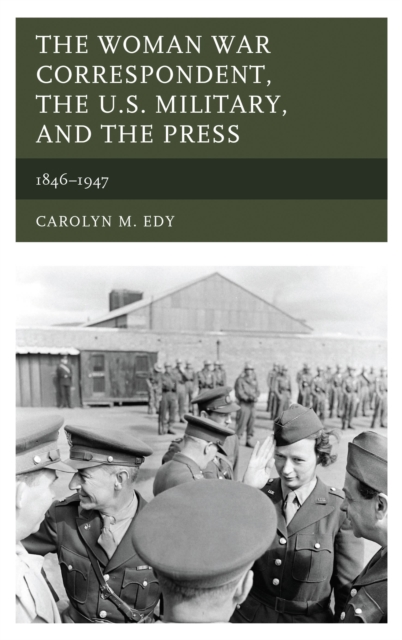
The woman war correspondent, the U.S military, and the press, 1846-1947
This book outlines the rich history of more than 250 women who worked as war correspondents up through World War II, while demonstrating the ways in which the press and the military both promoted and prevented their access to war. Despite the continued presence of individual female war correspondents in news accounts, if not always in war zones, it was not until 1944 that the military recognized these individuals as a group and began formally considering sex as a factor for recruiting and accrediting war correspondents. This group identity created obstacles for women who had previously worked alongside men as “war correspondents,” while creating opportunities for many women whom the military recruited to cover woman’s angle news as “women war correspondents.” This book also reveals the ways the military and the press, as well as women themselves, constructed the concepts of “woman war correspondent” and “war correspondent” and how these concepts helped and hindered the work of all war correspondents even as they challenged and ultimately expanded the public’s understanding of war and of women.
eBook