
Catalogue Search | MBRL


Are you sure you want to remove the book from the shelf?

{{itemTitle}}
40
result(s) for
"Women and literature Europe History To 1500."
Sort by:


Empowering Collaborations
This study examines partnerships between medieval women and scribes. Kimberly Benedict argues that medieval female visionaries often play prominent roles in collaboration while their male amanuenses serves as supports and foils.
Kimberley Benedict received her Ph.D. in English from Stanford University in 2001.
eBook


The literary subversions of medieval women
This study of medieval women as postcolonial writers defines the literary strategies of subversion by which they authorized their alterity within the dominant tradition.To dismantle a colonizing culture, they made public the private feminine space allocated by gender difference: they constructed 'unhomely' spaces.
eBook

From virile woman to womanChrist : studies in medieval religion and literature
Why did hagiographers of the late Middle Ages praise mothers for abandoning small children? How did a group of female mystics come to define themselves as apostles to the dead and end by challenging God's right to damn? Why did certain heretics around 1300 venerate a woman as the Holy Spirit incarnate and another as the Angelic Pope?
In From Virile Woman to WomanChrist , Barbara Newman asks these and other questions to trace a gradual and ambiguous transition in the gender strategies of medieval religious women. An egalitarian strain in early Christianity affirmed that once she asserted her commitment to Christ through a vow of chastity, monastic profession, or renunciation of family ties, a woman could become virile, or equal to a man. While the ideal of the virile woman never disappeared, another ideal slowly evolved in medieval Christianity. By virtue of some gender-related trait—spotless virginity, erotic passion, the capacity for intense suffering, the ability to imagine a feminine aspect of the Godhead—a devout woman could be not only equal, but superior to men; without becoming male, she could become a womanChrist, imitating and representing Christ in uniquely feminine ways.
Rooted in women's concrete aspirations and sufferings, Newman's womanChrist model straddles the bounds of orthodoxy and heresy to illuminate the farther reaches of female religious behavior in the Middle Ages. From Virile Woman to WomanChrist will generate compelling discussion in the fields of medieval literature and history, history of religion, theology, and women's studies.
eBook
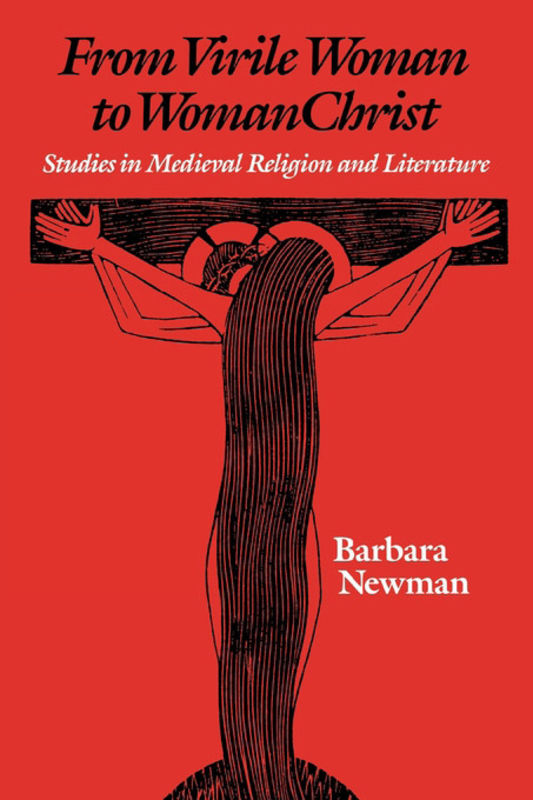
From Virile Woman to WomanChrist
Why did hagiographers of the late Middle Ages praise mothers for abandoning small children? How did a group of female mystics come to define themselves as \"apostles to the dead\" and end by challenging God's right to damn? Why did certain heretics around 1300 venerate a woman as the Holy Spirit incarnate and another as the Angelic Pope? InFrom Virile Woman to WomanChrist, Barbara Newman asks these and other questions to trace a gradual and ambiguous transition in the gender strategies of medieval religious women. An egalitarian strain in early Christianity affirmed that once she asserted her commitment to Christ through a vow of chastity, monastic profession, or renunciation of family ties, a woman could become \"virile,\" or equal to a man. While the ideal of the \"virile woman\" never disappeared, another ideal slowly evolved in medieval Christianity. By virtue of some gender-related trait-spotless virginity, erotic passion, the capacity for intense suffering, the ability to imagine a feminine aspect of the Godhead-a devout woman could be not only equal, but superior to men; without becoming male, she could become a \"womanChrist,\" imitating and representing Christ in uniquely feminine ways. Rooted in women's concrete aspirations and sufferings, Newman's \"womanChrist\" model straddles the bounds of orthodoxy and heresy to illuminate the farther reaches of female religious behavior in the Middle Ages.From Virile Woman to WomanChristwill generate compelling discussion in the fields of medieval literature and history, history of religion, theology, and women's studies.
eBook

The Cambridge Companion to Medieval Women's Writing
The Cambridge Companion to Medieval Women's Writing seeks to recover the lives and particular experiences of medieval women by concentrating on various kinds of texts: the texts they wrote themselves as well as texts that attempted to shape, limit, or expand their lives. The first section investigates the roles traditionally assigned to medieval women (as virgins, widows, and wives); it also considers female childhood and relations between women. The second section explores social spaces, including textuality itself: for every surviving medieval manuscript bespeaks collaborative effort. It considers women as authors, as anchoresses 'dead to the world', and as preachers and teachers in the world staking claims to authority without entering a pulpit. The final section considers the lives and writings of remarkable women, including Marie de France, Heloise, Joan of Arc, Julian of Norwich, Margery Kempe, and female lyricists and romancers whose names are lost, but whose texts survive.
eBook

Affective Meditation and the Invention of Medieval Compassion
Affective meditation on the Passionwas one of the most popular literary genres of the high and later Middle Ages. Proliferating in a rich variety of forms, these lyrical, impassioned, script-like texts in Latin and the vernacular had a deceptively simple goal: to teach their readers how to feel. They were thus instrumental in shaping and sustaining the wide-scale shift in medieval Christian sensibility from fear of God to compassion for the suffering Christ.Affective Meditation and the Invention of Medieval Compassionadvances a new narrative for this broad cultural change and the meditative writings that both generated and reflected it. Sarah McNamer locates women as agents in the creation of the earliest and most influential texts in the genre, from John of Fécamp'sLibellusto theMeditationes vitae Christi, thus challenging current paradigms that cast the compassionate affective mode as Anselmian or Franciscan in origin. The early development of the genre in women's practices had a powerful and lasting legacy. With special attention to Middle English texts, including Nicholas Love'sMirrorand a wide range of Passion lyrics and laments,Affective Meditation and the Invention of Medieval Compassionilluminates how these scripts for the performance of prayer served to construct compassion itself as an intimate and feminine emotion. To feel compassion for Christ, in the private drama of the heart that these texts stage, was to feel like a woman. This was an assumption about emotion that proved historically consequential, McNamer demonstrates, as she traces some of its legal, ethical, and social functions in late medieval England.
eBook

Her Life Historical
Her Life Historicaloffers a major reconsideration of one of the most popular narrative forms in late medieval England-the lives of female saints-and one of the period's primary modes of interpretation-exemplarity. With lucidity and insight, Catherine Sanok shows that saints' legends served as vehicles for complex considerations of historical difference and continuity in an era of political crisis and social change. At the same time, they played a significant role in women's increasing visibility in late medieval literary culture by imagining a specifically feminine audience. Sanok proposes a new way to understand exemplarity-the repeated injunction to imitate the saints-not simply as a prescriptive mode of reading but as an encouragement to historical reflection. With groundbreaking originality, she argues that late medieval writers and readers used religious narrative, and specifically the legends of female saints, to think about the historicity of their own ethical lives and of the communities they inhabited. She explains how these narratives were used in the fifteenth century to negotiate the urgent social concerns occasioned by political instability and dynastic conflict, by the threat of heresy and the changing status of public religion, and by new kinds of social mobility and forms of collective identity.Her Life Historicalalso offers a fresh account of how women came to be visible participants in late medieval literary culture. The expectation that they formed a distinct audience for saints' lives and moral literature allowed medieval women to surface in the historical record as book owners, patrons, and readers. Saints' lives thereby helped to invent the idea of a gendered audience with a privileged affiliation and a specific response to a given narrative tradition.
eBook

The Female Baroque in Early Modern English Literary Culture
This is a contribution to the revival of early modern women's writings and cultural production in English that began in the 1980s. Its originality is twofold: it links women's writing in English with the wider context of Baroque culture, and it introduces the issue of gender into discussion of the Baroque.
eBook